






 Portuguese
  Spanish


Oldest Rocks On Earth Reveal Hidden Secrets In Minerals With Billions Of Years.
In the heart of northern Canada lies one of the greatest mysteries of global geology: the Acasta Gneiss Complex. This rock formation houses some of the oldest rocks on Earth, estimated to be up to 4 billion years old. Located in a remote area of Canada, these ancient structures represent a direct window into the early days of the planet.
Through sophisticated scientific analyses, researchers have been able to extract crucial information from microscopic minerals found within these rocks, which has been essential for understanding how and when they formed.
The Power Of Zircon: A Crystal That Defies Time
Among the minerals most important in this investigation, zircon stands out.
-
China Develops Custom 140-Ton Electric Mining Truck with 770 kWh Swappable Battery, Deploys 290 Units in Xinjiang’s Largest Zinc Mine

-
Meta to Launch Arena, a New Prediction App Targeting 3.56 Billion Users, Competing with Polymarket and Kalshi

-
Scientist Challenges Famous Human Evolution Theory, Argues Homo Sapiens Evolved Gradually Over Thousands of Years
-
15-Year-Old American Builds Ocean Generator with PVC Pipe and 3D-Printed Propeller for $12, Wins National Prize, Presents at White House, and Makes Forbes 30 Under 30 List




With a thickness comparable to that of a human hair, this crystal is formed in igneous rocks — those created from the cooling of magma — and possesses extraordinary resilience.
Capable of withstanding heat, pressure, and even capturing radioactive elements, zircon acts as a geological time capsule.
It was through a sample of this crystal that scientists were able to date the oldest rock ever found on Earth, in the Nuvvuagittuq Greenstone Belt, also in Canada.
The zircon contained traces of an element derived from samarium 146 — an extinct radioactive element — allowing the researchers to calculate its age: about 4.28 billion years.
Formation Of The First Rocks: From The Seabed To The Earth’s Mantle
Studies indicate that the oldest rocks on Earth had different origins.
Some formed on the ocean floors of primordial seas, with fine particles compacted into layers of sedimentary rock.
Others emerged directly from the Earth’s mantle, as is the case with the Acasta complex, and solidified from the cooling of magma.
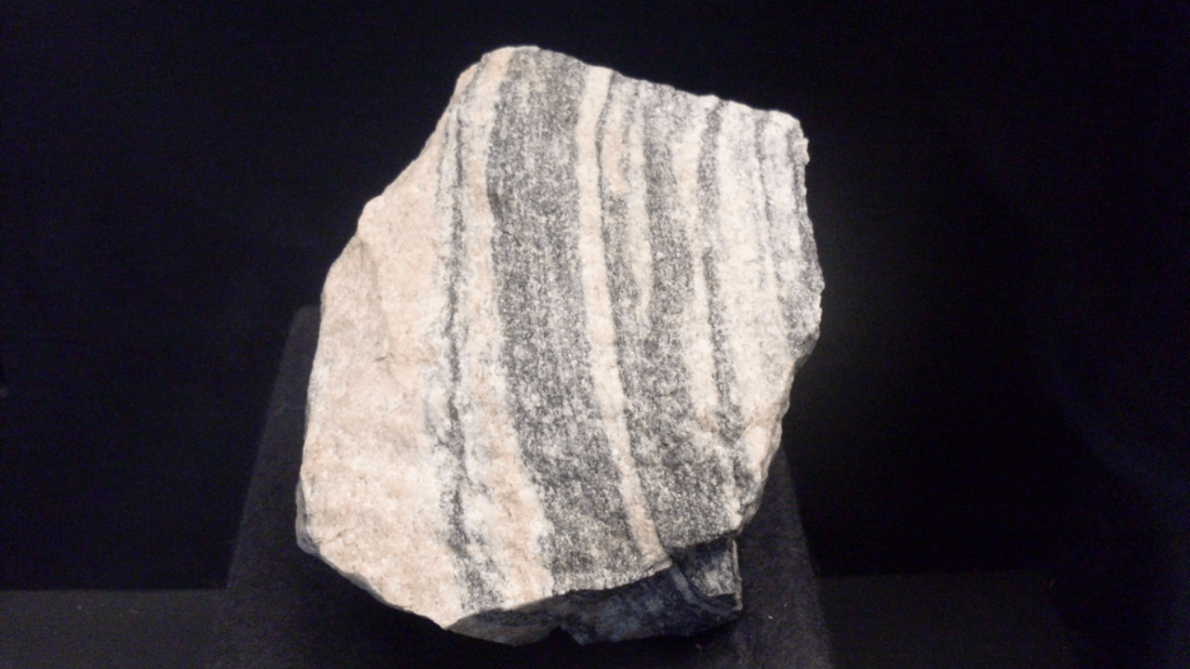
If I have a metamorphic rock, I can use the types of minerals and their chemical composition to determine the conditions it has undergone throughout its history,” explains geologist Darrell Henry from Louisiana State University.
He points out that temperatures of up to 700 °C and pressures thousands of times greater than atmosphere indicate that the rock was deeply buried at some point.
These discoveries, even recorded in the Guinness Book of World Records, are not just a scientific achievement — they are a true physical record of Earth’s early chapters.
Studying the minerals present in these formations is to understand the beginning of everything: the initial composition of the planet, the environments where life was still impossible, and the processes that shaped the Earth’s crust.






