






 Portuguese
  Spanish
  6 min of reading
  0 comments


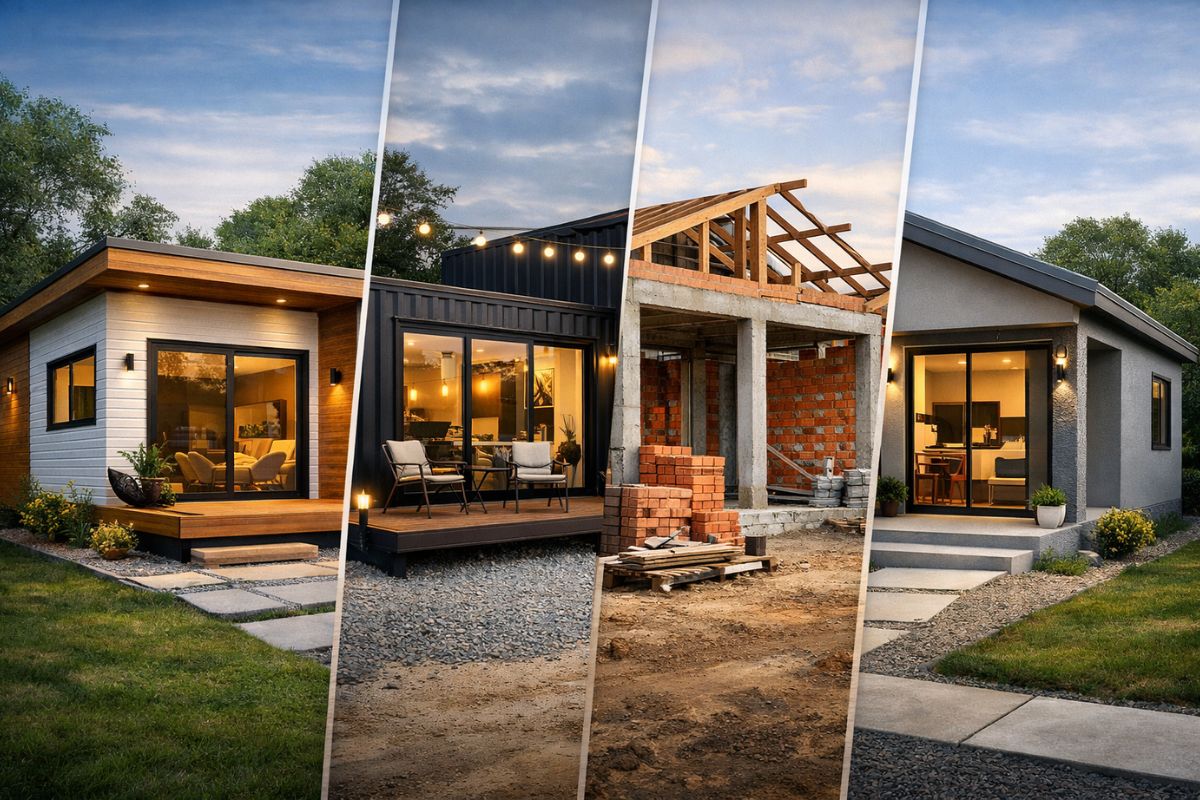
With rigorous planning, compatible land, and a streamlined project, building a house of 45 to 55 m² with a budget close to R$100 thousand stops being a vague promise and becomes a concrete strategy, combining execution speed, reduced waste, and four viable models for different profiles, regions, and routines in present-day Brazil.
The own house has ceased to be just a distant goal for many people who live under the pressure of monthly rent. When the budget revolves around R$100 thousand and the project respects the limit between 45 m² and 55 m², construction becomes a technical decision: less improvisation, more predictability, and focus on the essentials.
In this scenario, the central question is not just “if it’s possible,” but how it’s possible: which model fits better on the land, how much each choice costs over the course of the work, where labor is available, and why some formats yield better results with less waste. The answer lies in planning, not in a magic formula.
Why the R$100 thousand range became more viable for building a functional house
The viability of this investment range is directly linked to the design of the project. Compact and intelligent layouts reduce critical execution points, simplify structure, and shorten timelines. When excessive cuts in roofing, walls, and internal circulation are avoided, the project tends to be more stable in cost and faster in delivery.
-
Without a mansion, without high investment, and without a traditional classroom, a teacher living in a 22 m² house taught students to build a 9 m² studio apartment with the equivalent of R$10,000.

-
Largest bridge in São Paulo reaches 75% completion and is expected to strengthen strategic connection in the interior of São Paulo.

-
Without her own home and pressured by rent, a 25-year-old bought a small 15-meter boat, gradually renovated the interior by herself, transformed the interior with paint, new flooring, a larger bathroom, and started living on the canals, paying much less per month.
-
Tired of seeing families sleeping on the street, São Paulo delivered 18 m² furnished microhouses and took 888 people off the streets: Vila Reencontro became the model social housing for the homeless population.


Another decisive point is the size between 45 m² and 55 m², which is now common in interior cities and new subdivisions. This range allows for organizing useful environments without inflating low-function areas. In practice, a smaller and well-designed house tends to generate less leftover material, less rework, and less risk of financial mismanagement during construction.
The behavior of the construction industry itself also plays a role, as it has begun to offer more accessible and industrialized methods. This opens opportunities for those with limited resources who do not want to give up comfort and decent finishes. Instead of thinking of construction as an endless process, the focus shifts to efficiency from start to finish.
Four Types of House That Fit the Budget and Meet Different Profiles
There isn’t a single ideal model for everyone. The choice of house depends on land, logistics of materials, availability of professionals in the region, and urgency for moving. Aesthetics matter, but technical viability decides whether the project proceeds safely.
Within the approximate range of R$100 thousand, four options frequently emerge: simple single-story, prefabricated modular, container, and compact masonry. All can work, as long as the project is coherent with the lot and the family’s usage profile.
For easier visualization, here is a comparative analysis of optimized projects close to 50 m²:
| House Style | Estimated Cost* | Construction Time | Ideal Profile |
|---|---|---|---|
| Simple Single-Story | R$ 90 thousand – R$ 140 thousand | Fast | Small Families |
| Modular | R$ 80 thousand – R$ 150 thousand | Very Fast | Those Seeking Practicality |
| Container | R$ 70 thousand – R$ 130 thousand | Fast | Those Who Prefer Modern Aesthetics |
| Compact Masonry | R$ 95 thousand – R$ 160 thousand | Medium | Those Who Value Traditional Solutions |
*Values vary according to finishes, region, and logistics of materials.
This overview shows that the difference isn’t just in the initial price. Construction duration, maintenance type, potential for expansion, and availability of professionals can also vary significantly from one model to another. Choosing solely based on entry price may turn expensive later.
Simple Single-Story House: Why It Leads in Cost-Effectiveness and Predictability
The simple single-story house remains at the top of preference for a straightforward reason: it eliminates common structural complexities found in solutions with a second floor. Without stairs and without additional reinforced slabs, the project tends to be leaner in engineering and execution. This reduces stages, simplifies decisions, and helps to keep the timeline intact.
There is also a significant operational gain: because it is a widely known model, it is generally easier to assemble a team and organize work on-site. Resources like polymer mortar, when applied correctly, also speed up stages. The result is a house with a good balance between cost, time, and functionality for those looking to leave rent with less risk of surprises.
In daily use, this type of layout favors simple flow and practical routines, especially for small families. It is the most balanced alternative for those who want financial control and objective delivery, without relying on very specific market solutions.
Prefabricated Modular House and Container House: Speed, Clean Construction, and Less Waste
When time is the most critical factor, the prefabricated modular house gains traction. The logic is industrial: components arrive ready, and assembly happens on-site with less weather interference and less material waste. As there is less cutting and less improvised adjustments on-site, the construction tends to be more organized and predictable.
This predictability shortens the construction time and directly impacts indirect costs, especially daily wages of the team for extended periods. For those who need real speed, modular often becomes one of the most efficient choices, as long as the project is finalized before starting assembly.
The container house is presented as a contemporary option with a sustainable appeal. The repurposed metal structure already provides the physical base for walls and roofing, concentrating investment in thermal insulation and internal finishing. It is a format that usually adapts well to smaller land and quick construction proposals, with organization and less debris.
The point of attention is that, in the container, the comfort performance depends on the quality of thermal treatment and internal execution. In other words, savings may appear in the structure, but the final comfort is determined by technical detailing.
official profiles and direct channels of companies that truly deliver within this price range and have a proven track record:
- JP Container
- Minha Casa Box
- Azul Containers( @azulcontainers)
Compact Masonry: Tradition with Competitiveness When the Project Is Well Resolved
Even with newer methods, compact masonry remains strong because it combines durability, familiarity, and a broad availability of labor. In many neighborhoods, finding professionals accustomed to this system is easier, which aids in continuity of the work and reduces dependency on very specific suppliers.
It becomes especially competitive when the project avoids excesses: long corridors without function, dead areas, and cuts that inflate execution costs. With a rational layout, masonry maintains good cost performance and delivers a type of house that many owners are very familiar with in maintenance and daily use.
Another differential is the potential for future renovation and expansion. For those thinking about growing the house in stages, this factor weighs heavily in the decision. In the long run, flexibility also equals savings, as it avoids starting over when the family changes in size or routine.
How to Choose the Best Model Without Overbudgeting the House
The smartest decision starts before the first material purchase. The first filter is the land: dimensions, topography, access, and local rules influence time, cost, and method. Without this initial assessment, even a cheap project on paper may become expensive during execution.
Then, it’s worth mapping the reality of the region: material prices, delivery time, and availability of teams for each construction system. In some areas, modular is extremely efficient; in others, masonry is more predictable because there is a consolidated local supply chain. The best model is the one that works where you will build, not the most talked about.
Another critical point is project discipline. Changes during construction are often the quickest shortcut to exceed the R$100 thousand ceiling. Staying true to the initial plan, defining the standard of finishes from the start, and organizing payment stages reduce pressure on cash flow and improve control.
Finally, evaluating suitable housing credit lines can balance financial flow without compromising the construction. The goal is not to “spend less at any cost,” but to spend better: prioritizing structure, performance, and functionality of the house, leaving non-essential customizations for future phases.
The equation closes when three elements align: compact project, construction method compatible with local reality and disciplined execution. Among simple single-story, modular, container, and compact masonry, there isn’t a universal winner—there is the most suitable house for each land, timeline, and family profile.
Now, I want to bring this discussion into real life: in your case, which model would make the most sense today—given your city, the size of your lot, and the time you have to move? And if you had to prioritize just one criterion now, would you choose lower initial cost, faster construction, or easier expansion later?


-

-

-

-

16 people reacted to this.