






 Portuguese
  Spanish


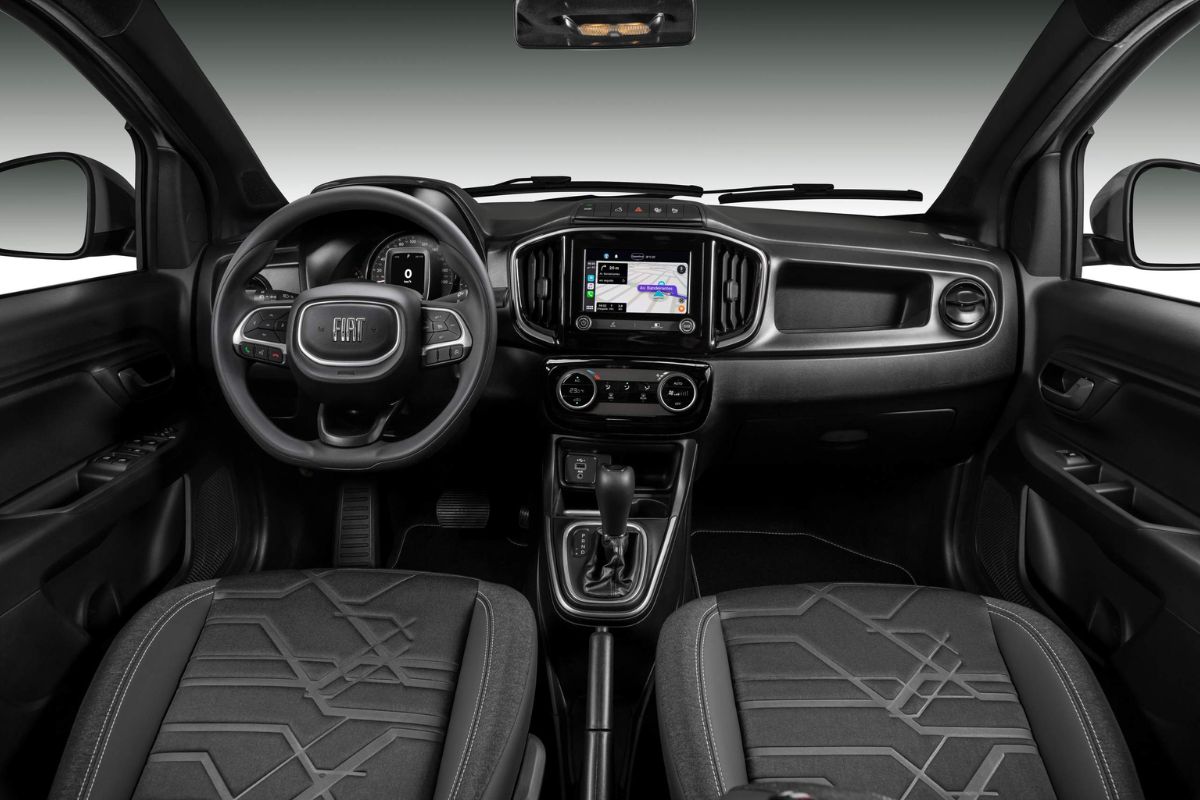


We Thoroughly Analyzed The Engineering Of The Best-Selling Pickup In Brazil To Understand Its Secret: How It Manages To Be A Robust Work Vehicle During The Week And A Comfortable Passenger Car On Sundays?
For years, one vehicle has dominated the top of the sales ranking in Brazil, surpassing not only its direct rivals but all passenger cars. This phenomenon is the Fiat Strada. And its top-of-the-line version, the Volcano, equipped with a turbo engine and automatic transmission, encapsulates the reason for this success: an almost impossible versatility.
But how did Fiat’s engineering manage to create a vehicle that serves heavy-duty, with a payload capacity of 650 kg, while also offering the comfort and drivability of a compact SUV? We delved deep into the technical specifications and design choices to conduct a review of the Fiat Strada Volcano 2025 and unveil the secret behind its market dominance.
Does The Turbo 200 Engine Deliver?
The standout feature of the Volcano version is the Turbo 200 Flex engine. This 1.0-liter, three-cylinder engine delivers an impressive 130 hp of power and 20.4 kgf.m of torque when fueled with ethanol. The main consumer concern is: can a 1.0 turbo engine handle the load with the bed full?
-
2027 Toyota Corolla Cross Unveiled: New Design, Enhanced Fuel Efficiency, Reduced Maintenance Costs, Advanced Technology, Connected Services, and Up to 10-Year Warranty

-
Fiat Cronos Precision 2018: Affordable Sedan with Spacious Trunk and Reliable Maintenance
-
Volkswagen to Cut Production by 1 Million Cars by 2030, Reducing Jobs and Platforms, Focusing on More Profitable Models

-
Toyota Launches First 100% Electric Car in Brazil: bZ4X with 343 HP, All-Wheel Drive, 361 km Range, Priced at $419,990 BRL, Limited to 99 Units



The engineering answer lies in the torque. The maximum torque appears at a very low 1,750 rpm. This means that the pickup has enough power for starts and climbs even when loaded, without needing to “wail” the engine. The partnership with the CVT automatic transmission, which simulates 7 gears, ensures that the engine is always at the ideal RPM, whether for power or efficiency. The “Sport” button on the steering wheel alters the throttle and transmission mapping, making the responses even quicker for overtaking.
Engineering The Duality: Comfortable As A Passenger Car?

One of the secrets of the Strada is its platform, the MPP (Modular Platform Pickup), which is an evolution of the architecture of passenger cars like the Argo, but with massive structural reinforcements. In the suspension, Fiat maintained a robust and legendary recipe.
- Front: McPherson, similar to that of a passenger car, ensuring comfort and good driving on asphalt.
- Rear: rigid axle with parabolic springs, a solution inherited from the old Strada and improved. This type of spring is extremely sturdy and ideal for carrying weight, being the main reason for its superior payload capacity compared to direct competitors.
This combination allows the Strada Volcano to be surprisingly comfortable on smooth asphalt, yet tough enough for heavy-duty work, answering the question about its comfort affirmatively.
Is The Volcano Version Worth It? Evaluating Consumption And Cost-Benefit
Costing around R$ 137,990, the Strada Volcano positions itself in a price range close to that of entry-level SUVs and even larger pickups, like the Montana in its entry versions. The question is: is it worth it?
Consumption: according to data from Inmetro, the consumption of the Strada Volcano CVT is 8.3 km/l in the city and 9.4 km/l on the highway with ethanol, and 12.1 km/l and 13.2 km/l, respectively, with gasoline. These are competitive numbers that make it a viable option for daily use.
Cost-Benefit: the answer lies in the package. For this price, it offers the practicality of the bed, a turbo engine with good performance, and a complete list of features, including multimedia center, LED headlights, and wireless charger. For those looking for a “two-in-one” vehicle – for family leisure and light/medium work – the value proposition of the Volcano is almost unique in the Brazilian market.
In summary, the secret of the Fiat Strada is an engineering without vanity, focused on delivering exactly what the Brazilian consumer needs: a robust, economical, comfortable, and versatile vehicle, capable of handling both city asphalt and dirt roads with the same competence.
In your opinion, has the turbo engine and CVT transformed the Strada into a “mini-Toro”? Do you think the cost-benefit of the Volcano version is worth it compared to larger pickups? Comment!





Sim eu tenho uma pequei estrada foi maravilhoso
Já tive várias camionete,,,sem dúvida a Hilux para serviços pesados e para o Agro é a Camionete, agora para quem quer dois carros em um, A Strada Ultra não tem pra ninguém, conformo, tecnologia, motor, no asfalto pra ninguém e ainda anda na terra como nunca,
Para a Fiat, aumenta em 05 cm os lugares dos passageiros e colocar freio ABS,,,
Aí não vai ter para nenhuma,,,
Claudio Aparecido Arcebispo