






 Spanish


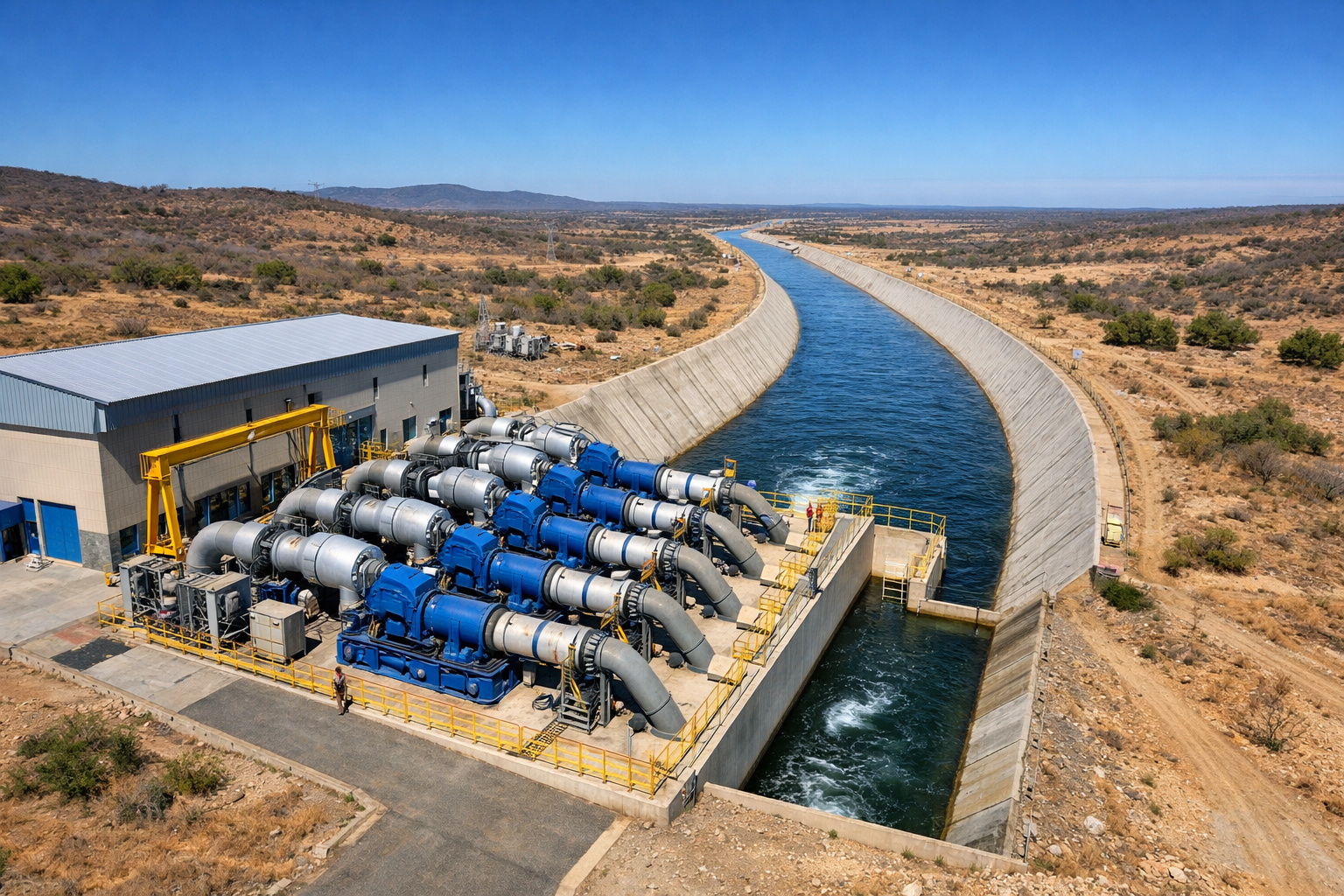


San Francisco River Integration Project Uses Pumping Stations to Overcome Elevation Differences of Up to 332.43 Meters and Ensure Water Security for 12 Million People
Ensuring water in the northeastern semi-arid region has always been a historical challenge. For decades, millions of Brazilians lived with scarcity. However, Brazil decided to confront this problem with large-scale engineering.
Thus, the San Francisco River Integration Project (PISF) was born. Its main objective is to guarantee water security for 12 million people. In total, these people live in about 390 municipalities in the semi-arid Northeast.
The information was disclosed by “Gov.br” in an official report detailing the complexity of the system. According to the agency, the project had to overcome significant natural obstacles.
-
World Cup Ball Chip Uses Technology to Detect Invisible Touches, Confirms Offside, Secures Portugal’s Victory Over Croatia

-
36-Meter Hydrogen-Powered Superyacht Arrives in Brazil to Debut German Engines and Showcase Future of Clean Navigation

-
Indian Students from Jaipur Win Top Prize at World’s Largest Science Fair with EcoFog, an Affordable Mesh to Harvest Fog Water Without Energy

-
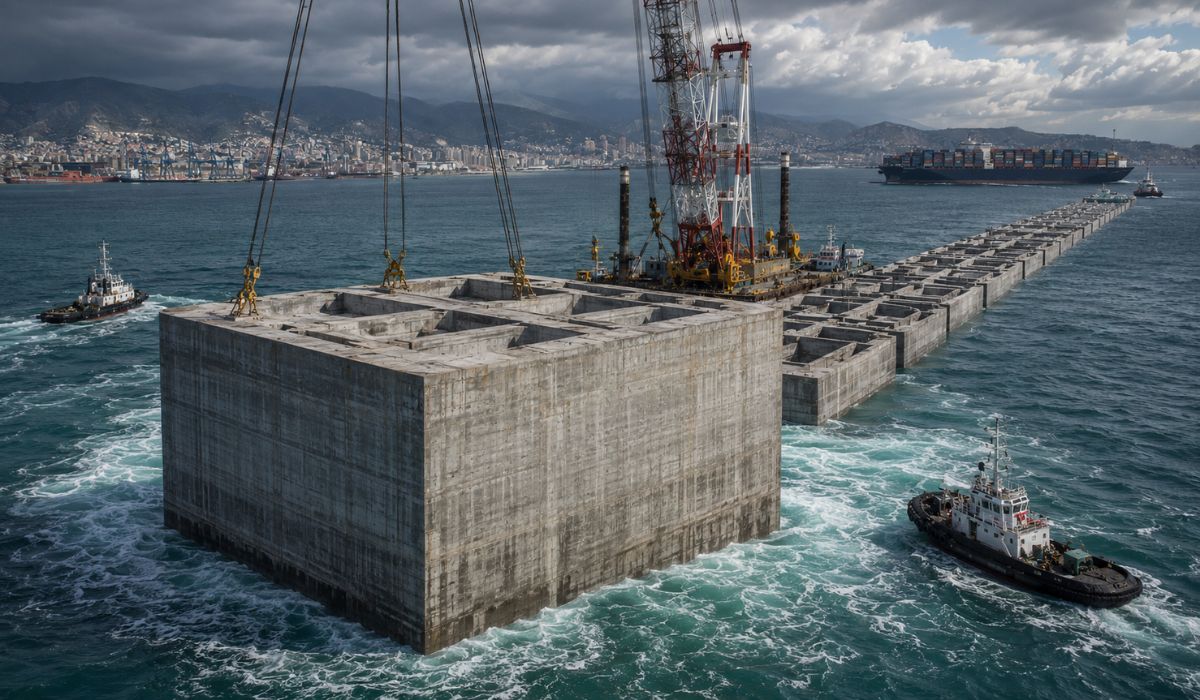
Italy Sinks Massive 11-Story Concrete Structures in the Ligurian Sea to Create a 6.2 km Barrier, Clearing the Way for 400-Meter Ships in Genoa



Unlike traditional systems, where water only flows downhill via gravity, the PISF does the opposite. First, it elevates the water. Then, it allows it to flow by gravity.
In some sections, the water rises about 200 meters. In other words, this height is equivalent to a 65-story building. Without this effort, the water would never reach areas that are hundreds of meters above the natural level of the San Francisco River.
According to Bruno Cravo, director of the Department of Strategic Projects of the National Water Security Secretariat (SNSH) of MIDR, the technical effort involved is enormous. For this, it was necessary to create a robust system of pumping stations. Primarily, to overcome the terrain of the Borborema Mountain Range.
North Axis Surpasses 188 Meters Over 82 Kilometers
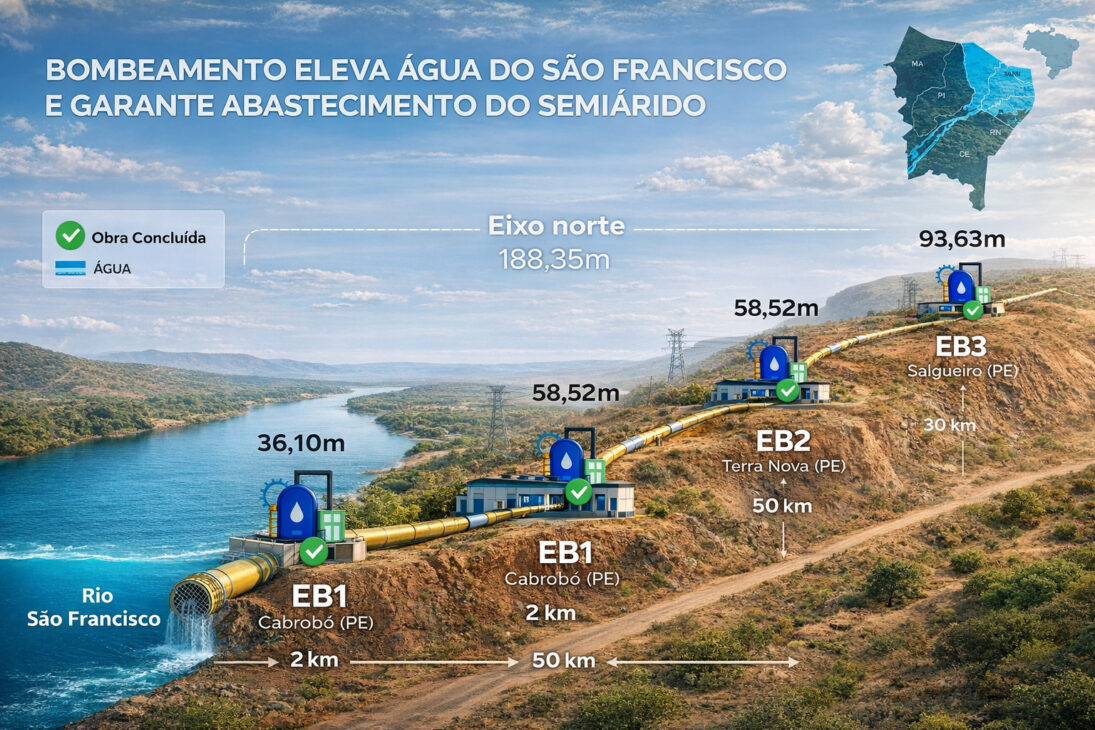
Along the North Axis, the numbers are already impressive. Initially, EBI-1, in Cabrobó (PE), elevates the water by approximately 36 meters. This means a building of about 12 stories.
Next, EBI-2, in Terra Nova (PE), promotes an elevation of 58.5 meters. Consequently, this height corresponds to a building of nearly 19 stories.
Then, EBI-3, in Salgueiro (PE), raises the water to 93.6 meters. That is, equivalent to a 30-story building.
In total, the stations along the North Axis overcome an elevation difference of 188 meters. All of this occurs over a length of 82 kilometers. From the intake point, at the San Francisco River, to the highest points of the canal.
Therefore, each station operates as a hydraulic step. First, the water rises to a reservoir. Then, it descends by gravity to the next stage.
Without this mechanism, the transposition simply would not work.
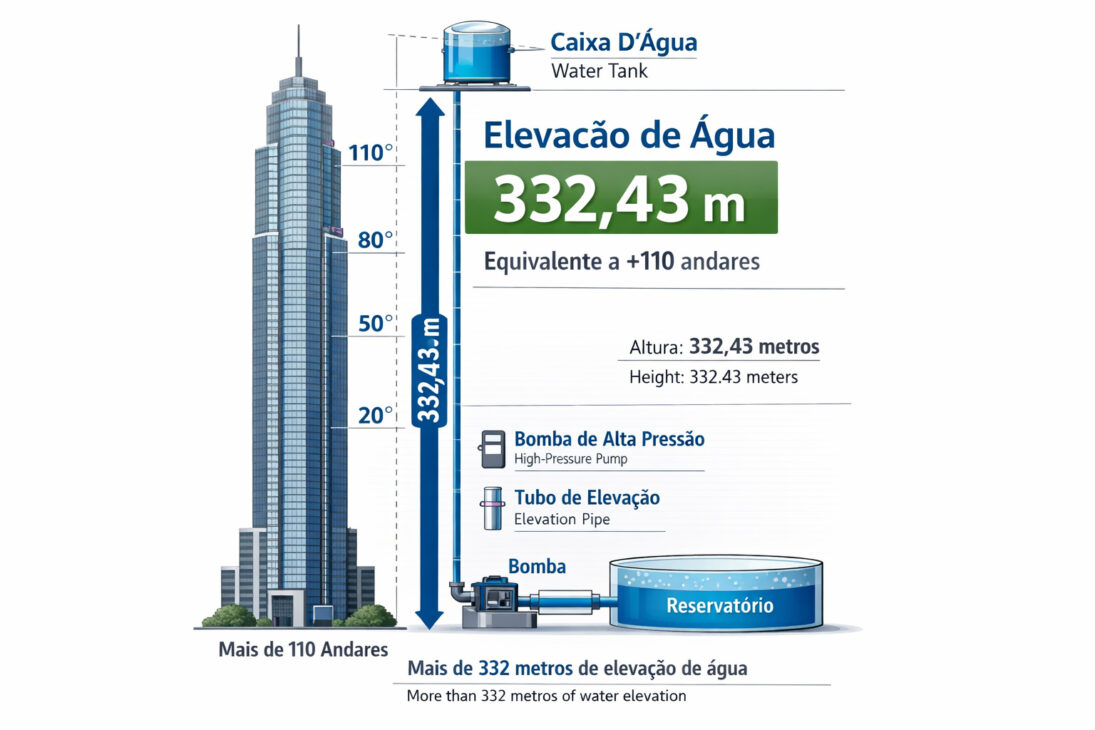
East Axis Reaches 332.43 Meters of Elevation Over 170.6 Kilometers
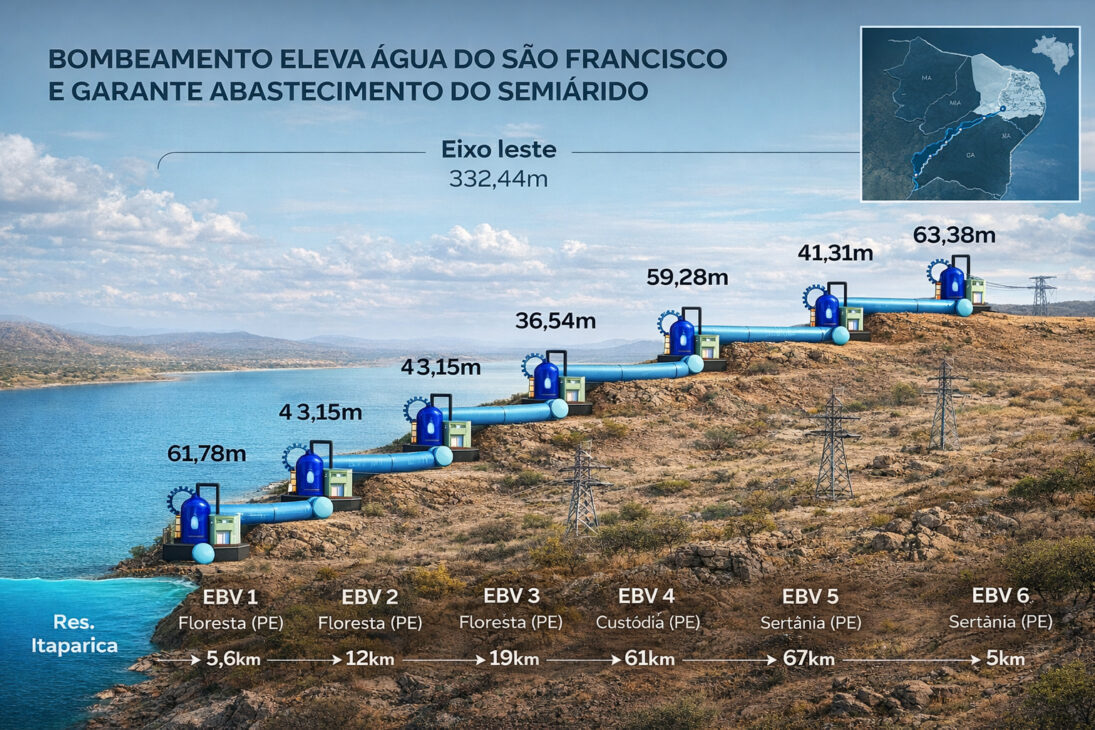
If the North Axis is already impressive, the East Axis is even more challenging. In total, it has a length of 170.6 kilometers and features six flow pumping stations (EBV).
First, EBV-1, EBV-2, and EBV-3, located in Floresta (PE), elevate the water by 168.47 meters. In practical terms, this is equivalent to a 56-story building.
After that, EBV-4, in Custódia (PE), adds another 59.2 meters.
Already in Sertânia (PE), the system enters its final phase. At this point, EBV-5 promotes an elevation of 43.3 meters. Right after, EBV-6 adds another 63.38 meters.
At the end of the journey, the East Axis surpasses a total elevation difference of 332.43 meters. For comparison, this height is equivalent to a building with more than 110 stories.
After each elevation, the water continues by gravity through channels, aqueducts, and tunnels. In total, the PISF comprises about 477 kilometers of channels.
Thanks to this system, Pernambuco, Ceará, Paraíba, and Rio Grande do Norte now benefit from a more structured water security.
Engineering That Brings Water and Development to the Semi-Arid Region
Besides engineering, there is a social impact. When water arrives, development comes as well.
Minister Waldez Góes emphasizes that the transposition benefits small communities, districts, and municipalities. In this way, the presence of water improves the quality of life. Additionally, it strengthens the local economy.
Therefore, the PISF not only overcomes the terrain. It also tackles the historical water inequality in the region.
By making water rise where it previously could not reach, Brazil transforms the Old Chico into a strategic tool for regional development.
In summary, the country demonstrates that it is possible to overcome elevation differences of up to 332.43 meters with planning, technology, and high-complexity engineering.
Did you imagine that water could rise the equivalent of a 110-story building to reach the northeastern hinterland?








Existe a legalidade e ou permitido, na área atendida, mas nessa e outras e ou estado, aí águas salobras para plantas, peixes, “lagostins”,… Palmeiras,… Solos de poucas preocupações de água, até algumas plantas de boa adaptação, o pequeno avocado no país do seu desenvolvimento tem similaridade de clima…
Kkk,o quadrúpede fez uma coisa fascinante,”formou milhares de pessoas e deu diplomas na área de ****,COM AMNÉSIA CRÔNICA.”
o capitão constipação!”
Interessante o nível técnico da obra,… Mas se tem visto nas mídias diversas ocorrência, se pontualidade a e detalhe, trechos fechados, inoperantes, quebrados, vandalizados, saqueados e outras… Certo que existem até algumas pontualidades, nichos para uso comercial e sobretudo familiar e ou subsistência, de modo geral chamados de panc, rasteira, arbustivos e até perenes resistente ao tipo de solo, salinidade , agua salobra, baixa e faltade fertilidade. O país tem bons técnicos que pode auxiliar… Aí é questão de paladar e aceitação,.. da alfarroba, caruru,… Até tipos de acerolas, cajus, e outros que podem ter bom uso e aceitação…
Mesmo a água que chega em nossas casas, tem problemas no trajeto, de várias formas, isso é normal. A manga, laranja são exportada para o mundo. Parreirais são lindos! É colhida o ano todo. No Sul é uma colheita por ano. Sem contar as hortas, pequenas plantações para consumo próprio. Muita gente não passa mais fome e está muito feliz. Água é tudo!