






 Portuguese
  Spanish


Researchers Discovered That Adding Coffee to Concrete Increases the Material’s Strength by 30%. This Stronger Concrete Can Be Used for Various Applications in Civil Construction, Offering an Innovative and Sustainable Solution.
A team of engineers from RMIT University in Australia has developed an innovative process that uses coffee grounds to make concrete stronger. By transforming the grounds into biochar, the method increases the concrete’s strength by nearly 30%. In addition to enhancing the material’s durability, this technique helps reduce the coffee waste sent to landfills, which amounts to six million tons annually in Australia, and decreases methane emissions generated during its decomposition. This innovation promises a significant impact on civil construction and environmental sustainability.
Discover How the Strongest Concrete with Coffee Is Produced
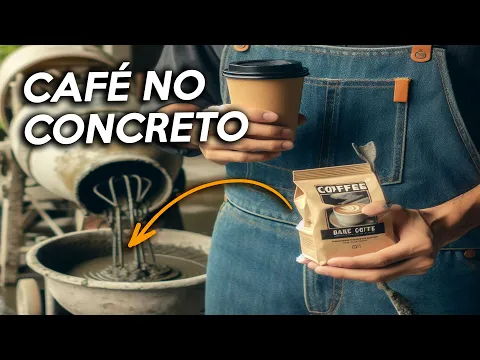

To manufacture coffee concrete, researchers transform the used grounds into biochar (a lightweight, coal-like residue) through a roasting method not too different from how beans are roasted to extract flavor.
This process is called pyrolysis and involves heating the soil to 350 °C in the absence of oxygen, which prevents the production of carbon dioxide and the increase of greenhouse gas emissions.
-
17-Story Building with 112 Apartments Opens in Australia to House Homeless Population, Offering Fully Equipped Units with Daily On-Site Support

-
81-Meter Bridge Made from Over 7 Tons of Recycled Plastic Connects Isolated Communities in Panama Canal Basin, Allowing Safe Passage for Over 300 Residents
-
Australia’s First Two-Story 3D-Printed House Built in 18 Hours, 22% Cheaper Than Traditional Methods, Uses Concrete That Hardens in 3 Minutes
-
Architect Converts 1955 Grain Silo into 31m² Home with Full Amenities, Including Kitchen, Bathroom, Curved Living Room, and Loft Bedroom




The engineers claim that the process is more energy-efficient than traditional pyrolysis techniques, as it requires lower temperatures than usual. Normally, pyrolysis can be a high-energy procedure, as temperatures need to be raised to around 700ºC and 900ºC, according to Dr. Shannon Kilmartin-Lycnh, co-leader of the study.
The coffee in concrete process increases strength and helps replace 15% of the sand typically used in concrete production with coffee biochar. Coffee concrete has its strength increased by 29.3%.
Coffee Concrete Will Be Used in Projects in Australia
According to Kilmartin-Lynch, structurally, coffee biochar is finer than sand but is also a porous material, allowing the cement to bond to the porous structure of the biochar itself. Furthermore, the stronger coffee concrete can prevent the material from drying out internally and developing micro-cracks, which can weaken its structure.
According to the researcher, the coffee concrete process is still in its early stages. More tests need to be conducted on durability and other aspects. The idea for stronger coffee concrete came from a cup. There was a lot of ground coffee and sachets being discarded.
The team wanted to see if they could turn these used coffee grounds into something more useful and valuable. Now that it is known that coffee in concrete increases strength, the researchers are working with local authorities on future infrastructure projects, such as the construction of pavements and walkways.
Challenges That Can Be Overcome with the Use of Coffee in Concrete
The research team leader, Professor Jie Li, states that coffee biochar can replace a portion of the sand used to make concrete.
Currently, 50 billion tons of natural sand are used in construction projects worldwide every year. According to the researcher, there are critical and persistent challenges in maintaining a sustainable supply of sand, due to the finite nature of resources and the environmental impacts of sand mining.
To address this issue, the construction industry must explore alternative raw materials to ensure its sustainability. The continuous extraction of natural sand worldwide, typically taken from riverbeds and banks to meet the construction industry’s growing demands, has a significant environmental impact. With a circular economy approach, it would be possible to keep organic waste out of landfills and also better preserve natural resources such as sand.




Trabalho na área da construção e sempre é bom ver e saber de renovação na área da construção