Portuguese
  Spanish



Partnership Between HII and Path Robotics Forecasts Use of Physical AI in Welding, After 14% Increase in Production in 2025 and Projection of Another 15% in 2026, Expanding Automation in Uncrewed Naval Construction and Raising Debate About Impacts on the Workforce
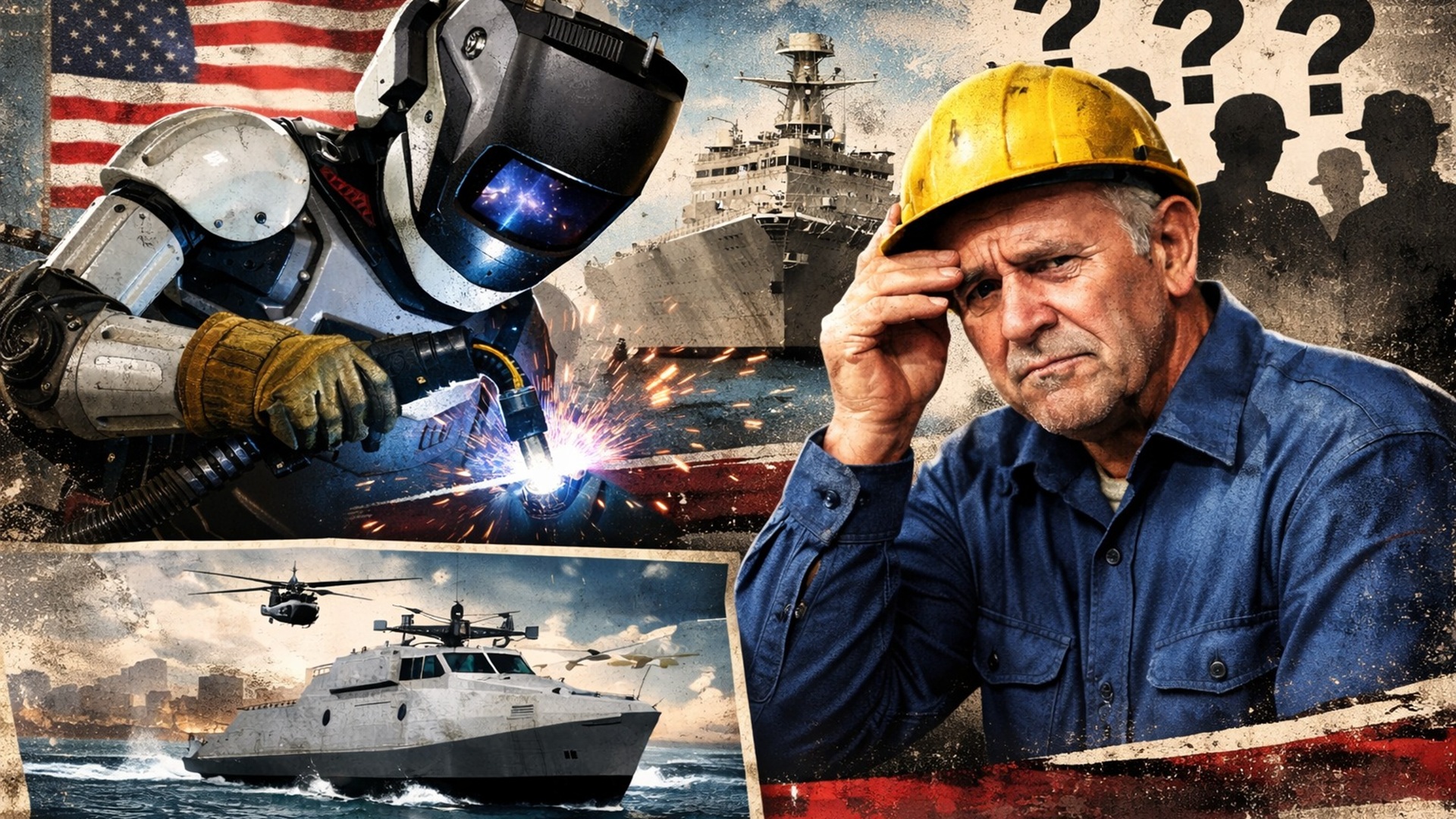
HII has signed a memorandum of understanding with Path Robotics to integrate physical AI into welding in uncrewed naval construction operations, with the potential to accelerate production, expand the workforce, and meet the growing demand from the U.S. Navy.
The Virginia-based company is exploring the integration of artificial intelligence for welding in naval construction operations. To this end, it formalized an MOU with Path Robotics, focusing on automating tasks and strengthening the maritime industrial base.
According to the company, the measure could accelerate production, strengthen the maritime industrial base, and increase the workforce in naval construction, including both crewed and uncrewed programs aimed at the U.S. Navy.
-
The U.S. Navy Conducts Submarine Tests in Idaho Lake to Detect Underwater Noises Hidden by the Ocean

-
Nuclear Submarine USS Alexandria Retired After 35 Years, Having Completed Over 1 Million Miles in Missions

-
MODEC Introduces New Hull Design for FPSO Gato do Mato to Produce Up to 120,000 Barrels of Oil Per Day in Brazil’s Pre-Salt Region
-
This Massive 12-Meter, 21-Ton Underwater Drone Can Operate Autonomously for Up to Five Days


Eric Chewning, Executive Vice President of Maritime Systems and Corporate Strategy at HII, stated that the partnership will allow for the incorporation of state-of-the-art physical AI models to expand the workforce and accelerate naval production.
He stated that naval production increased by 14% in 2025 and that there is an expectation of an additional 15% increase in 2026. According to Chewning, working with new partners could further accelerate this pace.
Expansion of Automation in Naval Construction
Chewning reported that the companies intend to jointly develop an AI-based autonomous welding solution to meet Navy standards and implement it at HII’s shipyard facilities.
He stated that the partnership has the potential to increase production efficiency without sacrificing quality. The initiative is part of the expansion of uncrewed and crewed naval construction operations.
According to a press release, HII and Path Robotics will work to identify and pursue opportunities in three areas. The first is the development of autonomous naval construction capability.
The second involves training workforce to expand automation. The third aims at establishing an intellectual property framework for AI-based autonomous welding systems.
Integration with ROMULUS Line Technologies
The companies will also invest in research and development to integrate Path’s physical AI models with other innovative technologies used in HII’s shipbuilding.
Among them is the ROMULUS line of unmanned surface vehicles from HII. According to the statement, the combination of these technologies will enhance the welding workforce and automate structural production.
The integration seeks to accelerate the production process and promote national security objectives. The initiative is related to uncrewed naval construction operations and strengthening the naval industrial base.
System with Real-Time Perception and Decision-Making
Andy Lonsberry, CEO and co-founder of Path Robotics, stated that the partnership with the largest military shipyard in the country comes at a critical time for national defense and the manufacturing industry.
He stated that welding is one of the most challenging processes to automate in any industry, including naval construction. According to Lonsberry, Path’s physical AI was developed to see, understand, and adapt to real-world conditions in real-time.
The company claims that its physical AI model and proprietary sensor and vision system can transform a traditional industrial robotic arm into a real-time perception and decision-making system.
According to Path, this allows the equipment to move from being a rigid and repetitive machine to being capable of seeing, understanding, and adapting to variations in a naval construction environment.
Current Status and Expansion Potential
Currently, HII’s divisions use automated welding robots that require human collaboration. Among them are traditional assembly line units for panel assembly and collaborative robots that work alongside shipbuilders.
Mechanized welders that follow pre-programmed paths are also employed. The AI-based autonomous welding technology is presented as an opportunity to expand distributed capacity.
According to the statement, the adoption of this technology could increase HII’s skilled workforce, accelerate deliveries, and meet the growing demand from the U.S. Navy.
The initiative is part of a movement to modernize the defense industry and consolidate uncrewed naval construction operations, focusing on automation, productive efficiency, and expanding industrial capacity over the coming decades.