Portuguese
  Spanish


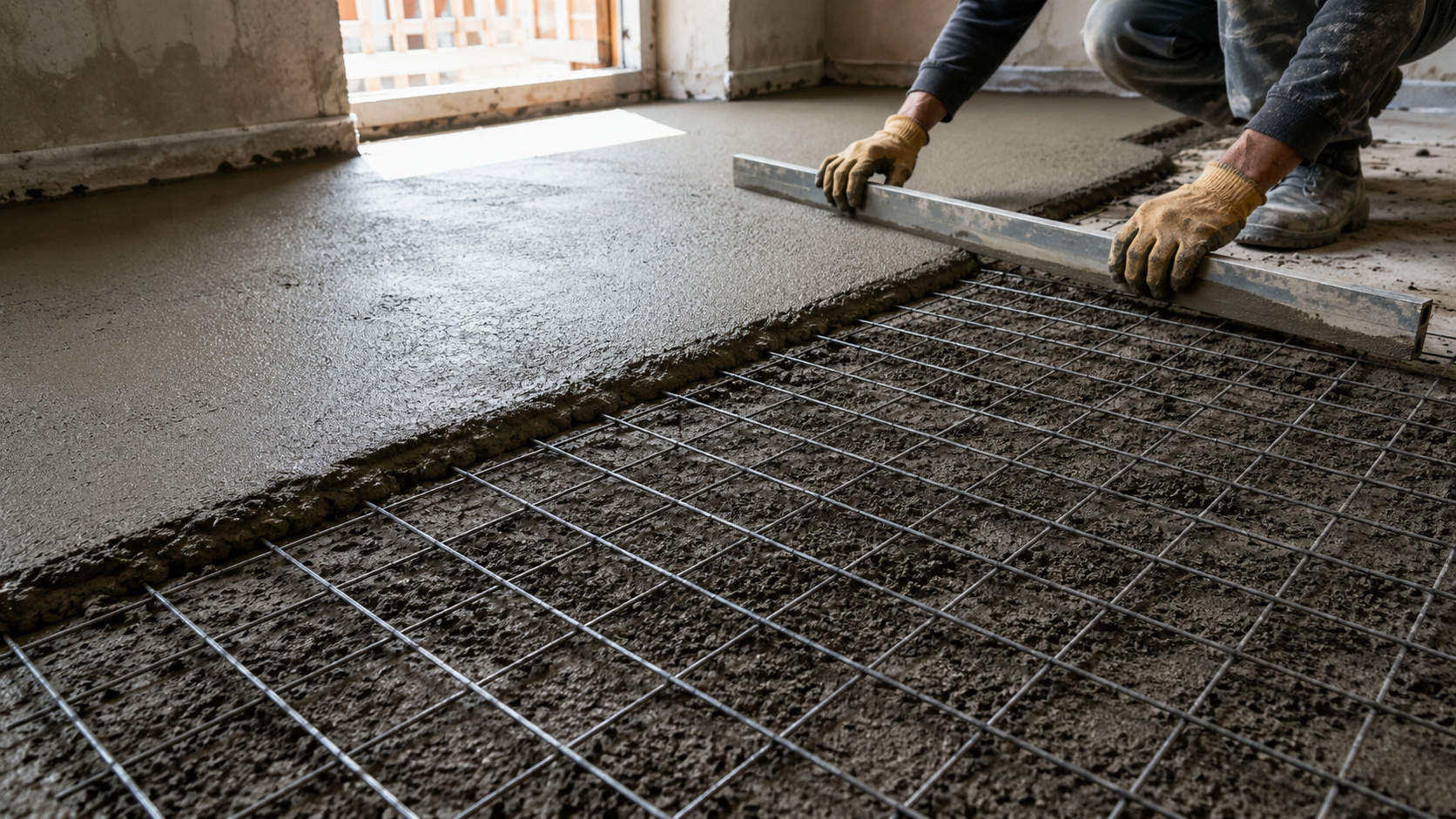

Discover how the subfloor, the POP mesh, and the adequate thickness help prevent cracks in the concrete floor and increase the durability of civil construction.
The concrete subfloor is a fundamental stage of civil construction as it serves as a base for finishes like porcelain, ceramic, vinyl, and laminate. This layer ensures leveling, surface regularization, and load distribution, as well as protecting hydraulic and electrical installations.
According to an article published by Super Rádio Tupi on July 2, 2026, executing the procedure correctly prevents serious problems like uneven surfaces and detachment of coverings. However, the ideal thickness of the mix and the right moment to apply structural reinforcement with the POP mesh often raise doubts on construction sites.
Structural engineering and the role of the regularization base in the subfloor
The main function of a well-structured floor goes beyond creating a flat surface for traffic. It acts directly at the interface of mechanical stress transition between the building’s foundation and the chosen finish.
-
Bristol Builds 11 Steel Stilt Houses Over Parking Lot, Providing Zero-Carbon Homes for Youth at Risk of Homelessness

-
New York Converts Massive Landfill with 150 Million Tons of Waste into a Giant Park, Concealing Decades of Consumption Beneath Green Hills
-
Experts Share 5 Practical Ways to Detect Hidden Wiring in Walls Before Drilling, Using Simple Techniques and Affordable Devices to Prevent Electrical Damage and Unexpected Costs

-
Brazilian Architect Wins International Award for Empowering Ugandan Women to Build Their Own Homes




When the material shows compaction failures, everyday impacts create fatigue points that result in serious hidden flaws. Understanding the mechanics of this layer and applying the appropriate steel reinforcement is the initial step to ensure that the structure withstands climatic variations and severe operational loads.


Technical dimensioning to prevent cracks in the concrete floor
The definition of thickness should not be done by guesswork but based on the loading requirements of the environment. It is always recommended to respect the structural design, avoiding excessively thin layers that increase the risk of cracks.
General thickness recommendations vary according to the type of space:
- Between 3 and 5 centimeters: Ideal for residential indoor areas that already have a regular underlying base.
- Between 5 and 7 centimeters: Recommended for situations where there is a need to correct larger surface unevenness.
- Greater thicknesses: Required in specific projects or environments subject to very high loads.
Layers executed below the minimum margin lose water quickly during the curing process, causing hydraulic shrinkage stresses that tear the mass from end to end.
Strategic use of POP mesh in subflooring under critical conditions
The incorporation of welded steel reinforcement within the compound acts as protection against tensile stresses. Traditional mortar has excellent compressive strength but is fragile when subjected to bending or thermal movements.
The use of this technology is mainly recommended in specific construction scenarios:
- Subfloors executed directly on the ground or on layers of compacted gravel.
- External areas exposed to direct solar radiation and weather conditions.
- Garages, industrial floors, access ramps, or places subject to ground movement.
By evenly distributing the forces throughout the slab’s extent, the steel prevents micro-cracks from evolving into large cracks, preserving the investment made in finishes. Technical guidelines published in specialized construction channels, such as Lar Cabral on YouTube, emphasize that focusing on the right thickness and the use of reinforcement is what truly shields the structure against pathologies.
Executive errors that destroy the durability of the subfloor
Even when acquiring good quality materials, basic operational failures compromise the final strength of the structure. A common mistake is the lack of proper base compaction, creating voids that result in localized breaks when the ground settles.
The indiscriminate addition of water to the mortar mix is another detrimental factor with significant impact. Although it facilitates the spreading of the material, the excess liquid reduces mechanical strength after evaporation. The absence of expansion joints in large area sections and the lack of proper wet curing in the first days complete the list of dangerous neglects.
Best practices for a strong and durable subfloor
The success of the execution depends on rigorous planning and adherence to technical handling recommendations. Proper base preparation, debris cleaning, and defining the ideal thickness significantly increase the lifespan of the entire set.
The execution protocol requires specific care:
- Completely remove dust, oils, or plaster residues from the slab before application.
- Use precision tools like a laser level to fix the reference benchmarks.
- Position the suspended reinforcement with spacers, ensuring it is in the upper third of the layer.
- Perform firm screeding and compaction with appropriate rules and tampers.
- Keep the surface moistened for a few days to ensure proper cement hydration.

The cost-benefit of technical planning in civil construction
Neglecting the technical specifications of the leveling base constitutes one of the most expensive mistakes in a construction project. The emergence of deep pathologies generates corrective maintenance costs that far exceed any savings made by omitting essential materials.
Careful sizing and the use of welded steel reinforcement are consolidated as intelligent preventive investments. By following the correct guidelines and respecting the drying time, the builder avoids rework, enhances the property’s value, and delivers a safe environment for many years.