






 Portuguese
  Spanish
  3 min of reading
  0 comments


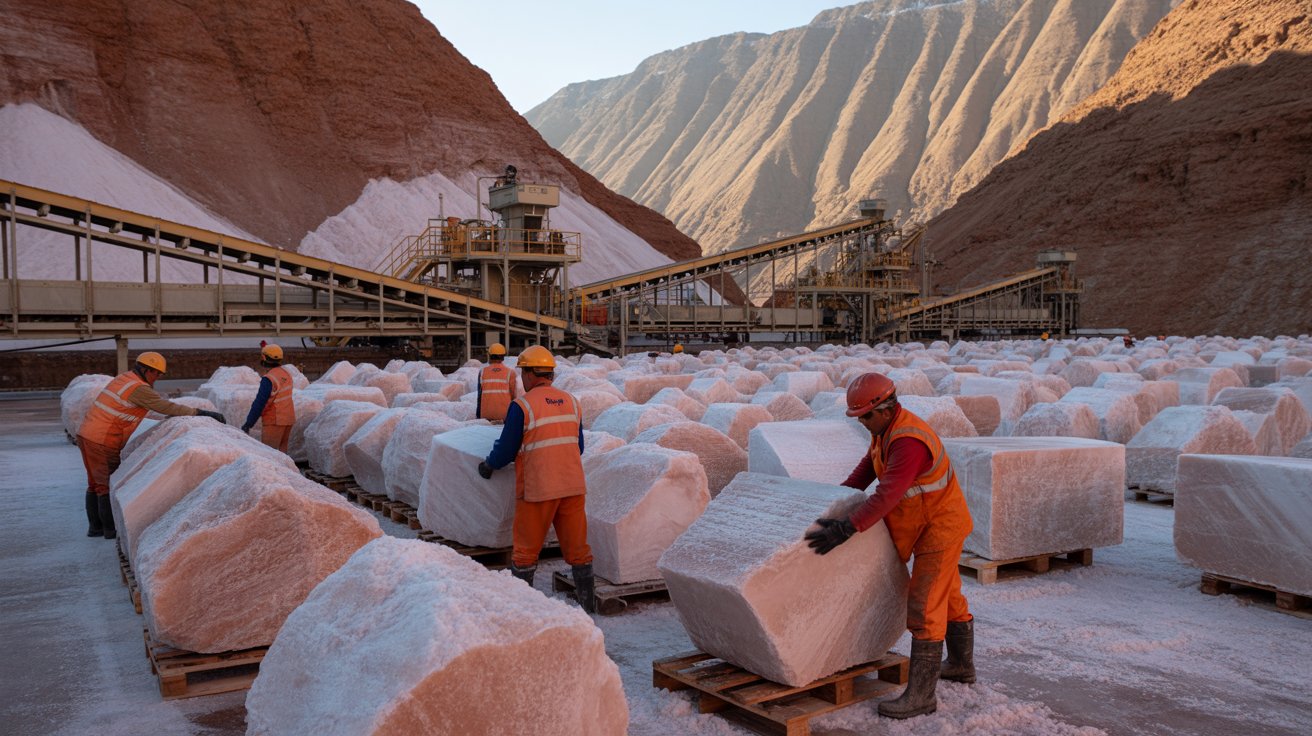
Despite Appearing Handmade, The Pink Salt Marketed Worldwide Is Processed With Heavy Machinery, Automated Sorting, And Continuous Production That Transforms A Millennia-Old Rock Into A Luxury Product
The Himalayan pink salt goes through a rigorous industrial process that involves large-scale mining, crushing, washing, drying, grinding, and automated packaging. The cycle begins in the Khewra mines in Pakistan, one of the largest salt reserves in the world, with tunnels dug tens of meters deep. Unlike sea salt, pink salt is a halite, meaning rock salt — extracted directly in solid blocks.
The extraction is carried out with industrial equipment such as excavators, crushers, and large diamond saws. Trucks transport the blocks to warehouses where the first sorting occurs. Only fragments with a pinker color and uniform texture proceed to the processing stages intended for human consumption.
The selected rocks undergo pressure jets to remove visible impurities. Then, the salt is dried in thermal tunnels with temperature and humidity control. This entire process aims to maintain the mineral integrity of the product, without chemical additives or whiteners.
-
As Havan approaches 200 megastores in Brazil, the city of São Paulo still has no unit; Luciano Hang attributes the absence in the country’s largest metropolis to bureaucracy and explains why the network’s expansion prioritized inland municipalities.

-
Man enters college at 70 years old and earned a bachelor’s degree, several master’s degrees, received the last diploma at 90, and became the oldest graduate in the history of a system with 23 universities.
-
International gallery chooses an old workers’ village in Jardim Botânico to open a new branch in Rio and surprises by bringing together 17 artists from Brazil, Mali, Portugal, and South Korea in a free exhibition.
-
Nepalese man was missing for six days on Everest, fell into an ice crevasse, survived on biscuits and melted ice, and only escaped after an avalanche cleared a path near Base Camp.





Sorting, Grinding, And Grain Size Classification
After drying, the salt blocks enter the grinding stage, where they pass through industrial grinders that reduce the particle size according to the final use. The pink salt can be ground into fine powder, intended for home cooking, or kept in larger crystals for decorative and therapeutic purposes.

Next, the crushed salt goes through vibrating machines that classify the grains by size with precision. This granulation separation allows the creation of different commercial categories of the product, each with a specific price and application. During this process, optical sensors detect and remove fragments with imperfections or off-standard colors.
This automation ensures standardization, food safety, and logistical efficiency. At no stage is there direct manual handling of the food — which contradicts the imagined artisanal production associated with pink salt.
Packaging, Design, And Premium Positioning
With the classification complete, the pink salt is directed for packaging. The packaging ranges from airtight jars to gourmet sachets with sophisticated labels. Each package highlights benefits such as “natural,” “additive-free,” or “rich in minerals,” reinforcing its visual and functional appeal.
The product’s appearance, combined with the packaging design, is one of the main elements of value enhancement. Although the composition of pink salt is chemically similar to that of regular refined salt — with about 98% sodium chloride — the aesthetics and narrative of purity place it prominently on the shelves.
In parallel to production for food consumption, the same pink salt is shaped by CNC machines for the manufacture of decorative lamps. The larger stones are cut, drilled, and polished until they achieve their final shape, always with electronic control of measurements and finish.
Global Export On An Industrial Scale
This process does not only occur in Pakistan, although the Khewra mine is the main source. Countries like India and Afghanistan also have similar operations, but the mass production model follows the same pattern: mechanical mining, automated processing, and high-performance packaging to meet global demand.
According to the channel Fábrica, which documents industrial processes around the world, pink salt goes through a completely technical, controlled, and standardized production chain before being sold with the appeal of a “natural product.” This includes everything from the use of optical sensors to the standardization of packaging in international markets.
Does Himalayan pink salt play a part in your routine? What do you think about this product that has been gaining a place on the tables of millions of Brazilians for years?




Be the first to react!