Portuguese
  Spanish


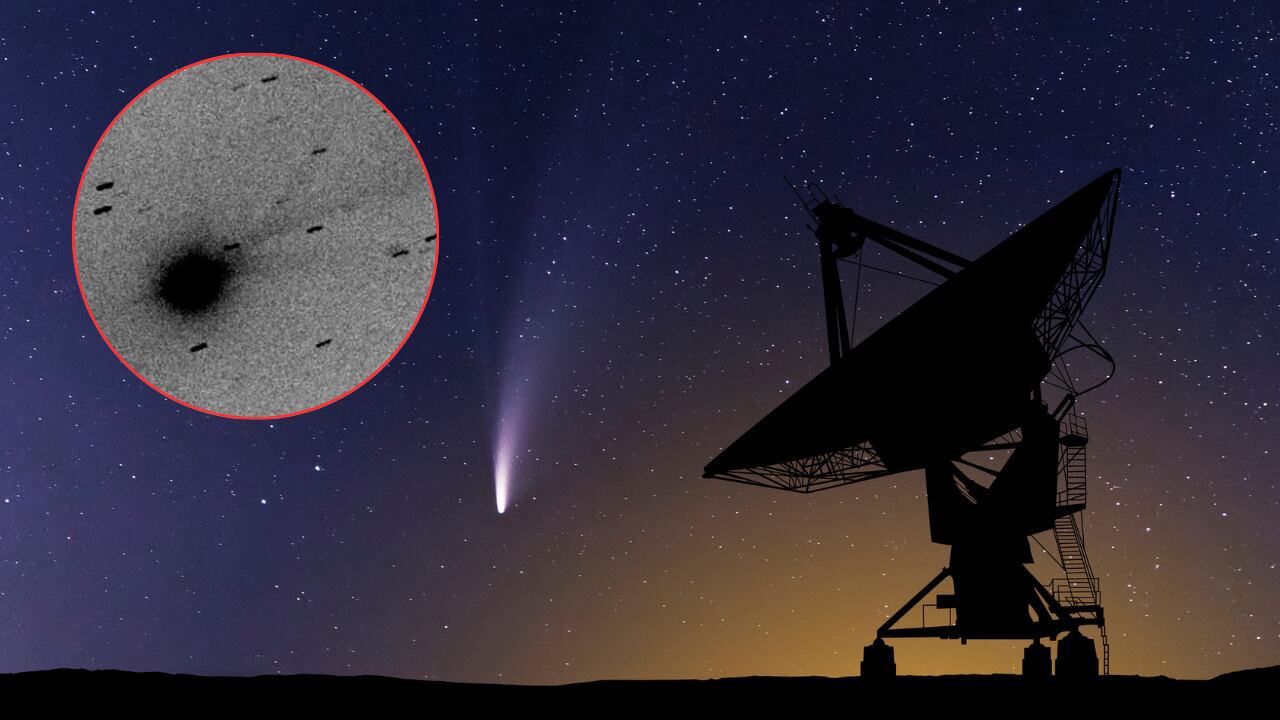


Astronomers Detect for the First Time a Radio Signal from an Interstellar Object: Comet 3I/ATLAS. The Discovery Confirms the Presence of Water Vapor and Begins a New Age in Radioastronomy
For brief moments in October 2025, an interstellar visitor crossed the Solar System leaving an unexpected trace: a weak but unmistakable radio signal. It was 3I/ATLAS, the third object identified with a trajectory from interstellar space, after the already famous 1I/ʻOumuamua and 2I/Borisov.
However, unlike its predecessors, this new cosmic traveler offered something never observed before: a clear and detectable radio emission associated with the presence of volatile compounds.
An Unprecedented Discovery
The detection was made on October 24, 2025 by an international team of astronomers from South Africa and Sweden, using the high sensitivity of the MeerKAT radio telescope. The measurements revealed absorption lines at frequencies of 1665 and 1667 MHz, typical of the OH radical, a product derived from water that forms when ice sublimates in comets.
-
Brazilian Researchers Develop Low-Cost Sensors to Detect Avian Flu in Minutes, Enhancing Global Health Security

-
545 Intact Amphorae Found 370 Meters Deep in Turkey Reveal Ancient Byzantine Trade Routes Connecting the Aegean and Black Sea

-
NASA to Send Astronauts Over 400 km Above Earth for 6.5-Hour Spacewalk to Repair Canadarm2 on the ISS

-
Microsoft Raises Xbox Prices Again Due to Rising Component Costs


The finding occurred when 3I/ATLAS was only 3.76 degrees from the Sun, an extremely challenging position for observation due to strong solar interference. Previous attempts made weeks earlier had detected nothing. However, just before perihelion, the point of closest approach to the Sun, reached on October 29, the signal from OH became apparent. The spectral analysis showed a Doppler shift consistent with an object moving at over 68 km per second relative to the Sun.
Evidence of an Active Comet
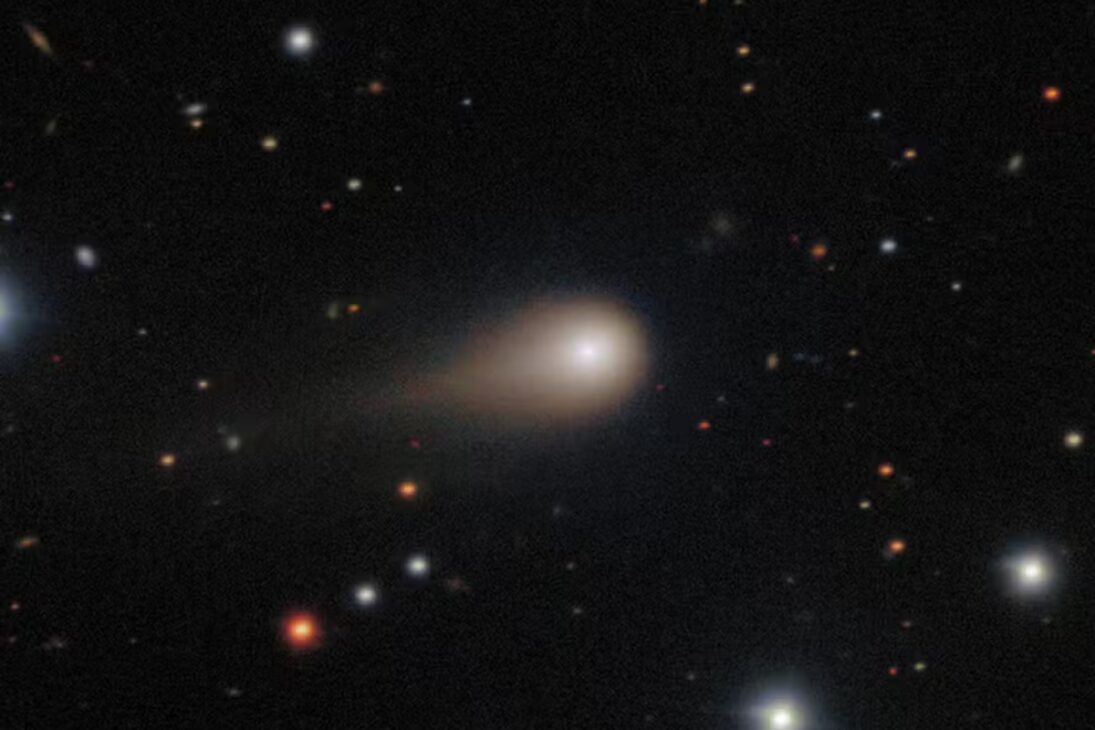
The intensity of the detected lines was weak, but sufficient to confirm the presence of water vapor in its coma, the gas layer surrounding the comet’s nucleus. This behavior places 3I/ATLAS within the typical pattern of active comets, demonstrating that, despite its interstellar origin, its structure and composition are similar to those of comets formed in our own system.
The discovery makes 3I/ATLAS the first interstellar object to leave a clear radioelectric mark, an indication that will allow scientists to study in real time the chemical processes occurring on its surface and in its surroundings.
Artificial Origin Hypothesis Discarded
The news reignited the debate over the possibility that some of these objects have artificial or technological origins, a hypothesis that gained popularity with ʻOumuamua due to its unusual shape and non-gravitational behavior. However, the data gathered so far on 3I/ATLAS do not support this hypothesis.
Observations from the Hubble Space Telescope and James Webb confirm that the object has a moderate coma, a tail directed opposite the Sun, and a controlled release of gases such as hydrogen cyanide, all typical traits of a natural comet.
First detected on July 1, 2025, 3I/ATLAS has been continuously monitored by a global network of ground and space observatories. As it moves away from the Sun, observing conditions improve, opening new opportunities to analyze its composition with more precise spectroscopic techniques, including low-intensity radiofrequency.
A New Chapter in Interstellar Astronomy
More than just a one-time discovery, this detection marks a milestone in modern radioastronomy. For the first time, an object from another stellar system has been studied not only through optical means but also through its radio emission, offering a new tool to understand how these wandering bodies interact with radiation and solar wind.
The radioelectric signature of 3I/ATLAS not only confirms its cometary nature but also inaugurates a new stage in the exploration of interstellar objects, allowing science to directly observe how deep space chemistry manifests within our own Solar System.