Portuguese
  Spanish


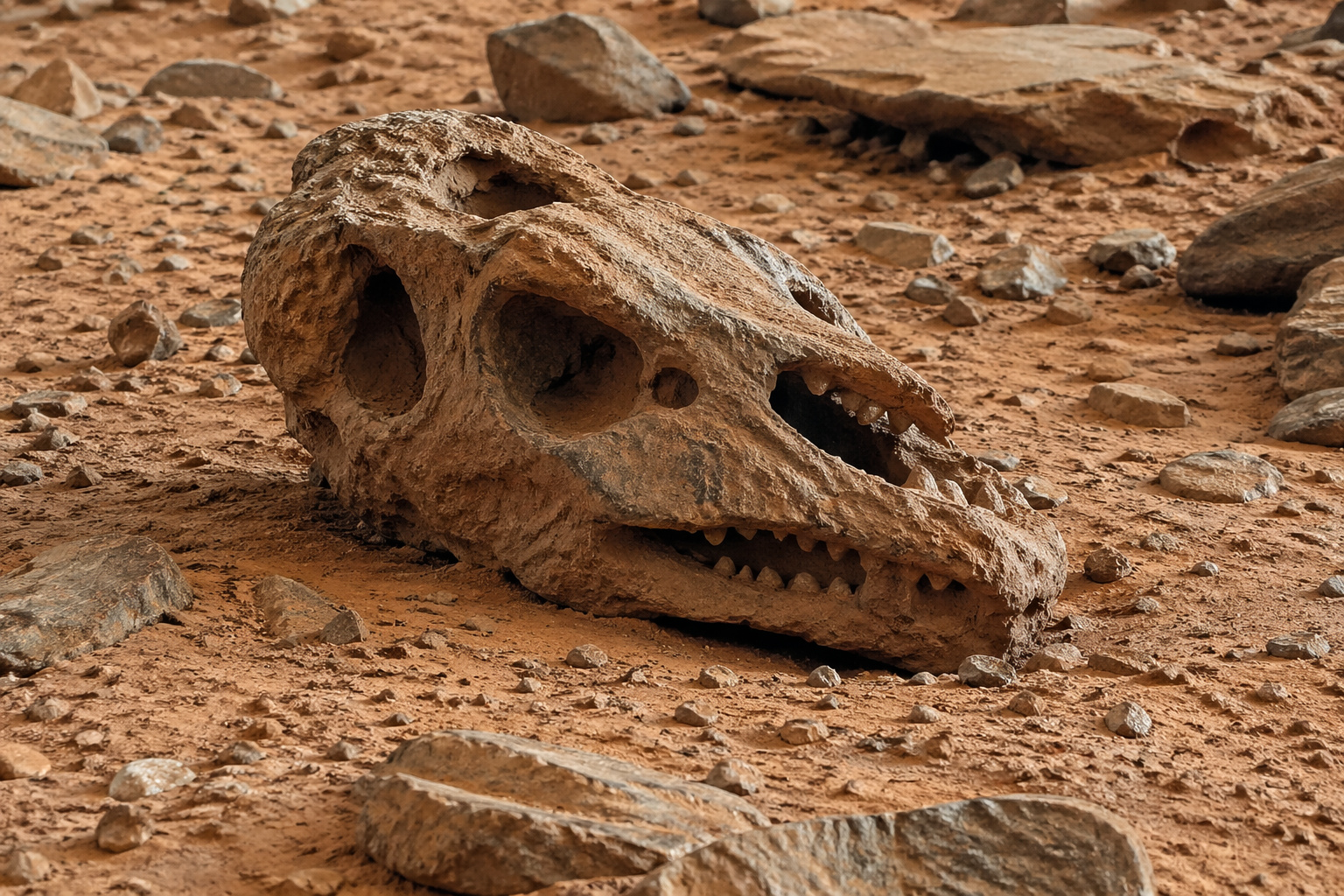

Image captured in April by Perseverance reinforces visual phenomenon known as pareidolia and captures the attention of the public and the scientific community
The Perseverance rover, from NASA, has gained attention again after recording an unusual rock formation on the surface of Mars.
The team made the recording on April 18, during scientific operations in Jezero crater.
The content quickly sparked curiosity and generated various interpretations.
The rock has a shape similar to a dinosaur skull, which led some of the public to speculate about fossils.
However, NASA reinforces that there is no evidence of complex life on the planet.
This interpretation occurs because the human brain tries to recognize visual patterns.
Visual phenomenon explains unusual appearance of the rock
Science defines pareidolia as the perception of familiar shapes in random patterns.
This psychological phenomenon frequently appears in images captured on Mars.
Thus, natural structures become associated with known objects.
-
Bioengineer Develops Microscope That Magnifies Objects Up to 2,000 Times Using Just a Folded Sheet of Paper, a Tiny Lens, and Less Than $1, Bringing Lab Science Anywhere for Less Than the Cost of a Candy

-
Dog Walker in English Forest Uncovers 3,400-Year-Old Bronze Age Axe
-
Texas Blackout Inspires Student to Develop Bionic Leaf Catalyst for Converting Sunlight, Water, and Bacteria into Fuel

-
Brazilian Students Develop Process to Turn Styrofoam Waste into Water-Purifying Charcoal




Perseverance has already captured other images that resemble figures such as animals.
One of these images suggested the shape of a turtle.
These examples show how the human brain seeks visual meaning even in unfamiliar environments.

Jezero crater concentrates mission efforts
The team captured the image in the Jezero crater, one of the most studied regions of the mission.
The area is about 45 kilometers in diameter and represents a strategic point for scientific analyses.
Data from NASA indicates that Jezero once housed a lake.
This lake received water from a river delta.
Therefore, the region has become essential in the search for evidence of ancient microbial life.
Perseverance mission has been active since 2021
The Perseverance rover landed on Mars on February 18, 2021.
Since then, the mission has been conducting detailed studies on the planet’s soil and geology.
Each new recording expands scientific knowledge about Mars.
Some images generate curious interpretations.
Even so, scientists analyze all data with technical rigor.
NASA remains focused on concrete evidence throughout the mission.
Curious record reinforces the importance of scientific analysis
The image sparked popular interpretations among the public.
This case reinforces the importance of careful scientific analysis.
Human perception can directly influence the reading of images.
Science is based on verifiable evidence and ongoing studies.
This process ensures greater accuracy in conclusions about Mars.
To what extent can images captured on other planets deceive human perception?