





 Portuguese
  English
  Spanish
  5 min of reading
  0 comments


Project Laranjix uses orange peel powder as a natural additive and will now undergo technical tests that may define its future in the market
A project created by students from the state network of Paraná placed a common waste at the center of an increasingly urgent discussion in civil construction: how to reduce waste and make construction materials more sustainable without compromising safety, performance, and durability.
The initiative is called Laranjix and uses powder obtained from orange peel as an additive for mortar. According to the Government of Paraná, the proposal was developed by students of the Technical Course in Systems Development at the Civic-Military State School Professor Darcy José Costa, in Campo Mourão.
The project, which was born in a school environment, is now in the process of entering the incubator at the Federal Technological University of Paraná, UTFPR. The new stage includes laboratory tests, technical feasibility analysis, and market potential evaluation.
-
How to properly build a brick wall, starting with measuring the area, choosing materials, preparing the mortar, aligning with nylon string, and finishing with lime, putty, and paint.

-
Four thousand PET bottles became a 24m² house in the interior of São Paulo, as ten students proved that it’s possible to build a home from floor to ceiling with recycled plastic, spending 30% less than a brick construction.

-
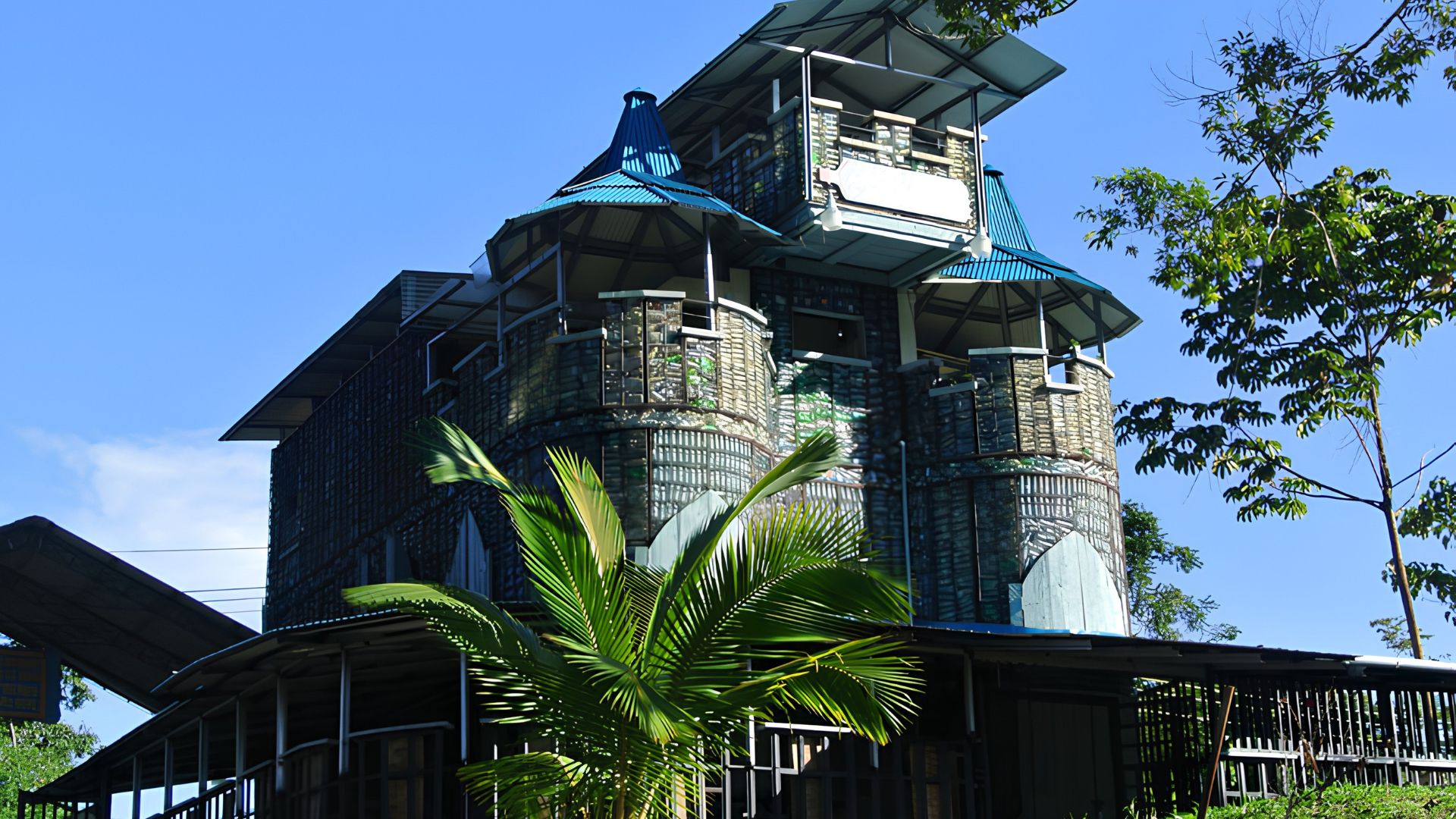
Man builds entire village with over 1 million PET bottles and impresses with creativity; known as Plastic Bottle Village, the project even erected a four-story castle with 40,000 bottles and entered the Guinness World Records.
-
Concrete made with seawater and marine sand challenges one of the basic rules of civil construction, replacing common steel with corrosion-resistant reinforcements, and can turn islands and coastal works into laboratories of a new salty engineering.



The idea is not yet a product ready for sale, and this point is important. The initial results themselves need to be confirmed by scientific tests before the material can be treated as a real alternative for widespread use in construction.
School project advances to a technical stage at UTFPR
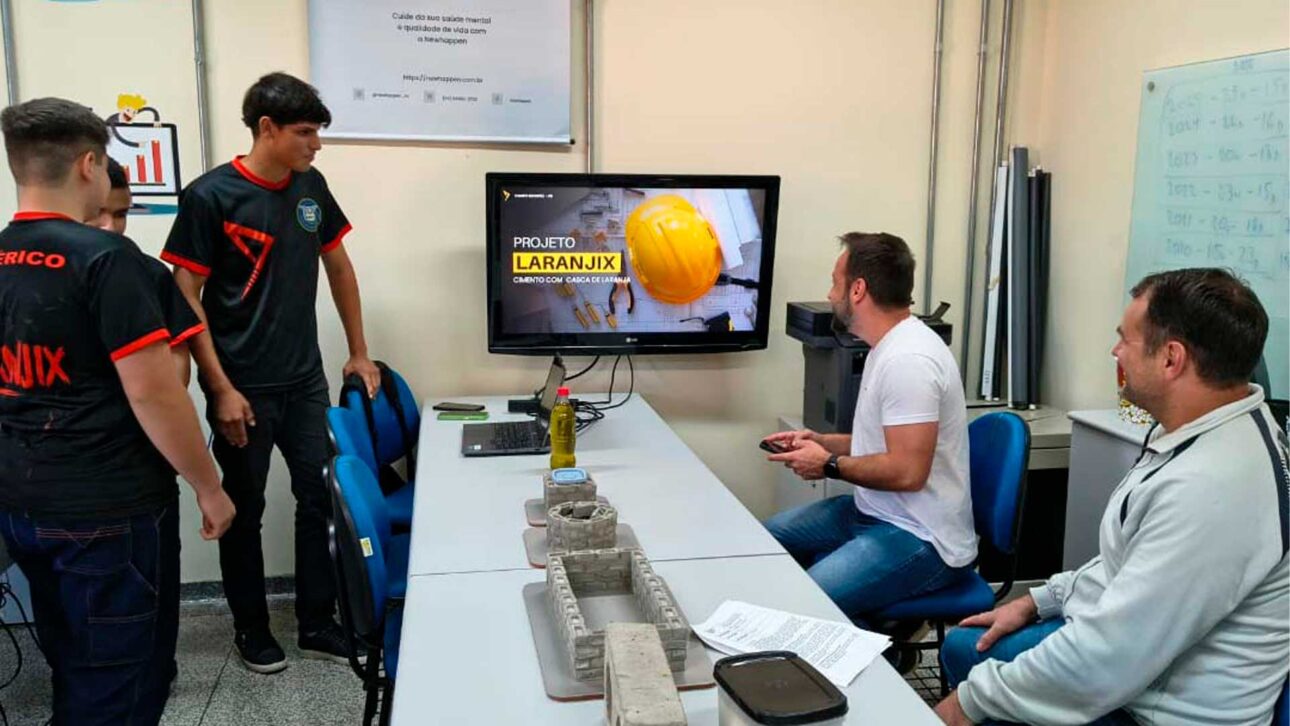
According to the State News Agency of Paraná, Laranjix was created in 2025 to participate in HackTech Paraná, a challenge promoted by the State Department of Education. The proposal received an honorable mention as one of the most innovative initiatives in the competition.
The group is formed by high school students integrated with technical education. The idea arose when the students were researching ways to combine juice industry waste and materials used in civil construction, especially mortar.
The logic of the project is simple but attention-grabbing: transforming orange peels, usually treated as waste or byproduct, into a fine powder capable of acting as an additive in the mixture. In the students’ proposal, this powder would replace lime used in certain mortar compositions.
In the week before the announcement of the project’s progress, the students presented the initiative to a panel composed of professors from the areas of Chemistry, Civil Construction, and Innovation at UTFPR. This evaluation marked the beginning of a more rigorous phase, with tests capable of determining whether the solution can move from school to market.
How orange peel is incorporated into sustainable mortar
According to the students’ report to the Government of Paraná, the process begins with the cleaning of the peels. Then, the material undergoes a stage of essential oil extraction with alcohol, is sun-dried, taken to the oven, and ground into a fine powder.
This compound is incorporated into the mixture in an approximate proportion of 4%. The proposal is that the orange peel powder functions as a natural additive for mortar, with the potential to alter properties such as water absorption, weight, and the material’s behavior in everyday use.
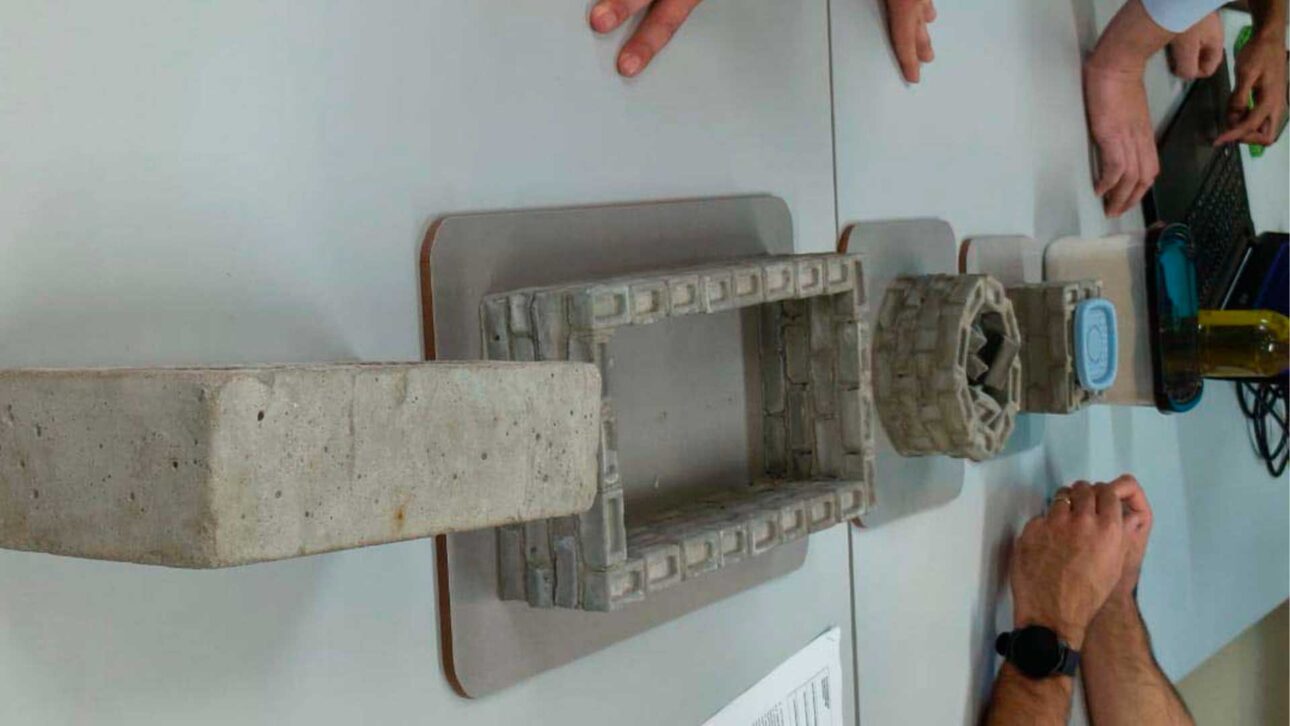
In homemade tests conducted by the students themselves, the group produced blocks and even plastered an entire wall to observe the result. According to the official release, the students noticed greater water repellency compared to the traditional mortar used in the experiments.
Another observed point was the weight reduction. In some preliminary tests, the blocks produced with the compound were about 500 grams lighter, according to student Emanuel Henrique Smanioto da Cruz, one of the project members.
These data, however, are still initial indications. For civil construction, practical observations need to be confirmed by standardized tests of resistance, adhesion, capillarity, permeability, durability, and material stability over time.
Why civil construction is observing this type of solution
The interest in alternative materials is growing because the construction industry is under pressure to reduce emissions, waste, and raw material consumption. The United Nations Environment Programme points out that buildings and construction remain among the major contributors to global energy consumption and CO₂ emissions.
Cement, an essential component of concrete and mortar, is also at the center of this debate. The International Energy Agency reports that the emission intensity of cement remains close to 0.6 tons of CO₂ per ton produced, highlighting the difficulty of decarbonizing this sector.
In the case of Laranjix, the proposal does not eliminate cement nor does it alone resolve the environmental impact of construction. What it does is enter a line of research and innovation that seeks to utilize organic waste, reduce industrial inputs, and test new formulations for construction materials.
Brazil has a favorable context for this type of study because it has a significant citrus chain. Data from IBGE indicated, in the March 2025 Systematic Survey of Agricultural Production, an estimate of 12.8 million tons of oranges in the country, with São Paulo responsible for the majority of national production.
Laboratory tests will define resistance, use, and safety
The stage at UTFPR will be decisive because civil construction cannot rely solely on appearance, lightness, or water repellency. A material used in construction needs to present predictable performance, especially when applied in coatings, blocks, plasters, or other construction elements.
According to the Government of Paraná, the next studies should evaluate mechanical resistance, thermal insulation, durability, and material performance. These points will indicate whether the orange peel additive can have practical application, what its limits would be, and in what situations it could be used safely.
Technical guidelines used in the sector show that innovative products undergo evaluations of mechanical performance, watertightness, permeability, and durability. This includes tests of adhesion, water resistance, thermal shock, and coating behavior with aging.
Therefore, the path to becoming a commercial product still depends on research, documentation, repetition of results, and eventual compliance with applicable standards. The incubator can help precisely in this bridge between the students’ idea and the market’s technical requirements.
From agricultural waste to innovation opportunity
The case also draws attention due to its starting point. The solution was not born in a large industrial research center, but within a public school, from a professional and technological education challenge.
According to the Civil House of Paraná, HackTech Paraná brought together students from different regions of the State and aimed to bring technical training closer to real societal problems. In this environment, Laranjix stood out for combining sustainability, creativity, and potential for practical application.
The proposal also aligns with the circular economy, a concept that seeks to keep materials in use longer and reduce the volume of waste discarded. By transforming orange peel into an input for mortar, the students attempt to give new value to a common organic surplus in a strong productive chain in Brazil.
If the tests confirm feasibility, Laranjix could advance to applications such as mortars, blocks, plasters, and other materials. If the results are limited, the project will still have demonstrated the value of applied research in technical high school education.







Be the first to react!