Portuguese
  Spanish


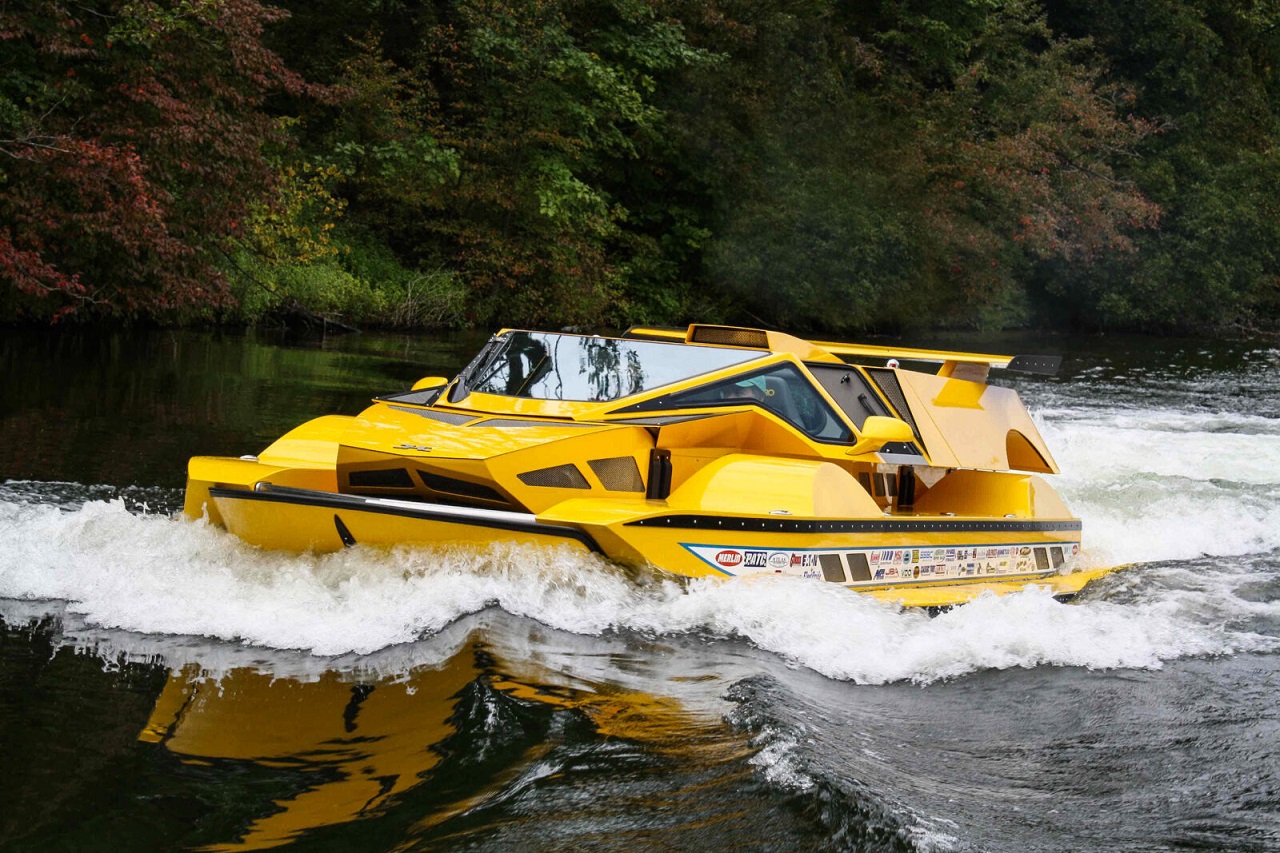

Rick Dobbertin, famous in the Hot Rods industry in the 80s, developed an “Amphibious” car sold for more than US$ 1 million. The model was a failure, but became a rarity among collectors.
With the advancement of automotive technology, several brilliant and bizarre creations have been developed, but some of them have been a real fiasco and the “HydroCar”, developed by Rick Dobbertin, is certainly on that list. Rick developed the model in the early 90s, focusing on creating a GT that could fly on the streets and drive across the waters, sparing no effort or money for that.
How Did the Idea for the Hybrid Car Come About?


Dobbertin’s hope was that someday the amphibious car market would be profitable, with his HydroCar opening doors for this peculiar category. However, like his previous project, called Surface Orbiter, the HydroCar was doomed to fail in the market.
Rick Dobbertin was a legend in the hot rod segment in the 80s. After a while, he sought out ways to undertake a project that challenged him in a way that a hot rod could no longer do, something that would take him out of his comfort zone and place him on the map of the world’s top manufacturers.
-
Researchers want to change the way of producing rare earth magnets, reducing purification steps and making better use of the elements found in Swedish deposits.

-
5.5 tons pulled from the seabed: a ‘living carpet’ of invasive coral was suffocating the Baía de Todos-os-Santos until the Brazilian Navy descended with divers, steel brushes, and acid salt to carry out the largest eradication operation of the species ever conducted in the country.

-
A Brazilian project dumped 5,500 concrete blocks and 2 barges into the ocean to block trawling in Paraná, and 25 years later what seemed like a risky intervention turned into an underwater nursery, a diving spot, and a refuge for endangered species.
-
Micron invested $9.3 billion in a factory in Hiroshima to produce the memory that powers the brain of global artificial intelligence.


This became the Dobbertin Surface Orbiter (DSO), a completely unique development in a 1959 Heil stainless steel milk tank designed to be self-sufficient while traveling both on water and land.
Dobbertin planned to embark on a circum-navigation expedition in 1993, with the DSO and his then-wife Karen aboard. The expedition ultimately was never completed due to various issues with the amphibious vehicle and his multiple attempts to succeed with the project also led to the end of the designer’s marriage.
Dobbertin HydroCar Sold for US$ 770,000
The DSO was Dobbertin’s first major failure, leading him to bankruptcy, which could have made anyone give up. With another project in mind, over ten years and a million dollars were spent on parts and other items to turn the dream into reality.
However, the designer never managed to finalize the project properly, and the idea proved to be unfeasible while being developed. Like the old car, the HydroCar left its maker broke, with the amphibious vehicle put up for sale in 2011.
The asking price for the model was US$ 770,000, quite low considering the time and money invested in the project, which failed to generate interest from any buyers. In the years that followed, the HydroCar occasionally resurfaced in the specialty market, always changing hands among collectors. It was finally sold in 2018 for US$ 60,500 and again in 2021 for an undisclosed amount.
Vehicle Can Reach 202 km/h
As a general rule, amphibious vehicles are neither good cars nor decent boats, and the HydroCar did not stray far from that expectation in those characteristics. Powered by a Chevrolet V8 engine of 572 cubic inches and a fully tuned World/Merlin dynamometer in aluminum generating 762 HP and 712 lb-ft (965 Nm) of torque at 4,200 RPM, the vehicle features a customized GM 4L80E Quadzilla transmission, with automatic transmission in the front axle in road mode and an Arneson Surface Drive in water mode.
Once the operation was complete, the HydroCar could reach over 96.5 km/h on water and as a car, it had a top speed of 202 km/h; however, neither of those numbers was fully tested and verified.
The HydroCar was developed entirely by hand, using a 304 stainless steel spaceframe and roll bar for the body and aluminum for the articulated sponsors.