






 Portuguese
  Spanish


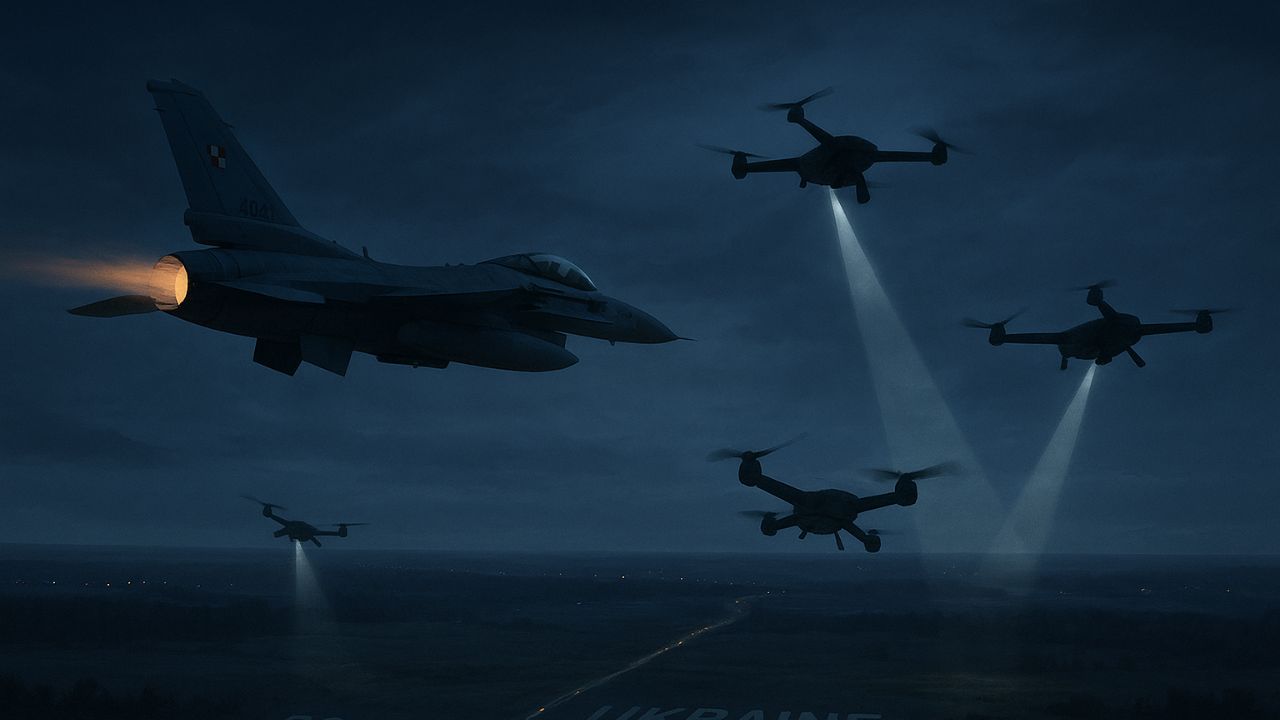

Russian Drone Incursion Into Poland’s Airspace Raises NATO Alarm. Understand What Could Happen If An Alliance Country Is Attacked.
Air Incursions and Max Alert in Poland
The Poland experienced moments of tension this Wednesday (09/10/25), when 19 Russian drones violated its airspace, according to Prime Minister Donald Tusk’s report to Parliament.
The incident occurred during the early morning and led to the immediate mobilization of Polish and allied fighters, following an alert issued by the Ukrainian Air Force.
The incident reignited fears about NATO’s direct involvement in the war between Russia and Ukraine, as Poland is a member of the military alliance.
-
U.S. Air Force Launches Air-to-Air Missile Project with Range of Up to 1,850 km for Indo-Pacific Operations

-
Australia to Deploy Up to 8 Nuclear-Powered Submarines in Indo-Pacific, Establishes Billion-Dollar Naval Chain Through AUKUS, Joining Elite Group Capable of Extended Underwater Missions

-
Indonesia Begins Construction of 2,000-Ton Scorpène Stealth Submarines with Advanced Weaponry and French Steel

-
Brazil’s Largest Navy Ship, NAM Atlântico, Transforms into Field Hospital During National Crises




The proximity of the Polish border to the Ukrainian city of Lviv — just 65 kilometers away — heightens the sensitivity of the situation.
Growing Tensions Since 2022
This was not an isolated case. Since the beginning of the war in February 2022, Poland has recorded four episodes of projectiles or drones coming from the conflict.
This time, the situation gained even more delicate contours because, in addition to Russia, Belarus claimed to have shot down part of the unmanned aircraft.
According to authorities in Minsk, the drones reportedly deviated from their course due to electronic interference during an attack between Russia and Ukraine.
The Belarusian government also stated that it informed both Poland and Lithuania about the approach of the equipment.
Request for Consultations with NATO
Given the gravity of the episode, Donald Tusk declared that he activated NATO based on Article 4 of the alliance’s treaty, which provides for consultations among member countries when any of them feels their security is threatened.
“There were 19 incursions into Polish airspace during the night,” said Tusk in Parliament.
The Prime Minister highlighted that, should the situation escalate, Article 5 may also be considered, which defines that an attack on one NATO country is equivalent to an attack on all members of the organization.
What Does Article 5 of NATO Say
The Article 5 is the basis of NATO’s collective strength. Established in 1949 during the Cold War, it states that an armed attack against any member will be treated as aggression against the entire alliance.
In practice, this means that military resources from countries like the United States, the largest power in the alliance, could be mobilized to defend Poland.
For smaller states — like Iceland, which does not even have a standing army — this protection is essential.
The treaty specifies:
“The parties agree that an armed attack against one or more of them, occurring in Europe or North America, shall be considered an attack against them all and, therefore, they agree that if such an attack occurs, each of them […] will assist the attacked party or parties by taking […] the actions it deems necessary, including the use of armed force, to restore security in the North Atlantic area.”
When Article 5 Has Been Invoked
Despite its relevance, Article 5 has only been invoked once in history: after the September 11, 2001 attacks in the United States.
Since then, NATO has reinforced its joint operations in missions in Afghanistan, Iraq, and Syria.
Moreover, even without formally invoking the article, the alliance has carried out collective defense operations, such as the deployment of Patriot missiles on the Turkey-Syria border in 2012 and the sending of troops to Eastern European countries after Russia’s annexation of Crimea in 2014.








