






 Portuguese
  Spanish
  4 min of reading
  0 comments


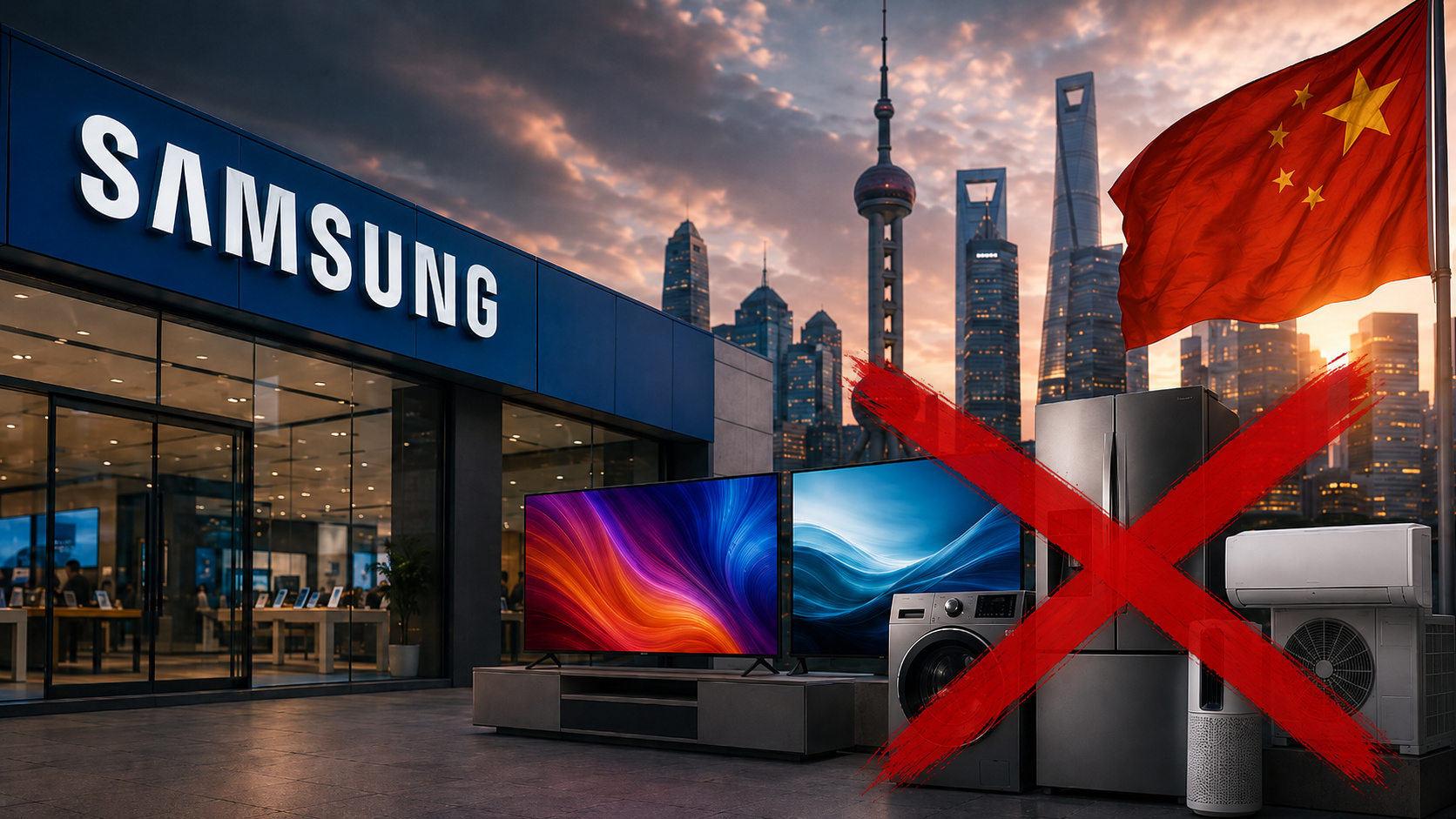
Samsung will stop selling TVs and appliances in China after the advance of TCL, Hisense, and local brands that dominated the market.
Samsung has decided to cease the sale of some of its consumer electronics products in China after years of losing market share to local manufacturers. The move mainly affects the television and appliance segments, areas where Chinese companies have rapidly expanded their presence, industrial scale, and competitiveness in recent years.
The move represents one of the biggest strategic changes for the South Korean company in the Chinese market since its entry into the country in the early 1990s. While maintaining operations related to semiconductors, cell phones, and industrial production, the company confirmed that it will stop selling certain lines of TVs and appliances to Chinese consumers. The information was revealed by Reuters on May 6 of this year.
Samsung ends sales of TVs and appliances after decades of presence in the Chinese market
According to information released by Reuters, Samsung reported that it will halt the commercialization of some consumer electronics products in mainland China, including televisions and appliances. The company stated that the decision was driven by intensified local competition and changes in market conditions.
-
Without a mansion, without high investment, and without a traditional classroom, a teacher living in a 22 m² house taught students to build a 9 m² studio apartment with the equivalent of R$10,000.

-
Without her own home and pressured by rent, a 25-year-old bought a small 15-meter boat, gradually renovated the interior by herself, transformed the interior with paint, new flooring, a larger bathroom, and started living on the canals, paying much less per month.
-
Long before sustainable construction became a trend, China built earthen fortresses with multiple floors, a central courtyard, and the capacity to house up to 800 people living in a community.
-
He got tired of renting, bought an old school bus, removed the seats, modified the roof, reinforced everything with steel, and created a two-story mobile home that looks small on the outside but houses two bedrooms inside.



The withdrawal comes after more than three decades of operation in the Chinese white goods and television sector. Reports from the Asian press indicate that the company began operations related to the segment back in the 1990s, when China’s economic opening attracted global electronics manufacturers.
Despite the exit from local sales of these products, Samsung will continue to operate in China in areas considered strategic, including smartphones, semiconductors, and some industrial operations aimed at export.
TCL, Hisense, and Chinese manufacturers began to dominate the market with mass production and more competitive prices
The advance of Chinese companies was one of the central factors behind the decision. Brands like TCL, Hisense, Xiaomi, Skyworth, and Haier expanded their share in the domestic market using large production scales, local distribution networks, and more aggressive pricing.


Data cited by Exame shows that Chinese manufacturers accounted for approximately 95.4% of television sales in the Chinese market in February 2026, leaving a very small share for foreign brands.
The situation is also reflected globally. Companies like TCL and Hisense have moved beyond being just low-cost manufacturers and are now competing for leadership in premium segments, Mini LED and large-screen televisions.
Samsung lost market share while Chinese brands expanded dominance within their own country
Reports cited by the Wall Street Journal show the extent of the change. In the Chinese offline market, Samsung had a share of only 3.62% in televisions, while refrigerators and washing machines recorded shares below 1%.
At the same time, Chinese groups began to control the majority of national sales. According to the data cited in the report, domestic brands already concentrate more than 90% of the TV market and more than 60% of the home appliance sector in China.
This transformation drastically reduced the space for foreign manufacturers in one of the largest consumer markets on the planet.
Change occurs after losses, leadership change, and increasing pressure in the television sector
Samsung’s reorganization comes at a time of strong pressure on the company’s television and home appliance division. According to Reuters, the segment recorded losses of approximately 200 billion South Korean won, equivalent to about US$ 138 million, over the past year.
The company also recently made a leadership change in the television area, replacing the head of the visual division for the first time in more than two years. The change occurred amid increasing international competition and a slowdown in demand.
In addition to the pressure from TCL and Hisense, Chinese manufacturers have started to invest heavily in panel technologies, Mini LED, OLED, and large screens, segments that were previously dominated by South Korean and Japanese brands.
Production will remain active, but Samsung’s focus shifts to cell phones, chips, and more profitable areas
Despite the closure of local TV and appliance sales, Samsung is not completely abandoning its Chinese operations. The company reported that it will continue to use some of the country’s industrial facilities as production centers aimed at international export.

The semiconductor and mobile device divisions remain among the company’s priorities in the region. Samsung itself highlighted that it intends to expand efforts in smartphones and solutions related to artificial intelligence in the Chinese market.
This shows that the move does not represent a total exit from China, but a restructuring focused on areas considered more competitive and profitable.
Samsung’s retreat shows how China has shifted from being just the world’s factory to becoming a powerhouse that challenges global giants
For decades, foreign companies dominated an important part of the Chinese electronics market. Today, the scenario is practically reversed. Local manufacturers not only control a large portion of domestic sales but also rapidly advance into international markets.
Samsung’s case has become one of the most visible examples of this change. The company that for years led the global television sector is now reducing its presence precisely in the country that has become the largest industrial center for electronics on the planet.
While TCL, Hisense, and other Chinese giants expand production, technology, and global participation, Samsung’s partial withdrawal reveals a shift that goes far beyond televisions and refrigerators: the battle for control of the global electronics industry is increasingly concentrated within China itself.





Be the first to react!