






 Portuguese
  Spanish


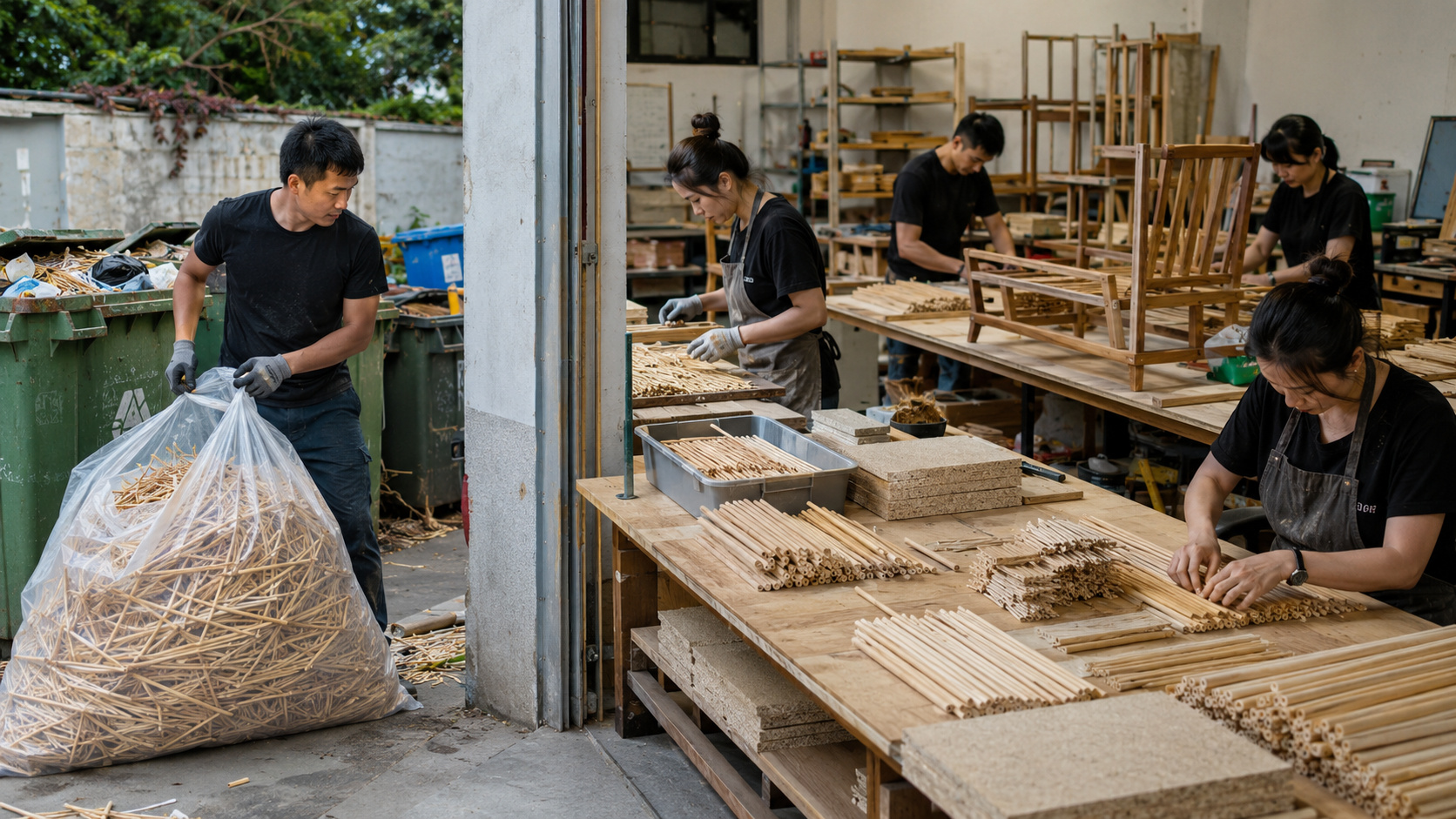

Canadian startup transforms discarded chopsticks into furniture and coverings using technology that compresses recycled bamboo into high-performance material.
Every year, billions of disposable chopsticks are used for just a few minutes and end up in the trash right after meals in Asian restaurants around the world. What seemed like just another common urban waste has become raw material for one of the most curious recycling startups in the sustainable design sector. The Canadian company ChopValue has created a system capable of transforming used chopsticks into furniture, panels, tables, coverings, and high-end decorative pieces.
The unique aspect caught attention because the company not only recycles the material: it presses the discarded bamboo until it creates an extremely dense composite, described by the company itself as harder than maple, stronger than oak, and as durable as teak.
The project was created by the German-Canadian engineer Felix Böck, who noticed the massive volume of chopsticks discarded daily in Vancouver, Canada. From this, he decided to test if that “restaurant waste” could become a structural material of much greater value.
-
Digital Transformation Essential in Energy, Oil, and Gas Industries, But IT Infrastructure Often Overlooked

-
Brazilian Students Repurpose Clay Tea Cups to Create Cooler That Lowers Room Temperature by Up to 10°C Without Air Conditioning or Fans
-
353-Year-Old Mystery Deepens as Archaeologist Arrested with Teeth and Bone Fragment Possibly Linked to d’Artagnan, the Real Musketeer Behind Alexandre Dumas’ Inspiration

-
16-Year-Old Invents CoolTowel, a Fitness Towel That Stays Cold for Up to 2 Hours, Wins Global Alibaba Competition with Over 15,000 Participants, Earning $1 Million



The idea arose after the engineer noticed billions of chopsticks going to waste
According to ChopValue and partner projects related to the circular economy, more than 1.5 billion disposable chopsticks are thrown away every week worldwide.


A large portion of these utensils is produced in Asia, transported thousands of kilometers, and used only once before being discarded.
Felix Böck realized that, despite being quickly discarded, the chopsticks were still made of high-quality bamboo. Instead of treating the material as waste, he decided to see it as a source of engineered wood ready for reuse. This is how ChopValue was born in 2016, initially in Vancouver.
The company collects used chopsticks from restaurants, airports, and universities and transforms chopsticks into furniture
The company’s operation begins with collection programs spread across restaurants, food courts, universities, and airports.
The used chopsticks are separated into specific containers and sent to the company’s local micro-factories. There, the material undergoes sanitization, drying, organization, and industrial pressing.
According to the University of Toronto Mississauga, a partner in ChopValue’s recycling program, the company has already recycled over 200 million chopsticks and diverted hundreds of tons of waste from landfills. The company itself claims to have surpassed 283 million chopsticks recycled globally.
Recycled bamboo becomes an extremely dense and resistant material
The most impressive aspect of the project might be the material created by the startup. The chopsticks are aligned, compressed under heat and pressure, and transformed into dense boards similar to engineered wood. ChopValue claims that the final result is a high-performance composite developed with proprietary technology.

According to the company, the material becomes:
- harder than maple;
- more resistant than oak;
- and as durable as teak.
This has allowed the recycled chopsticks to become more than just decorative raw material, turning into structures used in:
- tables;
- countertops;
- panels;
- chairs;
- stands;
- claddings;
- corporate furniture;
- and commercial interiors.
A single table can use about 10,000 recycled chopsticks
The volume of material used in the products is also noteworthy.
According to reports on the company’s operation, a large table can consume approximately 10,000 recycled chopsticks. Smaller items, such as stands or household utensils, use a few hundred units.

The scale forced ChopValue to create a decentralized production model.
Instead of operating just one central factory, the company uses small microfactories near the cities where the chopsticks are collected. This reduces transportation, emissions, and logistical costs.
Today the company has operations in countries such as Canada, United States, Mexico, Japan, Singapore, Philippines, Malaysia, and the United Kingdom.
The project became an international reference in circular economy
ChopValue gained international prominence precisely because it managed to transform an extremely mundane waste into a premium product.
The model caught the attention of hospitality companies, offices, restaurants, and even programs linked to IKEA Social Entrepreneurship, which highlighted the startup as an example of circular economy applied to design and local manufacturing.
The central concept of the company is simple: use existing urban waste instead of cutting down new trees to produce furniture and coverings.
Therefore, the startup began to describe its products with the slogan “All of the wood, none of the trees.”
The company that turns chopsticks into furniture and creates a global industrial chain
ChopValue’s goal today goes beyond recycling chopsticks into furniture. The company works to expand a model of urban microfactories capable of reusing local waste and transforming it into high-value-added industrial products.
According to the company, the system also helps reduce emissions related to the international transport of wood and furniture. ChopValue claims to have already avoided more than 13.8 million kg of CO₂ equivalent emissions since the start of operations.
This may be exactly what has turned the project into one of the most curious examples of the modern circular economy: it shows that something used for just a few minutes during a meal can end up returning to the market as a table, panel, or piece of furniture designed to last decades.


