Portuguese
  Spanish


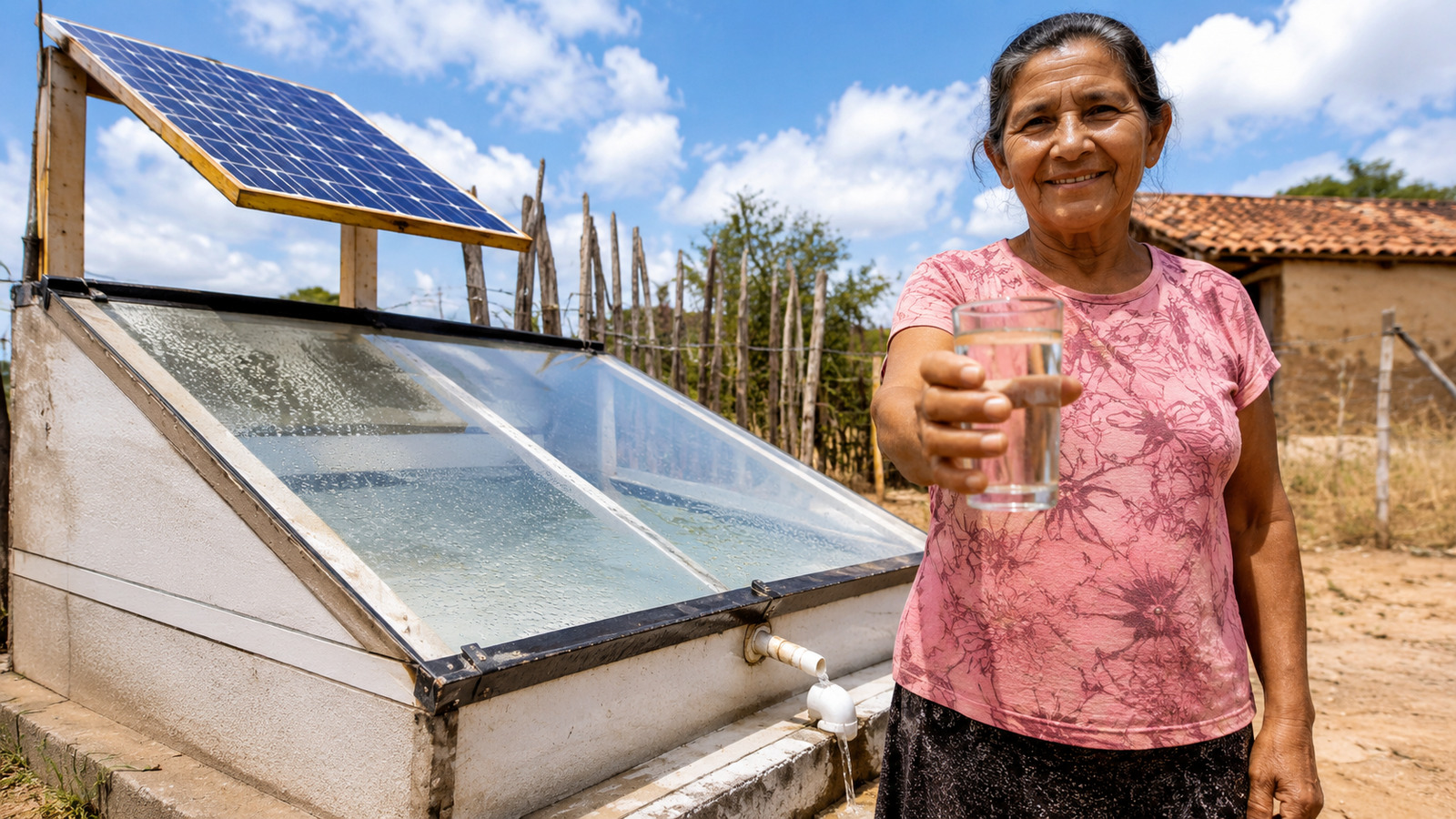


Technology developed with academic support transforms brackish water into potable water using solar energy, already reaching more than 200 families in Paraíba and the Northeast and offering a more accessible alternative in the face of drought
The solar desalination technology has already reached more than 200 families in Paraíba and other parts of the Northeast, transforming brackish water into potable water with the support of solar energy. In rural communities of Queimadas, the equipment has reduced hours-long journeys in search of water and has become a concrete alternative in the face of drought.
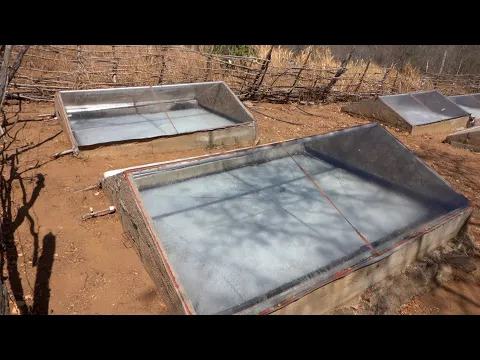

Solar desalination unit changes routine in Queimadas
In the rural communities of Queimadas, in the Campina Grande region, the lack of water has always been part of the families’ routine.
Residents walked long distances to ponds, reservoirs, and wells, often to fetch water that was unsuitable or tasted like dirt.
-
Ancient Stone City in the Desert, Once Home to 30,000, Puzzles Scientists with Nabateans’ Water Mastery 2,000 Years Ago

-
Ancient Creature Thought Extinct Since Dinosaur Era Reappears, Baffling Scientists

-
India Deploys Giant Fabric Tubes Filled with Sand to Combat Coastal Erosion and Rebuild Disappearing Beaches

-
China Unveils Most Human-Like Humanoid Robot for Public Sale, Featuring Silicone Skin and 88 Joints, Priced from $17,600




Severina Marinho, a resident of the rural area, recalls that the hardship was great because the water had to be carried from afar. She recounts leaving around 5 a.m. and only returning hours later.
The farmer Severino de Sousa also reports that the search for water could take up to 4 hours of travel. The difficulty affected basic day-to-day decisions, such as studying or going to the fields, creating a routine marked by uncertainty.
It was in this scenario that the work of Wanderley Silva emerged, a doctoral student in the research line of solar desalination at the State University of Paraíba.
The researcher grew up in a region affected by scarcity and brought personal experience closer to academic work.

How brackish water becomes potable water
The solar desalination unit uses the sun’s heat to transform brackish water into water suitable for consumption. The process is simple: the water is heated, evaporates, condenses on a glass surface, and is then collected without salt and impurities.
In practice, the technology offers a low-cost solution compared to more expensive systems. The production cost of the equipment went from about R$ 3,000 to up to R$ 5,000 per unit, but it still remains below alternatives like reverse osmosis, which can reach R$ 50,000.
The current model was the result of tests with different materials. Wanderley states that glass, canvas, and cement began to be used after corrosion problems caused by salt in previous versions of the system.
Popular knowledge also helped in the improvement of the equipment. A local farmer’s suggestion to use canvas was incorporated into the project, making the desalinator more resistant and suitable for the semi-arid conditions.

Project has already reached more than 200 families
The experience in Queimadas expanded to other municipalities in Paraíba, such as Remígio, São Vicente do Seridó, Cubatí, Pedra Lavrada, Caraúbas, Monteiro, Camalaú, Santa Luzia, Soledade, Cuité, Campina Grande, and Caturité.
With resources from the Federal Institute of Paraíba, 35 units were built. Bank grants enabled another 70 units in Caraúbas and 50 more in sites in Santa Luzia. The group also began to be hired by private companies.
Besides Paraíba, the project reached states like Ceará and Pernambuco. The proposal is not limited to the installation of the equipment.
Students and researchers also train residents to build and maintain the desalinators.
In Capoeiras, a quilombola community received training to operate the technology. Extensionist Célia Holanda, from the Agronomic Institute of Pernambuco, states that the location of the equipment was defined by the need for water.

Drought keeps pressure on supply
The importance of the solar desalinator appears in a scenario of persistent scarcity. The National Water and Basic Sanitation Agency predicts that 2026 will be one of the most challenging years for water resource management in the country.
In Paraíba, the start of the year with little rain led 41 municipalities to adopt rationing. The measure affected domestic supply and essential economic activities for many rural families.
Data from the Executive Water Management Agency of Paraíba show that about 100 of the 132 monitored reservoirs were operating at less than half capacity. Nine were dry, and another 39 had less than 10% of the total volume.
For families like Wanderley’s, the technology changed the relationship with water. Luiza, the researcher’s mother, reports that the water comes from the well, passes through the system’s “little houses,” loses the salt, and goes to the tank, ready to drink.

The equipment does not eliminate all the effects of drought, but it reduces the distance between families and drinking water. As Severina Marinho summarizes, during the most difficult periods, it is the water from the desalinator that saves.
This article was prepared based on information from the source material provided, with data from the State University of Paraíba, Federal Institute of Paraíba, Agronomic Institute of Pernambuco, National Water and Basic Sanitation Agency, and Executive Water Management Agency of Paraíba, with data, numbers, and statements preserved as per the material consulted.
With information from O Eco.