






 Portuguese
  Spanish
  4 min of reading
  0 comments


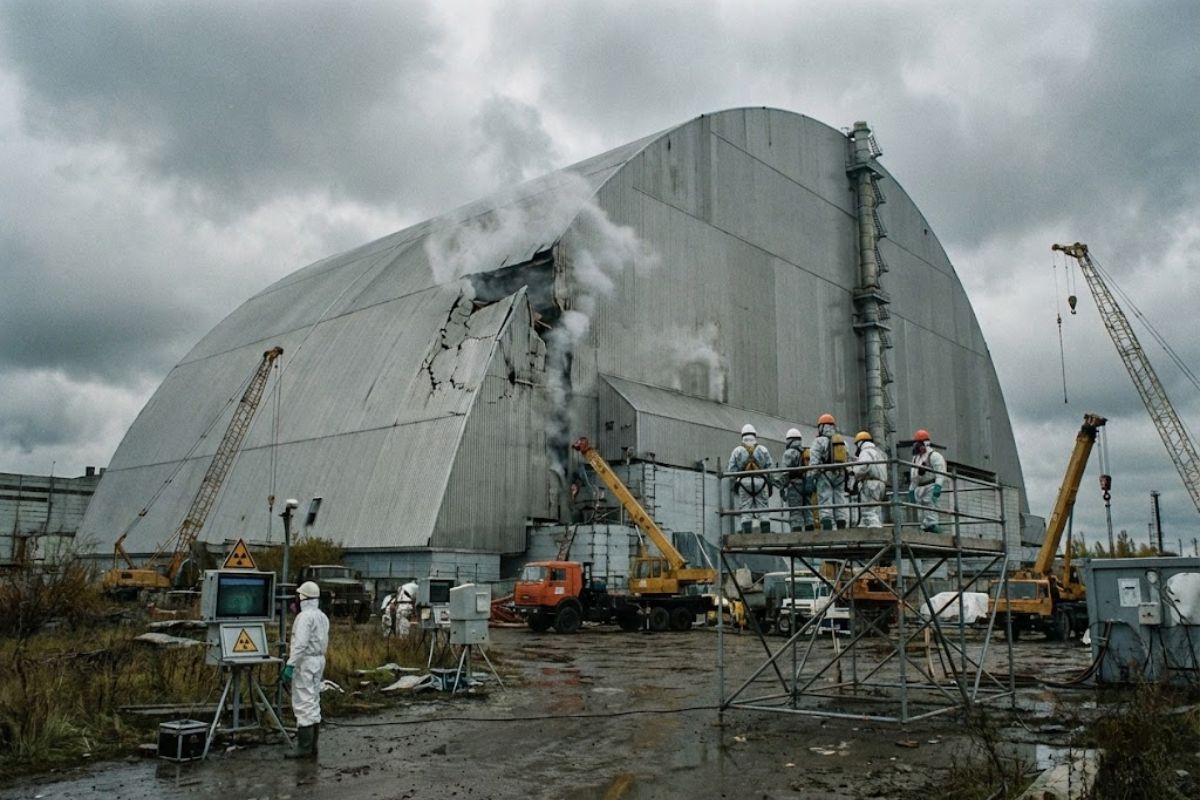
In Statement On December 5, 2025, The IAEA Stated That The Chernobyl Shield Hit By Drone In February Lost Safety Functions Of The New Safe Confinement, Including Radiation Confinement In Reactor 4, And Urgently Requested Permanent Repair To Prevent Escape In The Contaminated Region, According To Tests
On December 5, 2025, the IAEA reported that the Chernobyl shield is no longer able to fulfill the confinement function after severe damage caused by a drone in February 2025, compromising the protection installed over the reactor 4.
The agency stated that the New Safe Confinement, structured to reduce the release of radiation from reactor 4, has lost core safety functions. Ukraine attributed the drone attack to Russia, which denied responsibility, and the IAEA has begun to demand urgent reform.
What The IAEA Declared About The Loss Of Safety

The IAEA stated that the Chernobyl shield lost its main safety functions, including the containment capability.
-
American company drills a 1,830-meter hole in Kansas using oil well technology, places a nuclear reactor inside, and claims it will generate electricity without any cooling tower.

-
Canada invests more than 2 billion dollars to upgrade an old nuclear laboratory and try to rival the world’s major atomic energy powers.
-
Nuclear company backed by Bill Gates partners with Hyundai for next-generation 345 MW nuclear reactor

-
Russia is sailing all 8 nuclear icebreakers of its fleet simultaneously for the first time in history, as the Arctic freezes two weeks earlier than expected.




In the technical assessment communicated on December 5, 2025, the damage caused by the drone in February compromised the performance of the New Safe Confinement, a structure known as NSC (abbreviation in English).
The alert from the IAEA was issued after tests and investigations conducted since the drone attack.
According to the agency, the priority is to restore barriers capable of reducing the release of radiation from reactor 4 and preventing particles from reaching the atmosphere and already contaminated areas.
How The New Safe Confinement Was Planned For Reactor 4

The New Safe Confinement was built to replace the initial protection erected shortly after the disaster in April 1986.
In 2016, the IAEA had recommended to the Ukrainian government the construction of a new Chernobyl shield around reactor 4, with the aim of allowing safer access for workers and enabling the dismantling of what remained of the reactor.
Until the drone attack in February 2025, the Chernobyl shield had been functioning as an additional barrier to keep radiation confined.
The IAEA indicated that, with the structural integrity compromised, the risk is now the increased escape of radiation, especially under conditions that favor dispersion.
What Is Still Unknown About The Radiation That May Be Leaking

The IAEA stated that it has not yet determined the amount of radiation that may have been released after the damage.
The absence of this number does not eliminate the assessment of functional failure, the agency asserts that the Chernobyl shield no longer guarantees the necessary level of confinement in reactor 4.
In practice, this makes monitoring more critical and requires engineering planning focused on scenarios of gradual release.
The IAEA also highlighted that localized work has been done on the Chernobyl shield, but that the moment requires a more definitive intervention to restore the containment function of radiation.
Urgent Reform Demand And What May Change In The Short Term
The IAEA called for urgent reforms to the Chernobyl shield to restore its safety functions.
The focus is on reconstituting the containment capacity and reducing vulnerabilities that allowed a drone to damage the New Safe Confinement.
In addition to physical works, the agency advocated for the suspension of attacks in the area of the complex to avoid new impacts on reactor 4 and areas with radioactive waste.
The goal, according to the IAEA, is to prevent the war from exacerbating the risk of radiation in the region and increasing contamination.
Nuclear Risks In War And The Expanded Alert For Zaporiyia
The IAEA used the case of the Chernobyl shield to reinforce alerts about fighting near nuclear facilities.
The agency noted that the former Chernobyl plant, now out of operation, was occupied by Russian forces at the beginning of the invasion and then returned to Ukrainian control, leaving the surroundings exposed to attacks by drones and other incidents.
The agency also mentioned the Zaporizhia plant, described as the largest nuclear power plant in Europe, as another sensitive point in the conflict.
For the IAEA, the pattern of attacks and counterattacks near nuclear infrastructure increases the likelihood of damage and raises the risk of the release of radiation.
Monitoring the upcoming technical communications from the IAEA and any repair reports of the Chernobyl shield is the most direct path to measure the evolution of risk in reactor 4 and the effectiveness of the proposed reforms.
Do You Believe That The IAEA‘s Demand For Urgent Reform Of The Chernobyl Shield Will Be Met In Time To Reduce The Risk Of Radiation In Reactor 4?




-

1 person reacted to this.