Portuguese
  Spanish


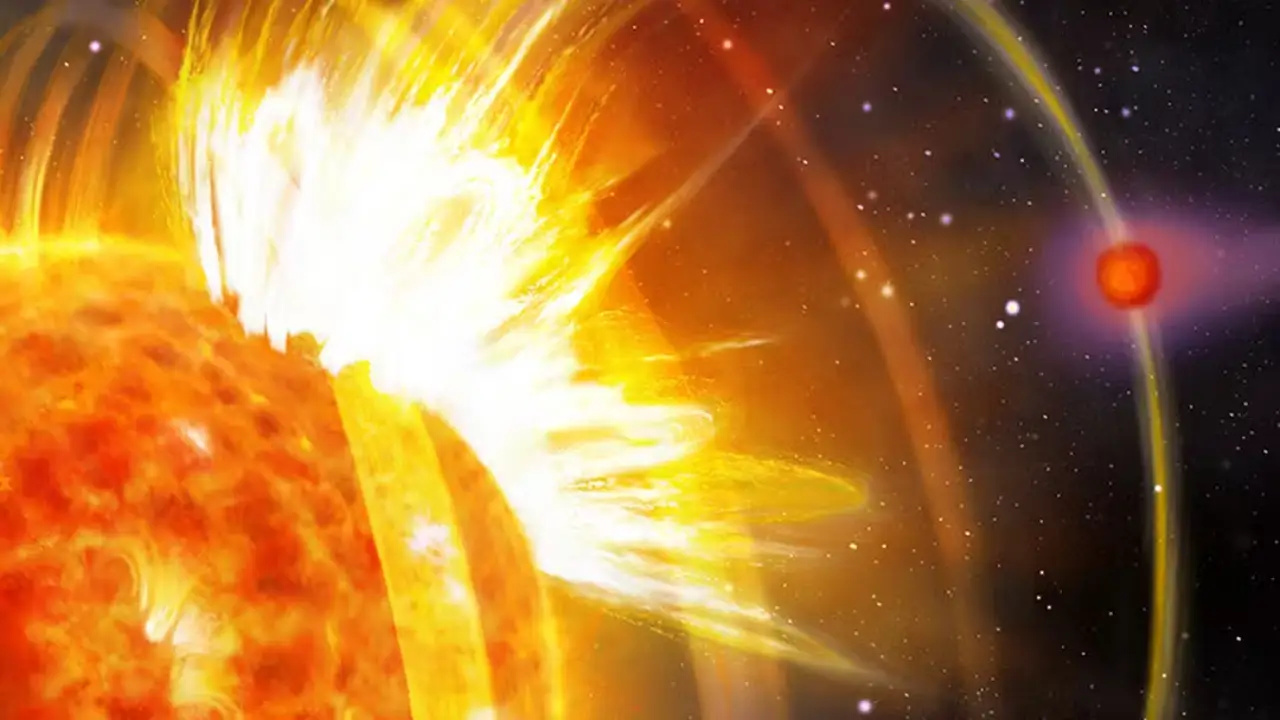

Scientists Find a Star That “Died” Twice in Space! A Supernova That Won’t Give Up! See How SNR 0509-67.5 Exploded Twice and Is Helping Scientists Understand the Universe in Astronomy
This cosmic feat, captured by the Very Large Telescope in the Atacama Desert, in Chile, is shaking up the astronomy world. The discovery, made by the European Southern Observatory (ESO), is not just a stunning image to decorate your desktop but a key to understanding how the universe expands. Let’s dive into this incredible phenomenon called “twin eruption” and find out why it’s turning heads among astronomers!
The Remnants of a Star Called SNR 0509-67.5
Scientists found something unique while studying the remnants of a star called SNR 0509-67.5, located an impressive 60,000 light-years from Earth, in the Large Magellanic Cloud. This supernova, which exploded about 400 years ago, left behind two concentric rings of calcium, like clues from a cosmic crime. Normally, type Ia supernovae, violent explosions of white dwarfs, happen once and that’s it. But this star decided to repeat, in a rare event called a twin eruption.
“We had never seen a type Ia supernova with such clear evidence of two explosions,” said astronomer David Jones from ESO in a statement to Nature Astronomy. The study, published in the prestigious journal, is helping to answer a question that intrigues astronomy: what makes these supernovae explode?
-
Coastal City in Rio de Janeiro Faces Slow Destruction as Sea Claims 500 Homes and Businesses

-
48-Year-Old Woman Wins Million-Dollar Prize, Gifts Neighbor First International Trip as Thanks for Years of Support

-
Women Once Mocked for Collecting Trash Form Group to Turn Organic Waste into Compost, Generate Daily Income, and Improve Market Cleanliness in One of the World’s Lowest GDP per Capita Countries
-
Archaeologists Uncover 40,000 Roman Bronze and Copper Coins from the 3rd Century in Fire-Destroyed French Neighborhood



A Cosmic Show That Defies the Laws of Astronomy
Type Ia supernovae generally occur when a white dwarf, a star that has already “died” and turned into a dense shell, starts sucking material from a companion star. When it accumulates enough matter, reaching the so-called Chandrasekhar limit (about 1.4 times the mass of the Sun), it explodes in a devastating thermonuclear reaction, illuminating space like a cosmic lantern. This consistent brightness of type Ia supernovae is so reliable that scientists use them as “cosmic rulers” to measure distances in the universe and calculate its rate of expansion.
But SNR 0509-67.5 broke the rules. Using the MUSE instrument of the Very Large Telescope, astronomers noticed something strange: shock waves in a shell shape and two calcium rings. “The rings suggest that the initial explosion did not completely destroy the white dwarf. Instead, it accumulated helium from a neighboring star, which detonated a second, even more powerful explosion,” explains astrophysicist Loredana Vetere from ESO in an interview with BBC Science.
The Star That Defied Death: A Spectacle of the Twin Eruption
So, how did this star achieve this feat? Scientists believe that after the first explosion, the white dwarf “stole” helium from a companion star. This highly flammable helium triggered a shock wave so intense that it made the star’s core, which was already “dead,” explode again. The most surprising part? This second explosion happened without the white dwarf reaching the Chandrasekhar limit, defying what astronomers thought they knew about type Ia supernovae.
This discovery, detailed in Nature Astronomy, suggests that white dwarfs may be more versatile than we imagined. “This changes our view of how these explosions happen and may impact calculations about the expansion of the universe,” highlights Vetere.
The Universe Is Expanding Faster and Faster
Type Ia supernovae are crucial for astronomy because they explode with such predictable brightness that they serve as markers for measuring cosmic distances. These measurements help calculate the rate of expansion of the universe, a number that has intrigued scientists for decades. Recently, studies like those from the Hubble Space Telescope and the James Webb Space Telescope have confirmed that the universe is expanding faster than expected, and discoveries like the twin eruption may clarify why.
“If white dwarfs can explode in different ways, we need to recalibrate how we use these supernovae to measure space,” says cosmologist Adam Riess, Nobel Prize winner in Physics in 2011, in an interview with Scientific American. The twin eruption of SNR 0509-67.5 is a new piece in this cosmic puzzle.
What did you think of this discovery? Leave your comment below or share this article to spread the fascinating story of this supernova that didn’t give up shining!