Portuguese
  Spanish


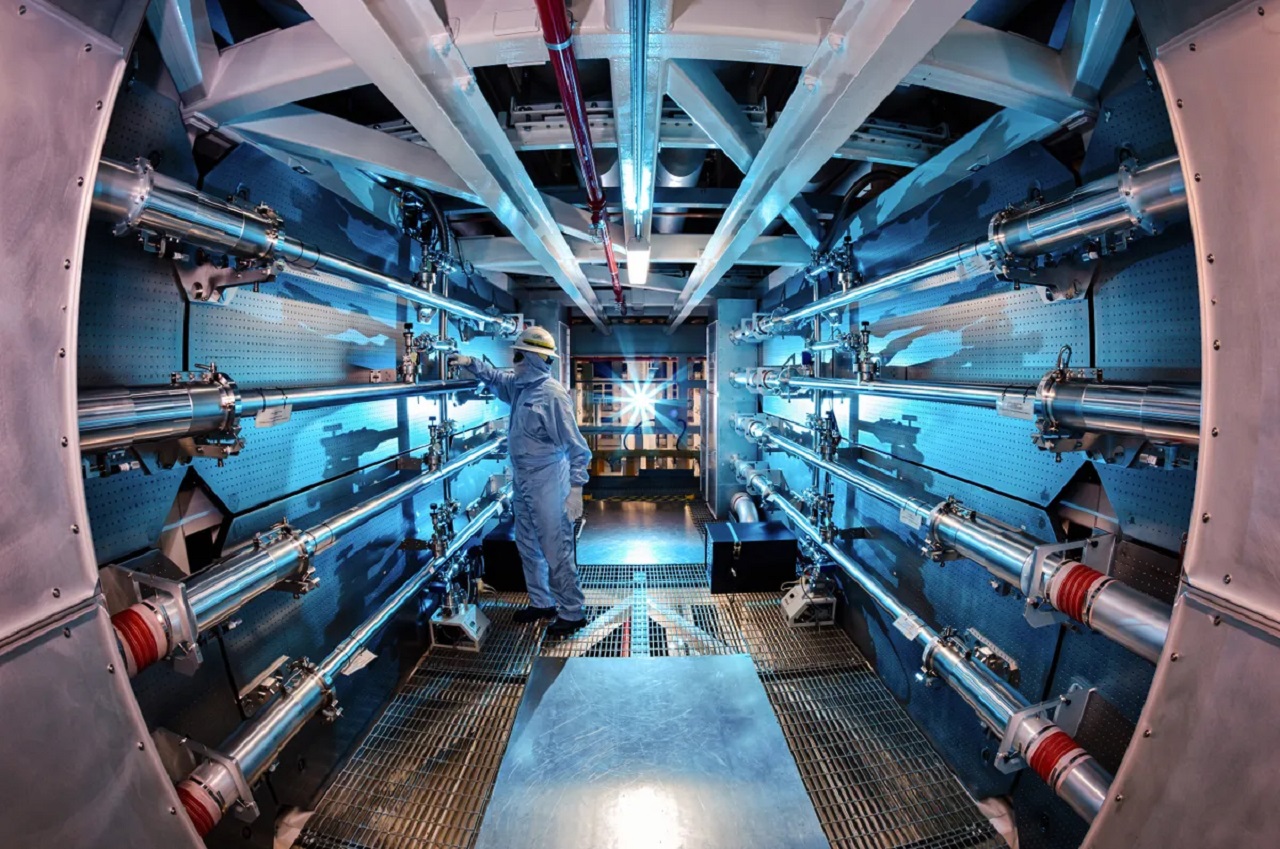

The U.S. Is Advancing with Its First Nuclear Fusion Tests That Promise to Generate More Clean Energy Than the System Consumes. However, It Is Still Early for the “Artificial Sun” to Power Homes.
The U.S. Department of Energy announced on Tuesday (13) that it successfully conducted the first nuclear fusion experiment in history that generated more electricity than the system itself consumed. This news is seen as a breakthrough in clean energy production. Unlike nuclear power plants, which operate through nuclear fission, involving the splitting of heavy atoms to generate energy, nuclear fusion involves joining light atoms, with a small portion of their mass being converted into pure energy, functioning like an “artificial sun”.
New U.S. Project Is an Unprecedented Achievement for the Clean Energy Sector

This same process occurs inside the Sun and other stars, with the benefit of not generating radioactive waste. However, generating an “Artificial Sun” on Earth still faces several technological and engineering challenges, considering that it is necessary to heat the material to very high temperatures while maintaining the reaction at a stable level for a long period.
Nuclear fusion has been studied for over a century and today is seen as one of the main candidates for clean energy sources in the future, capable of combating climate change and rendering current nuclear plants a thing of the past.
-
In Tasmania, a Beach Features a Natural Stone Mosaic Formed by Earth’s Cracks Millions of Years Ago
-
China’s Artificial Sun Reaches 100 Million Degrees, Six Times Hotter Than the Sun’s Core, Putting Beijing Ahead in the Race for Infinite Energy

-
Steam Machine Converts All Types of Plastic Waste into Durable Building Blocks, Processes Over 90 Tons Monthly, and Is Sold to Municipalities
-
John Deere’s Autonomous 9RX Tractor Uses 16 Cameras for 360-Degree Vision, Operates in Short Weather Windows While Monitored by Smartphone


Until now, other reactors around the world had been breaking records for clean energy generation with the “Artificial Sun” for a few seconds but had not yet managed to exceed the amount of energy necessary to ignite nuclear fusion.
The new U.S. experiment took place on December 5 at the Lawrence Livermore National Laboratory (LLNL) located in California. The experiment supplied 2.05 megajoules to the reactor, resulting in an output energy of 3015 megajoules.
U.S. Project Started in 1960
The “Artificial Sun” project in the U.S. originated in the 1960s when LLNL researchers hypothesized that it would be possible to use lasers to induce nuclear fusion in the lab. The research involved creating a series of increasingly powerful laser systems, leading to the development of the National Ignition Facility (NIF), the largest and most powerful laser in the world.
For the development of nuclear fusion ignition, the laser energy is transformed into X-rays inside a small chamber, which then compresses a fuel capsule until it implodes, generating high-temperature and high-pressure plasma for clean energy generation.
According to the researchers, the experiment is historic for achieving an unprecedented balance of kinetic energy, meaning it produced more energy from fusion than the energy used in the laser that ignited it. However, the U.S. department asserts that many advances in technology and science are still necessary before nuclear fusion can generate energy for homes.
Challenges of Nuclear Fusion Energy
The quest for clean energy generation through the same process as stars has led to various overly ambitious predictions that pointed towards a clean energy revolution. Expectations have always been exaggerated, and unmet promises have led public opinion to wane.
Although there is indifference and funding difficulties, researchers in the field are making progress and are expected to eventually solve the significant technical challenges involved in the production process.
This experiment is just a step on a long road to achieving a fusion facility that would operate continuously, generating energy for entire cities. It is easy to see why the field of energy and fusion is subject to high expectations, as the project itself already sounds epic.