






 Portuguese
  Spanish
  3 min of reading
  1 comment


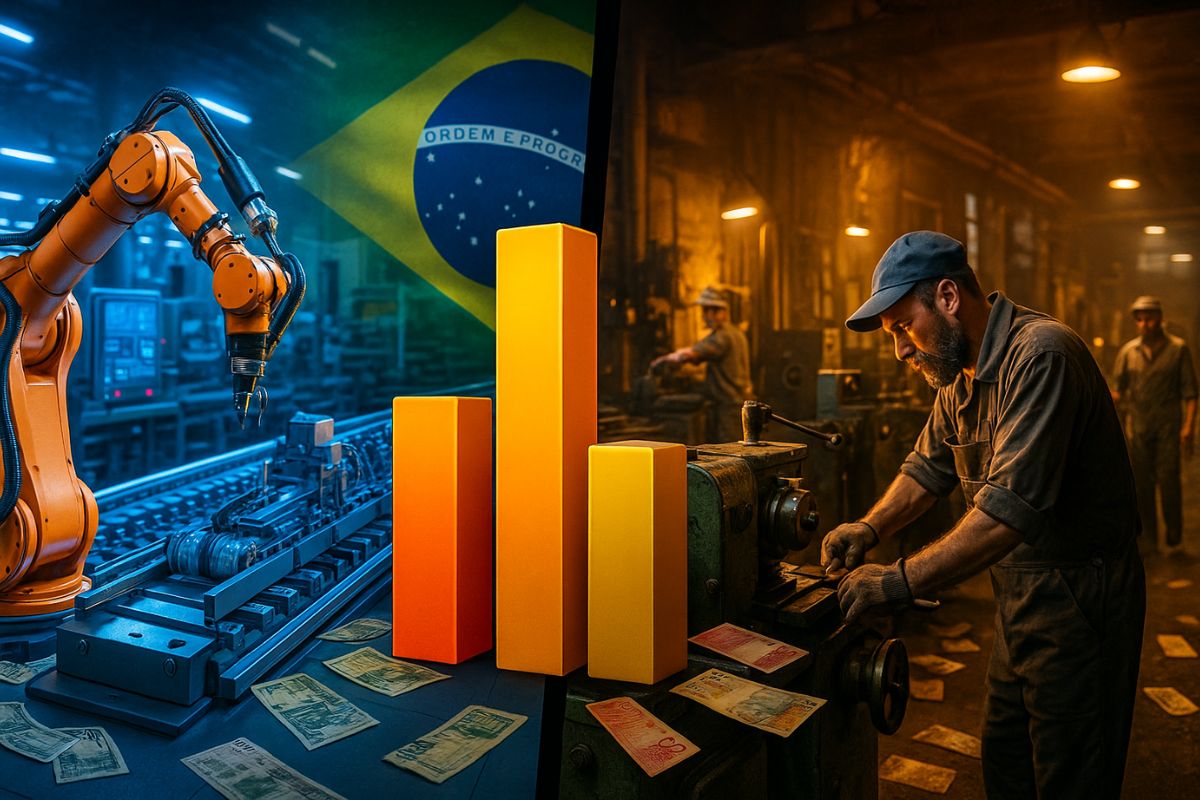

The Productivity Of Multinationals In Brazil Is 15 To 20 Times Higher Than That Of National Companies, But Public Policies Continue To Fund The Less Competitive.
The Brazilian economic debate usually focuses on fiscal adjustment and interest rates, but a piece of data revealed by former Central Bank president Gustavo Franco draws attention to another problem: the low productivity of the national economy. According to surveys from the Foreign Capital Census, conducted every five years by the monetary authority, multinationals in Brazil show productivity up to 20 times higher than that of local companies operating outside of international trade.
Despite this, public policies continue to direct resources to protected and less competitive sectors, instead of stimulating the companies more integrated into global supply chains.
For Franco, this imbalance largely explains Brazil’s lag behind economies that opted for greater trade openness.
-
High Interest Rates and Record Defaults Lead to Surge in Vehicle Repossessions and Crowded Car Auctions in Brazil by 2026

-
São Paulo Offers Over 13,000 Job Openings: Opportunities in Industry, Logistics, and More Across the State

-
Brazil’s BNDES Allocates $65 Million to Fund 85,000 E-Bikes for App-Based Delivery Workers, Offering Purchase Discounts and Leasing Options to Boost Income and Improve Delivery Operations
-
JBS Invests Nearly $160 Million in Texas Megaproject to Expand Beef Production and Operations Through 2027


The Weight of Multinationals in Brazilian GDP
Multinationals in Brazil, whether foreign-controlled or national firms with little international participation, already account for approximately one-third of the country’s GDP.
These companies are responsible for employing thousands of workers in strategic sectors and for spreading management practices and technology that enhance efficiency.
However, even with this relevance, government incentives continue to prioritize less productive sectors, often reliant on subsidies and protectionist barriers.
This limits the country’s ability to modernize its economy and to compete on equal footing with other emerging nations.
The International Comparison That Highlights Brazil’s Delay
An example cited by Gustavo Franco is the case of South Korea. In the 1960s and 1970s, Brazil and the Koreans had similar per capita income, about 15% of the American average.
Today, Korea has reached nearly 67% of U.S. income, while Brazil remains around 17%, practically stagnant for half a century.
The central difference lies in strategy: while South Koreans bet on openness, innovation, and productivity, Brazil maintained a model of protection for traditional sectors, without fully integrating its companies into global value chains.
The Risk of Insisting on the Losing Sectors of Globalization
The diagnosis is clear: without redirecting investments and labor to the most dynamic sectors, the country will remain trapped in cycles of low growth.
For economists, insisting on funding inefficient industries means wasting resources that could be applied to areas with greater economic and technological impact.
The consequence is the perpetuation of the so-called “Brazil cost,” which includes bureaucracy, low productivity, and loss of external competitiveness.
Meanwhile, countries that invest in innovation and international integration are advancing rapidly in income and human development indicators.
The Future of Brazil in Light of Productive Choices


The warning from Gustavo Franco reinforces the need for Brazil to revisit its economic priorities. Supporting multinationals in Brazil and companies integrated into global trade might be the way to unlock growth, raise wages, and broaden the country’s presence in international supply chains.
And you, do you think Brazil should change its strategy and better support productive sectors linked to globalization, or do you consider it important to continue protecting traditional industries? Share your opinion in the comments — your perspective is essential in this debate about the future of the Brazilian economy.





Sim. Gustavo Franco tem razão. Não é só isso. O financiamento direcionado a setores que não produtivos e para empresas se modernizarem, mas isso não acontece, tem que acabar.