






 Portuguese
  Spanish


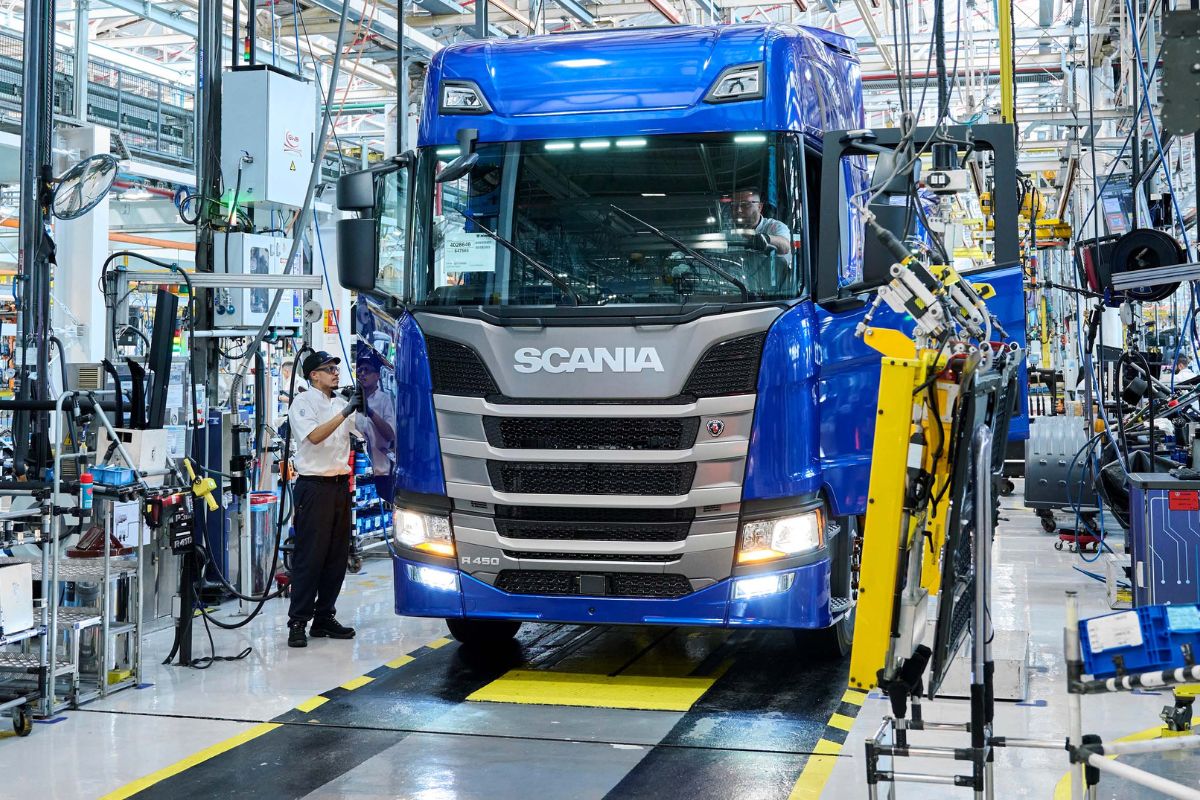


In the Scania Factory, 160 tons of sheet metal become daily structures with modular chassis, complex cabins, and complete heavy trucks, while painting robots apply multiple layers and 4×2 to 10×6 axles are tested in brakes, engines, and dynamometers before arriving to the demanding customer at every validation stage.
In 2025, the Scania factory in Europe consolidates an industrial model in which 160 tons of galvanized sheet metal per day are transformed into structures capable of supporting up to 48 tons of cargo, with any type of implement, from dump trucks to concrete mixers. Production starts in the chassis workshop and progresses through cabins, painting, final assembly, and testing until the truck crosses the quality line.
Throughout a chain that integrates units in Oskarshamn, Meppel, Zwolle, Angers, and Södertälje, the Scania factory combines modular construction, high robotization, and successive inspections to ensure that each vehicle delivered to the customer has 4×2 to 10×6 axles, Euro 6 engines, and validated pneumatic brake systems in roller dynamometers and test tracks.
From Sheet Metal to 48-Ton Modular Chassis

In the first production workshop, the Scania factory assembles the structure that will be the truck’s base.
-
At 17, she hand-painted her first watercolor design for school uniforms; her brand grew without investors, sold 135,000 pieces, and aims for $3 million in revenue by 2026.

-
Shell Discovers Intact Early 19th-Century Wooden Shipwreck in the Gulf of Mexico at Over 1,300 Meters Deep
-
Brazilian Entrepreneur Turns Door-to-Door Jewelry Sales into a Family Business Empire with Over 70 Stores

-
$75 Million Bridge in Brazil Opens to Connect Cities, Create Jobs, and Cut Travel Time from 30 to 2 Minutes; Spanning 1.24 km, It’s Among the Country’s Largest and Ends Decades of Ferry Queues.




This is where chassis with a load capacity of up to 48 tons are born, prepared to receive any type of bodywork, including dump trucks and vehicles for severe operations.
The side rails, crossmembers, and supports are assembled from sheets that arrive in large rolls.
These elements form a modular chassis in which the various configurations originate from the same components, which reduces complexity, facilitates maintenance, and standardizes global quality.
Still in this initial phase, each structure undergoes dimensional and visual inspections, as any deviation directly impacts subsequent assembly.
In the second stage, wires, hydraulic hoses, cables, and valves are positioned on the inside and outside of the structure.
The main elements of the brake and suspension systems are installed on the chassis, forming the backbone of the heavy trucks.
The brakes receive a two-circuit system, entirely pneumatic, with anti-lock and the possibility of electronic distribution of braking forces, when the customer specifies this package.
Cabins with 310 Pieces and 160 Tons of Sheet Metal per Day

The cabin unit in Oskarshamn, Sweden, is the structural heart of the Scania factory.
Daily, about 160 tons of galvanized sheet metal enter the press workshop, where they are cut and stamped into approximately 200 different types of parts.
Each cabin is formed by about 310 distinct metal plates, which are welded into subassemblies and then joined in the final bodywork.
Highly articulated welding robots form automated cells that resemble an industrial ballet.
These robots are programmable and capable of learning new welding routines, adjusting movements and junction points according to the model or cabin specification.
The result is a robust metal structure, designed to protect the driver and reduce damage to others in the event of an accident.
Next, the cabins move to the painting workshop. In automated lines, each piece receives multiple layers of paint, applied almost entirely by sophisticated spray robots.
The process utilizes an advanced paint distribution system, which sends the exact volume to 22 painting robots, through pipes that function like a pneumatic tube, reducing waste and ensuring color and thickness repeatability.
Automated Painting and Piece-by-Piece Inspections
Before receiving paint, the cabins and components are hung on metal structures, washed in high-pressure systems, dried, and cooled.
Only then do they enter the painting booths, where robots apply base, color, and varnish layers, in up to one of 500 color shades requested by the customer.
After application, the assemblies go through a curing oven and cooling zone.
Visual inspection is done piece by piece, looking for micro-defects, coverage failures, dust spots, and any scratches.
Small corrections are made immediately by specialized employees, so that only cabins within standard proceed to the finishing assembly.
In the Meppel factory, responsible for plastic coverings, front panels, and external details, the painted and plastic components are combined with precision.
The alignment of grille, bumpers, and decorative elements is millimeter-perfect, as any misalignment appears in the customer’s final perception.
At the end of this stage, the assembled cabins are logistically ordered for the final truck assembly lines.
Euro 6 Engines and Axles from 4×2 to 10×6
Next in the flow, the Scania factory installs the engine onto the chassis.
The engine and gearbox assemblies arrive pre-assembled and are supported on special mounts with anti-vibration insulation, reducing noise and protecting the structure.
Radiator, battery compartment, drive shafts, stabilizer bar, and exhaust system are integrated in this same phase.
The range of engines allows the customer to choose different levels of power and torque, always within the Euro 6 environmental standards, focusing on high torque at low RPM, suitable for heavy road and off-road transport work.
Engineering also anticipates versions with all-wheel drive and gearboxes adapted to different ground clearance heights.
In the next workshop, axles and wheel hubs are installed. The customer can specify trucks with one or two front axles and multiple rear axles, in wheel formulas ranging from 4×2 to 10×6.
The correct weight distribution, combined with additional reinforcements when there are two front axles, reduces tire wear, improves drivability, and decreases transport costs over the vehicle’s lifespan.
Final Assembly, Dynamometer Testing, and Quality Control
In the final assembly, the cabin is positioned over the chassis by equipment resembling an eagle, suspended over the line, making this stage one of the most iconic at the Scania factory.
The fit between cabin and chassis is done with fine control of height, setback, and fixation points, to ensure internal ergonomics and correct weight distribution.
Next, wheels, large-capacity fuel tanks, batteries, and all necessary technical fluids are installed.
Hydraulic cranes, controlled torque wrenches, and time-limited workstations protect operators from loads and repetitiveness while ensuring the correct tightening of nuts and bolts.
With the truck assembled, the testing phase follows.
The vehicle enters a roller dynamometer, where the first start and programming of the electronic modules take place.
Initial and working pressure, brake circuit operation, and actuator response are measured.
Then, the truck undergoes additional technical tests, with adjustments to camber, headlights, tachograph, and auxiliary systems.
A pre-sale specialist then conducts a road test in an open area, evaluating gear changes, performance of the electrical system, hydraulic system, and dynamic behavior.
Only after a new detailed external inspection, checking for gaps, scratches, leaks, and fixations, does the truck return to the quality control department, which authorizes release or requires rework whenever a requirement is not met.
Logistics, Modularity, and Customization
Producing a truck is inseparable from internal logistics.
Each cabin, panel, wiring harness, and axle group is delivered to the line in the exact order they will be assembled, to avoid stops and rework. This requires synchronization between Oskarshamn, Meppel, and the final assembly plants in Zwolle, Angers, and Södertälje.
The modular chassis allows the Scania factory to install various implements as requested by the customer.
The same structural set can receive a dump body, concrete mixer, equipment for transporting wood, or waste collection systems, preserving standardized fixation points and ensuring that dynamometer and track tests represent the real working condition.
At the end of the process, each truck leaves the line with a complete history of inspections, adjustments, and measurements.
The philosophy is to launch the vehicle on the road only after exhausting the testing limit in the factory itself, to reduce failures in the field and preserve the brand’s image of robustness in heavy transport.
In light of all this engineering concentrated in a single line, if you could visit the Scania factory for a day, would you prefer to witness the pressing of the cabins, the action of the painting robots, or the final tests on the dynamometer?





Bom dia, seria o máximo acompanhar todas as etapas, já que sou carreteiro a 30 anos, trabalho em um Scania G-450, porém se tivesse que escolher escolheria acompanhar o processo de pintura.