






 Portuguese
  Spanish


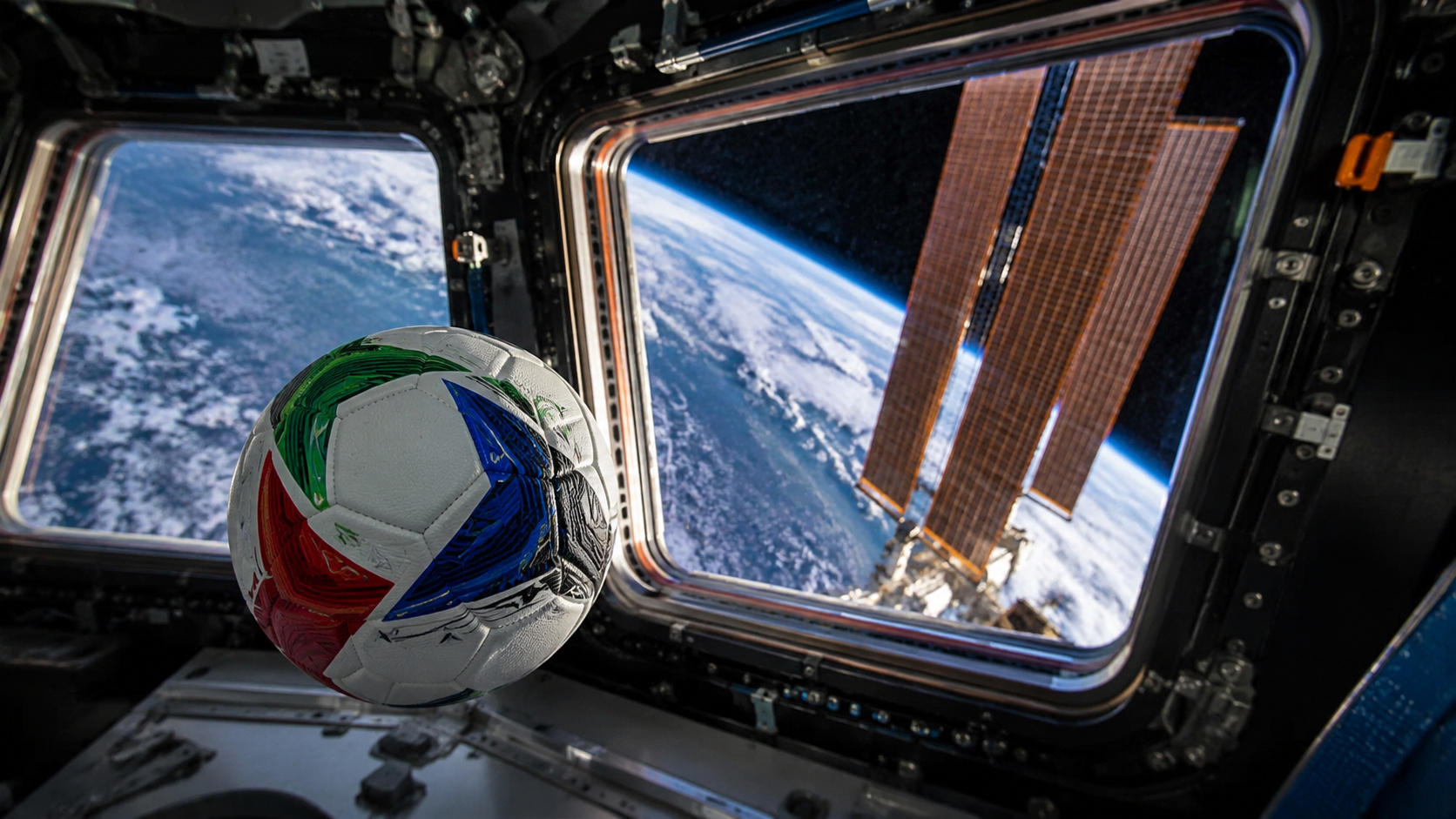

Experiments on the International Space Station show how mass distribution, rotation, aerodynamics, and electronic sensors influence the behavior of soccer balls.
The NASA connected the 2026 World Cup to space exploration by releasing research on the physics of soccer balls.
The studies involve demonstrations on the International Space Station and aerodynamic analyses conducted at the agency’s terrestrial facilities.
On June 8, 2026, NASA resumed the release of experiments related to microgravity, electronic sensors, and the internal balance of the balls.
-
World’s Largest Container Ship Departs Shanghai with 24,000 Containers, Set to Debut in Europe in July

-
Qatar Commissions World’s Largest Gas Ship, a 344-Meter Giant Now Under Construction
-
Expert Challenges Alarmism Over El Niño in Brazil: Atmosphere Yet to Respond to Warm Pacific, Advises Farmers Against Selling Cattle or Delaying Planting Before September
-
In a Degraded Atlantic Forest Area, a São Gonçalo Resident Transforms Land into a Living Eco-Museum, Now a Model for Environmental Education


The initiative accompanied the World Cup held in the United States, Mexico, and Canada, between June 11 and July 19, 2026.
The balls used in the space experiments, however, were sent to the orbital laboratory in 2019, not during the 2026 tournament.
Space experiment reveals the effects of microgravity
The research was developed in partnership with the International Space Station National Laboratory.
According to NASA, the microgravity environment allows for the observation of certain movements with less interference from conditions present on the Earth’s surface.
Astronauts can, in this way, analyze more clearly the stability, rotation, and internal balance of the equipment.
The relationship between the geometric center and the center of mass also directly affects the ball’s movement.
An irregular concentration of weight, consequently, can cause oscillations and less predictable movements.


Mass distribution interferes with the ball’s rotation
In May 2026, astronaut Jessica Meir participated in an educational activity about the physics of soccer.
During the demonstration, balls with different mass distributions were moved inside the International Space Station.
A balanced ball thus exhibited a more regular and smooth rotation.
Models with unevenly distributed weight, on the other hand, demonstrated greater instability during movement.
Balanced mass distribution represents, according to NASA, one of the most important tests of engineering applied to sports equipment.
Electronic sensors can alter performance
Since 2022, electronic sensors have been integrated into official balls used in major international competitions.
These components allow for the recording of relevant data, such as:
- ball speed;
- position during the match;
- moments of contact with players;
- information used by referees;
- data used in sports broadcasts.
However, electronic devices add weight to the interior of the equipment.
The positioning of these components needs, therefore, to be carefully planned to avoid changes in rotation and trajectory.
Space experiments have expanded, according to NASA, the understanding of the effects caused by these technologies.
The conclusions also contributed to evaluations of balls intended for major international tournaments.

NASA analyzed the Brazuca in a wind tunnel
Research related to soccer was also conducted at the agency’s terrestrial facilities.
On June 12, 2014, engineers at the Ames Research Center released tests conducted with the Brazuca.
The ball used in that World Cup was placed in a wind tunnel in California.
Specialists observed, in this way, how the air circulated around the panels, seams, and surface of the equipment.
The texture, panel shape, and seam depth directly influence the trajectory, according to NASA.
These characteristics determine whether the ball can curve, dive, or maintain a more stable direction.
Kicks with little rotation can still generate unstable airflows and cause unexpected changes during flight.
World Cup brings space science and football closer
During the 2026 World Cup, NASA also promoted public activities related to space science.
On June 20, 2026, members associated with the Artemis mission participated in the pre-game program between the Netherlands and Sweden in Houston.
The popularity of football was used by the agency to present scientific research to the public.
The initiative simultaneously showed how studies conducted in space help explain phenomena observed during a match on Earth.
Nominal sources: NASA, Johnson Space Center, Ames Research Center, and International Space Station National Laboratory.
Did you imagine that such small sensors could alter the rotation and trajectory of a ball? Share your opinion!


