






 Portuguese
  Spanish
  6 min of reading
  0 comments


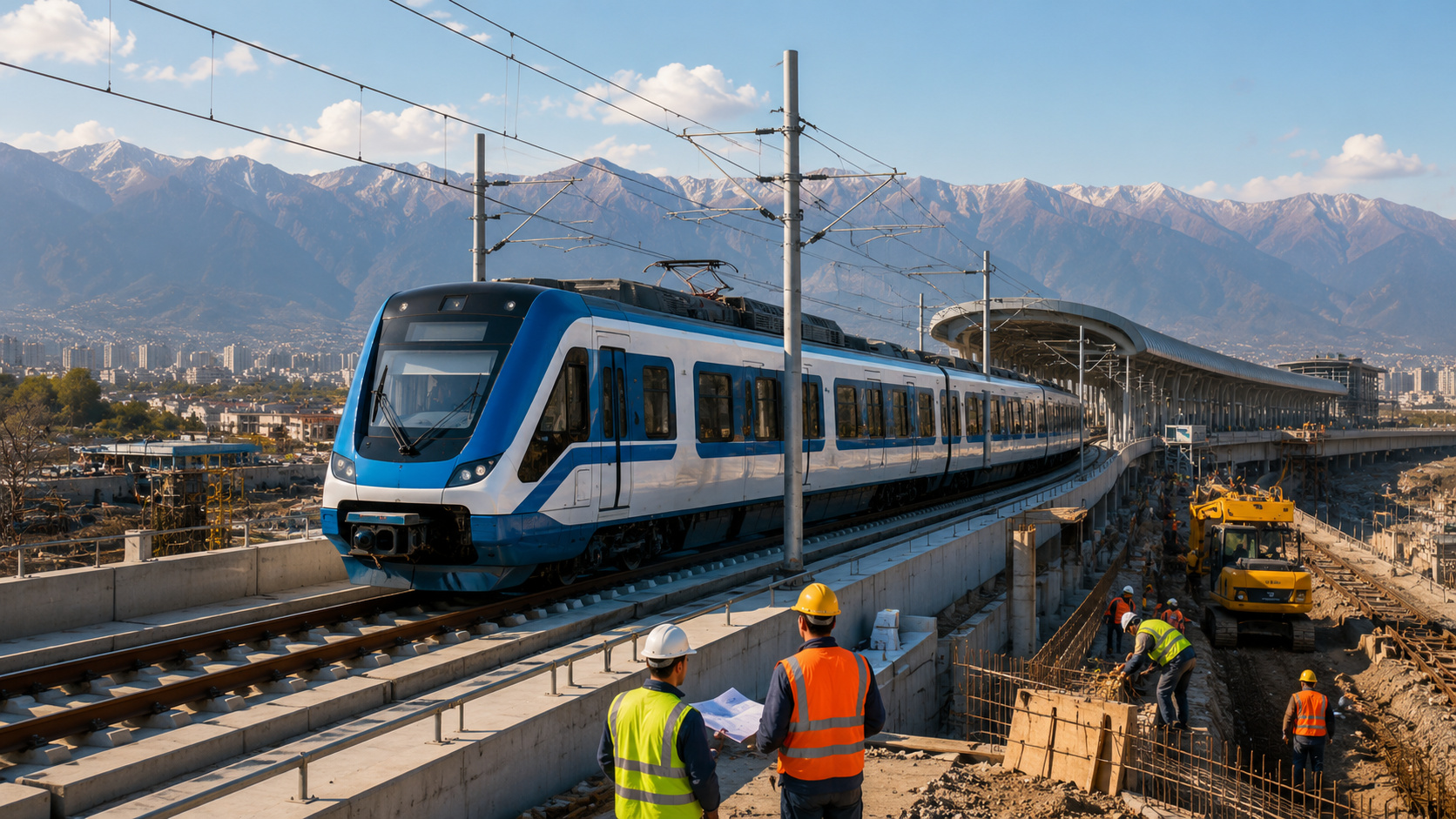
Chile hands over to China the largest suburban railway project in its history, with the Santiago-Batuco line, an investment of US$ 950 million and operation scheduled for 2030.
According to Railway Gazette International, EFE Trenes de Chile, the Chilean state railway company, signed on August 25, 2025 the largest civil and railway works contract in its history. The agreement provides for US$ 470 million for the consortium Constructora Gran Andes SpA, formed by China Railway Construction Corporation, CRCC, and its subsidiaries CR22 and CRCEB.
The project is the reconstruction of the Santiago-Batuco suburban line, with 26 km, connecting the north of the Metropolitan Region to the center of the capital in 24 minutes, compared to the 90 minutes the journey takes today by car. The line is expected to transport 35 million passengers per year when it enters operation in 2030, with six stations, seven railway bridges, two passenger tracks, and one freight track.
China dominates the Chilean railway market with CRCC, CRRC, and China Railway International Group
CRCC did not enter Chile only through the Santiago-Batuco project. The company has already participated in the construction of Lines 5, 6, and 7 of the Santiago metro, the most used transportation system in the country, consolidating its presence in strategic civil works in the Chilean capital.
-
Norway will excavate 3 million cubic meters of rock to open a 1,700-meter maritime tunnel, where ships will pass through a mountain in 10 minutes, escaping a stretch that has killed more than 30 people since 1900.

-
How much does it cost to build a sidewalk with interlocking pavement in 2026? See the average construction prices and the most common extra expenses that can increase the final budget.

-
Blocks made of salt challenge traditional construction, emerging from salt flats and salt pans like translucent stone, shining in hotels and pavilions in the desert, and transforming a material that melts in humidity into an extreme symbol of an impossible mineral architecture.

-
Young architect decides to renovate his grandfather’s 1960s kitchen, avoids erasing a lifetime of memories, and transforms the space while preserving 85 years of family history.



In March 2026, the China Railway International Group won the contract of US$ 101 million to design, supply, and install the electrical and traction systems of the Santiago-Batuco and Santiago-Melipilla lines, including the SCADA supervision and control. This expanded the Chinese presence from physical infrastructure to the technological layer of railway operation.


The trains are also Chinese. CRRC Sifang has a contract of US$ 171 million with EFE to supply 32 three-car compositions, with a maximum speed of 140 km/h and capacity for 800 passengers per composition.
In practice, the new suburban network of Santiago now depends on Chinese companies for construction, electrification, rolling stock, and control systems.
How China advanced in the metro and trains of Chile without drawing attention
Chile operates one of the most modern metro networks in Latin America. Santiago has 7 lines, more than 130 stations, and train frequency comparable to that of European capitals. For decades, expansion contracts were mainly contested by European and Japanese groups, such as Alstom, Siemens, and Kawasaki.
The change happened gradually. CRCC won the first civil construction contracts on the most recent lines of the Santiago metro by competing with prices below those of Western rivals and with competitive delivery schedules.

The logic is known: first the company enters through civil construction, then expands its presence to equipment, systems, and higher value-added stages.
The electrification contract won by China Railway International Group in 2026 shows exactly this movement. The parallel with Bogotá is direct. In the Colombian case, Chinese companies not only build but also operate and maintain systems for decades. In Chile, the operation has not yet been transferred, but the railway supply chain is almost entirely in China’s hands.
Santiago-Batuco Line of US$ 950 million will have surface and underground sections
The complete project of the Santiago-Batuco line has an estimated cost of US$ 950 million. This amount is divided into two sections with different technical challenges and separate contracts, which helps explain why several Chinese companies appear in different stages of the work.
The first section is the surface part, covered by the US$ 470 million contract of CRCC. It goes from the Rio Mapocho to Batuco and reuses an existing freight line that will be rebuilt to receive high-frequency suburban operation. This stage includes track duplication, construction of six stations, seven new bridges, and elimination of level crossings.
The start of surface works was scheduled for December 2025, and the delivery of the first segment, from Batuco to Quilicura, with integration to Line 3 of the metro, is projected for 2030. This stage is crucial for transforming a freight corridor into a high-capacity metropolitan passenger connection.
Subterranean section of Santiago-Batuco reveals new dispute between Chinese companies
The second section is the underground stretch, which connects the Rio Mapocho to Quinta Normal, in downtown Santiago.
This segment will be 3.2 km and includes two underground stations, one on the future Line 7, at Matucana, and another at Quinta Normal, where a station built in the 1990s was never equipped.
The estimated cost of this tunnel is US$ 220 million. The consortium that submitted the lowest bid for the work was formed by China Road and Bridge Corporation, China Railway International Group, and China Railway Tunnel Group.
This shows that the competition has moved beyond just tracks and now also involves tunnels, urban integration, and underground infrastructure.
The opening of these proposals revealed a clear picture of the current competition. Three consortia competed, one Spanish, one Chilean, and one Chinese.
The Chinese group presented the lowest offer. Even with the final decision still pending at the beginning of 2026, the market has already started to consider China as a favorite in the underground stages of Chilean railway expansion.
Santiago-Melipilla line expands China’s railway dominance in Chile
The Santiago-Batuco is not the only major suburban project underway in Chile with dominant participation from Chinese companies. The Santiago-Melipilla line, with 61 km southwest of the capital, is a parallel project of even greater scale and reinforces China’s advance over Chilean railway infrastructure.

The Melipilla line has a total estimated investment of US$ 1.5 billion and will connect Santiago to the municipality of Melipilla, with stations in Maipú, Padre Hurtado, Peñaflor, Talagante, and El Monte. In March 2026, the electrification contract for the two lines, Batuco and Melipilla, was awarded to China Railway International Group in a single package worth US$ 101 million.
The CRRC trains for both projects will have a maximum speed of 140 km/h and a capacity for 800 passengers per train. The first deliveries are scheduled for 2027, before the lines’ inauguration, allowing time for testing, commissioning, and operational preparation before commercial opening.
Chile’s railway project shows how China occupies the entire transport chain
The Chilean case helps explain how Chinese expansion in the international railway sector works. Instead of securing a single isolated contract, companies progressively advance over the entire production chain, starting with civil construction, moving to electrification, rolling stock, digital systems, and in some countries, even operation and maintenance.
When the Santiago-Batuco line becomes operational in 2030, passengers will travel on a train manufactured in China, on tracks installed by a Chinese company, with an electrical system designed by a Chinese company and supervision carried out by Chinese software.
The dominance is not concentrated in one part of the project, but in the complete ecosystem of Santiago’s new suburban infrastructure.
For the European railway infrastructure industry, Chile is becoming one of the clearest examples of how Chinese competition operates in practice. It is not a sudden market takeover. It is a continuous technical, contractual, and industrial occupation that gradually transforms the external supplier into the dominant player of an entire system.
The largest suburban railway project in Chile’s history changes the country’s technological axis
At the August 2025 ceremony, Chile’s Minister of Transport, Juan Carlos Muñoz, stated that the contract represented the concrete start of a project capable of directly impacting citizens.
The statement highlights the social weight of the work, but the most important structural data is another: the largest suburban railway project in Chilean history is being built from end to end by companies from the same foreign country.
When the first train leaves Batuco and arrives at Quinta Normal in 24 minutes, in 2030, it will run on infrastructure mostly shaped by Chinese groups. This includes civil works, electrical supply, railway composition, and supervision systems, consolidating a new technological axis in metropolitan transport in Chile.
The advance of China on Chilean tracks is no longer just a sequence of contracts and starts to represent a change in industrial dependency. What is at stake is not only who builds the line, but who starts to control the technology, equipment, and operational base of the country’s suburban rail transport.







Be the first to react!