Portuguese
  Spanish




For the first time in history, solar and wind energy supplied more electricity than all global demand growth in 2025 — and fossil generation fell for the first time in a century
In 2025, something happened for the first time in the history of renewable energy: electricity generated by solar and wind sources exceeded 100% of all global demand growth.
Furthermore, according to an Ember report published on April 21, 2026, renewables supplied 109% of the increase in demand — leaving enough clean energy for global fossil generation to decline for the first time this century.
In practice, renewable energy not only kept pace with global consumption growth. In this way, it surpassed and began to push coal, gas, and oil backward.
-
El Niño Intensifies: Over 90% Chance of Persisting Until 2027, Raising Ocean Temperatures and Increasing Severe Weather Risks in Southern Brazil, Warns Federal Report

-
NASA Prepares Trio of Small Satellites to Track Tropical Storms and Capture Rapid Rainfall Development from Above the Clouds

-
$7,999 Isaac 1 Robot Aims to Tackle Household Chaos: Folds Clothes, Makes Beds, and Organizes, but Raises Privacy and Cost Concerns with Camera Reliance and Remote Human Assistance
-
Mobile Electron Accelerator Units Enable Safe Testing of Water, Materials, and Industrial Waste Treatment in Countries Without Permanent Labs





The numbers that mark the turning point for renewable energy
Ember’s “Global Electricity Review 2025” report analyzed data from 215 countries, covering 93% of global electricity demand.
Consequently, the data shows that renewable energy generation reached 33.8% of all global electricity in 2025 — a historic record.
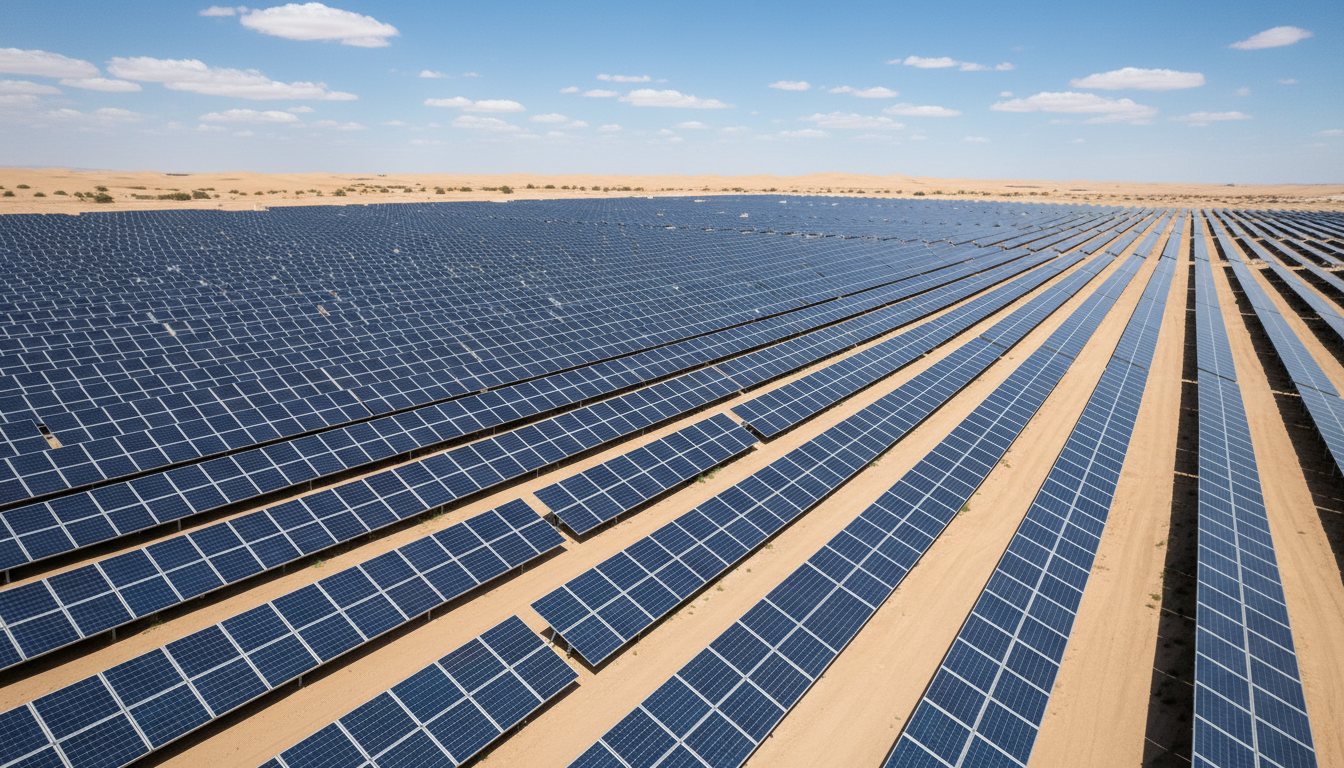
Solar energy led: it grew 30% in a single year and added 600 TWh of generation — the largest expansion ever recorded by any energy technology in a single year.
- Renewables in 2025: 33.8% of global electricity (record)
- Solar + wind: supplied 109% of demand growth
- Solar alone: +600 TWh in 2025 (largest expansion of any source in history)
- Coal: fell below 33% — lowest share in 100 years
- Global installed renewable capacity: 49% of total (almost half)
- Battery additions: 110 GW — surpassed historic record for new gas plants
To get an idea of the scale, globally installed renewable energy reached 49% of all electrical capacity — practically half. In a world of 5,149 GW of renewables, the fossil era is starting to look like the exception, not the rule.
China and India cut fossil emissions at the same time — for the first time
The most surprising data from the report is that China and India — the two most populous countries and historically largest CO₂ emitters in the electricity sector — reduced their fossil generation simultaneously for the first time in history.
China cut 0.9% of its fossil generation. India cut 3.3%.
In comparison, these two countries together represent more than a third of all global electricity demand. Therefore, when both decline at the same time, the impact on the global balance is immediate.
In California, giant batteries already supply 42.8% of electricity when the sun sets — another sign that the transition is accelerating in the largest economies.
110 GW of batteries: the missing piece for renewable energy to work at night
One of the most used arguments against renewable energy has always been intermittency: the sun doesn’t shine at night, the wind doesn’t always blow.
In 2025, the world added 110 GW of batteries — more than any year of new natural gas plants in history.
Furthermore, the cost of batteries fell by 45%, making storage economically viable for the first time on a massive scale.
Consequently, countries like China and Australia already operate grids where solar generates during the day and batteries distribute at night — eliminating dependence on gas as “backup”.

In Latin America, renewable energy grew 2.5 times more than demand
Latin America and the Caribbean performed even more impressively than the global average.
In the region, solar and wind added 39 TWh of generation in 2025 — 2.5 times more than the 16 TWh growth in electricity demand.
In other words, renewable energy in the region not only covered all new demand but also replaced part of the existing fossil generation.
For Brazil, which already has one of the cleanest energy matrices in the world thanks to hydroelectricity, the addition of solar and wind further diversifies the mix — reducing vulnerability to droughts that affect reservoirs.
What this means for those who pay electricity bills
For the end consumer, the advance of renewable energy has direct consequences on their wallet. For example, the more solar and wind enter the system, the less need there is to activate gas and coal thermal power plants — which are more expensive.
In Brazil, this effect is already visible: when reservoirs are full and wind and solar generation is high, the tariff flag turns green — with no additional cost on the bill.
In comparison, European countries that still heavily rely on natural gas saw their energy bills skyrocket during the 2022 crisis. In this way, renewable energy is not just an environmental issue — it’s an economic security issue.
According to Eco/Sapo, the record growth of solar was decisive in curbing demand for fossil electricity in 2025.
Furthermore, the trend directly connects to what is happening in the United States, where 99% of all new electricity capacity in 2026 will be renewable.
The caveats that Ember itself makes a point of highlighting
Despite the historic milestone, the report warns of important limitations.
Firstly, electricity represents only a fraction of total global energy consumption. Transport (ships, planes, trucks) and heavy industry still massively depend on fossil fuels.
Furthermore, the installed capacity of renewable energy (49%) is much higher than the effective generation (33.8%) — because solar and wind do not produce 24 hours a day.
On the other hand, geographical concentration is a concern: China, the US, and the European Union together account for 79.5% of all renewable additions. Developing countries lag behind.
Nevertheless, IRENA Director-General, Francesco La Camera, summarized: “By the end of 2025, renewables represented 49% of global installed electricity capacity and 85.6% of all annual additions.”
According to Ember, solar is expected to surpass nuclear, hydro, and wind as early as 2026, gas in 2031, and coal in 2033 — becoming the largest source of electricity on the planet.
The question remains: if renewables already supply more than all demand growth, how long until fossil fuels are just a memory of the last century?