Portuguese
  Spanish


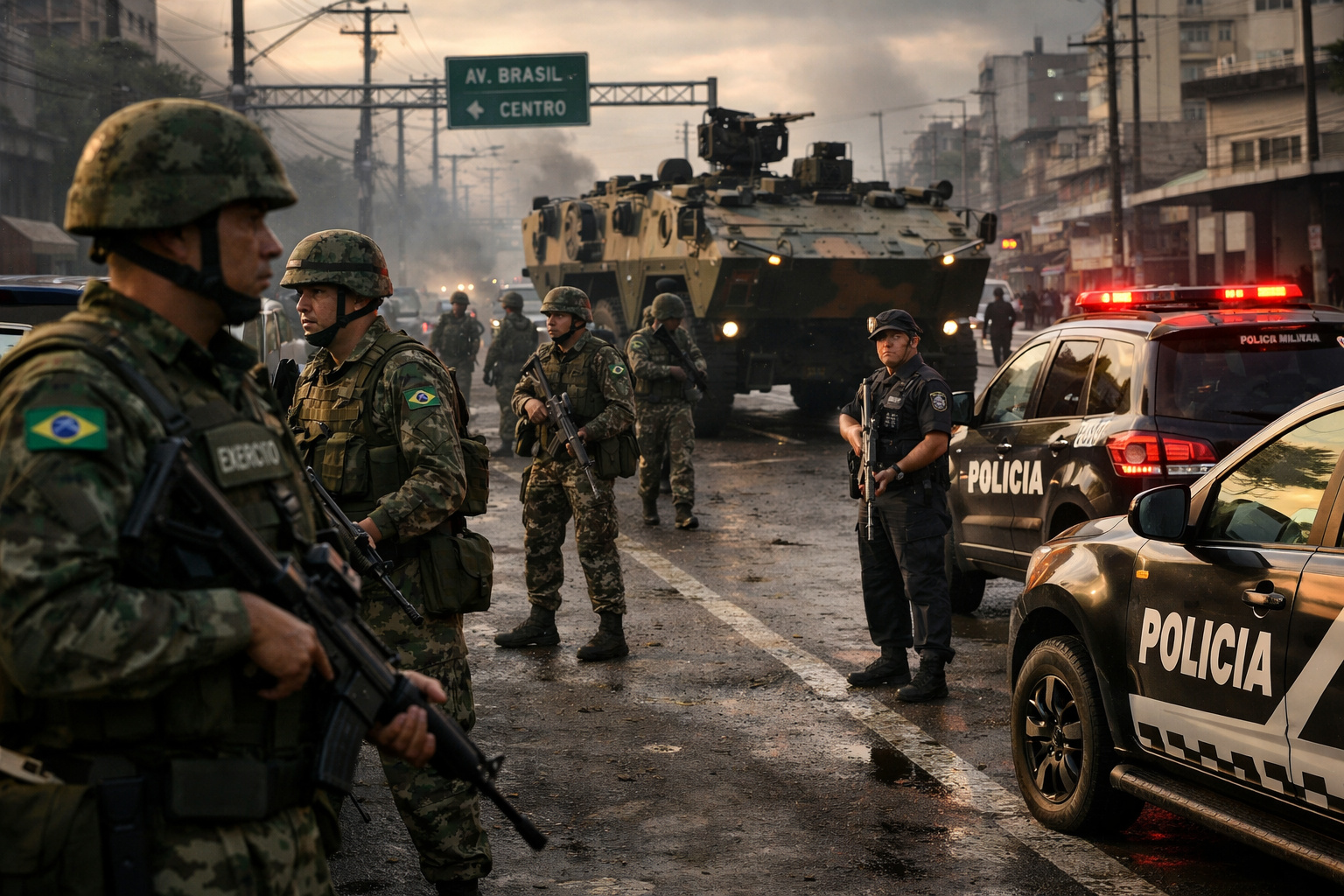


Proposal Presented in Congress Authorizes Military Support in Cities and Highways Upon Request from Governors and Branch Heads, Maintaining Command under the Ministry of Defense and Amending Complementary Law 97/1999 to Expand Response to Security Crises
The Brazilian Armed Forces will be able to act in combating organized crime even without the formal declaration of the Guarantee of Law and Order (GLO), if the Complementary Law Project (PLP) 229/2025 advances in the National Congress. This information was disclosed by the Federal Senate News Portal, based on a report from the Senate Agency, published on 02/20/2026, at 08:34 AM. The proposal provides for the deployment of Army, Navy, and Air Force in cities and highways to confront criminal organizations linked to drug trafficking, terrorism, gangs, and militias, expanding the current scope of military action.
Currently, the use of the Armed Forces in public security operations depends on the declaration of the Guarantee of Law and Order (GLO) by the President of the Republic. However, according to the text of PLP 229/2025, military support could occur even without this formal instrument, as long as serious situations of confrontation with organized crime are characterized. Thus, the measure seeks to provide a quicker response to critical scenarios.
The project is authored by Senator Eduardo Girão (Novo-CE) and will be analyzed by the Senate. According to the justification presented, the proposal aims to fill what the legislator classifies as a “gap” in current legislation, allowing states and federal authorities to summon the Armed Forces as a form of support to existing security measures.
-
Brazil’s Largest Navy Ship, NAM Atlântico, Transforms into Field Hospital During National Crises

-
Brazilian Navy Demonstrates Strength in Naval Exercise with Over 20 Nations, Deploys Frigate Independência in Anti-Submarine and Air Defense Scenarios, and Joins Historic Formation with 26 Ships from 14 Allied Navies off the U.S. Coast

-
BAE Systems to Supply New Bofors 40Mk4 Cannons to the Brazilian Navy
-
Ukraine Bets on Swedish Gripen E Jets to Counter Russia, But 16 Fighters Won’t Arrive Until Late 2020s; Kiev to Use C/D Models for Pilot Training and Operations Amid Ongoing Missile and Drone Threats



Governors and Branch Heads Will Be Able to Request Troop Support
According to the text of PLP 229/2025, governors will be able to request support from the Armed Forces in situations deemed critical. However, the coordination and command of operations would remain under the responsibility of the Ministry of Defense, maintaining the hierarchy and institutional structure provided for in the Constitution.
In addition to governors, the Legislative and Judicial Branches will also be able to request troop deployment. The request could be formalized through the presidents of the Federal Senate, the Chamber of Deputies, and the Supreme Federal Court (STF). This point significantly broadens the possibilities for mobilization of the Armed Forces on national territory.
According to Senator Eduardo Girão, restricting the use of the Armed Forces only to situations where there is a formal GLO declaration by the President of the Republic represents an operational obstacle in light of the advances of organized crime. For him, the change would strengthen the federal pact and enable a “quick and coordinated response to threats that compromise the security of individuals, the sovereignty, and the integrity of the population.”
Amendment to Complementary Law 97/1999 May Redefine the Role of the Armed Forces
The project proposes to amend Complementary Law 97, of 1999, a norm that regulates the article of the Constitution responsible for addressing the Armed Forces. This legislation defines the assignments of the Army, Navy, and Air Force, in addition to the conditions under which they may be employed on national territory.
Despite the expansion of operational scenarios, the text highlights that the proposal preserves the competencies of the civil and military police. In other words, state forces would remain responsible for everyday public security. However, in exceptional circumstances, the use of armored vehicles, equipment, and military personnel may be deemed essential to restore public order and ensure the safety of communities.
“The project preserves the competencies of the civil and military police but acknowledges that, under certain exceptional circumstances, the use of armored vehicles, equipment, and military personnel may be essential to restore public order and ensure the safety of communities,” argues Girão in the justification for the proposal.
Currently, the project awaits distribution to the Senate committees, a crucial step before a potential vote in plenary. If it advances, the measure could directly impact public security policy in Brazil, redefining the limits and possibilities for employing the Armed Forces in the fight against organized crime.
With information from: Senate