Portuguese
  Spanish


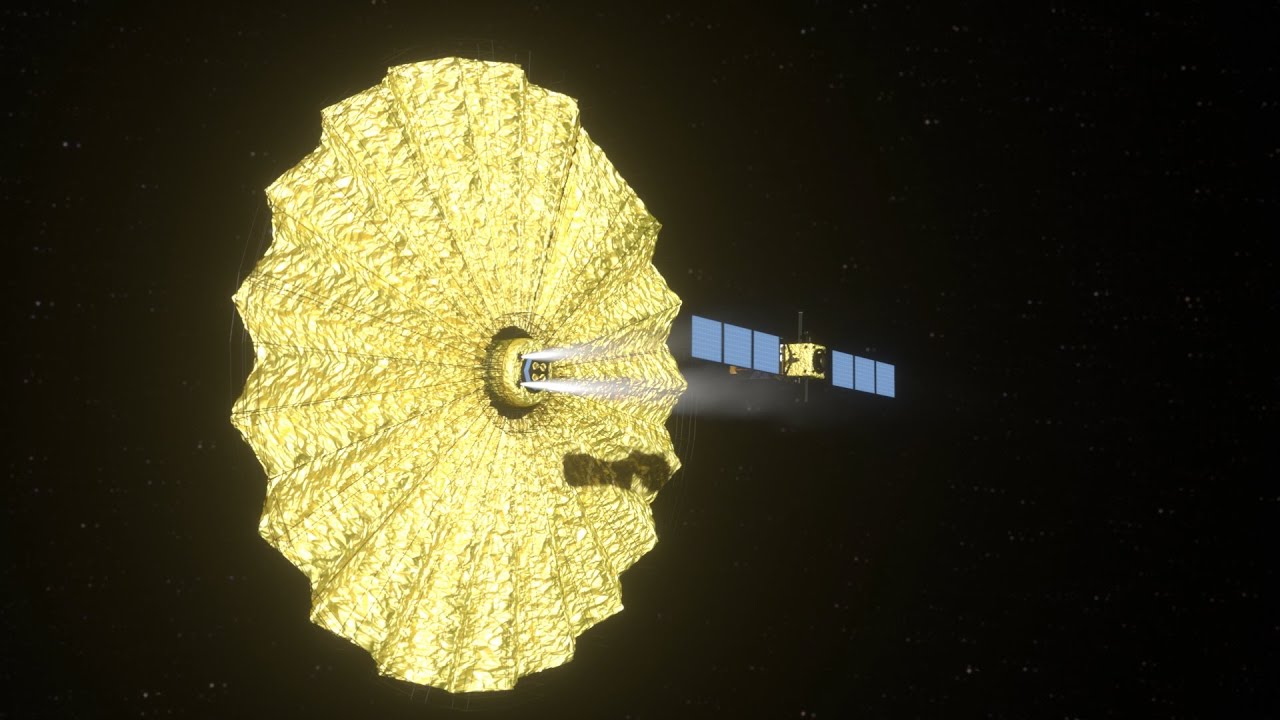

NASA’s Starshade uses a flower-shaped structure to block starlight and attempt to capture direct images of exoplanets like Earth.
Detecting exoplanets is no longer a novelty for modern astronomy, but photographing them directly is still one of the biggest challenges in the field. The problem is brutal: the light from the host star is usually so intense that it almost completely wipes out the planet’s brightness, especially when it comes to small, rocky, and potentially habitable worlds. To tackle this limitation, NASA is developing the Starshade, a concept of an external flower-shaped occulter that would fly separately from the telescope to block starlight before it reaches the observatory’s mirrors.
The proposal is to allow direct images of exoplanets and, in the future, enhance the ability to study atmospheres and signs of habitability in Earth-like worlds.
What is NASA’s Starshade and how the space flower blocks starlight
The Starshade is described by NASA as an external starlight suppression structure. Instead of being inside the telescope, like an internal coronagraph, it would act as a second spacecraft positioned between the observatory and the target star to create an artificial eclipse in space.
-
A 13-foot robot nicknamed Godzilla is assembling the world’s largest nuclear fusion reactor piece by piece.

-
Experts Warn: Aging NASA Launch Facilities Could Hinder Artemis Moon Mission Progress
-
Self-Driving Harvester Now Operating in Brazil’s Vast Farmlands
-
Astronomers Discover Two Giant Exoplanets as Light as Cotton Candy, Challenging Current Scientific Models 1,110 Light-Years from Earth


It is precisely this architecture that makes the concept so unusual. The star continues to emit its light normally, but the Starshade attempts to prevent this brightness from invading the telescope’s field, allowing the much weaker light from the orbiting planet to pass through.


NASA states that this technology can enhance the ability to detect and characterize small, rocky planets in habitable zones, regions where liquid water could exist on the surface. This explains why the concept is considered one of the most ambitious bets in the search for potentially Earth-like exoplanets.
Starshade petals are not decorative and exist to control light diffraction
The flower shape is not a visual detail designed to make the project more appealing. NASA itself explains that the petals were designed to create a smoother edge and reduce the deflection of light waves around the structure, which helps produce a much darker shadow for the telescope to work with.
Without this cut-out design, the diffraction of starlight would continue to invade the optical system and greatly reduce the blocking efficiency. In other words, the floral shape is a central part of the physics of the concept, not an aesthetic finish.
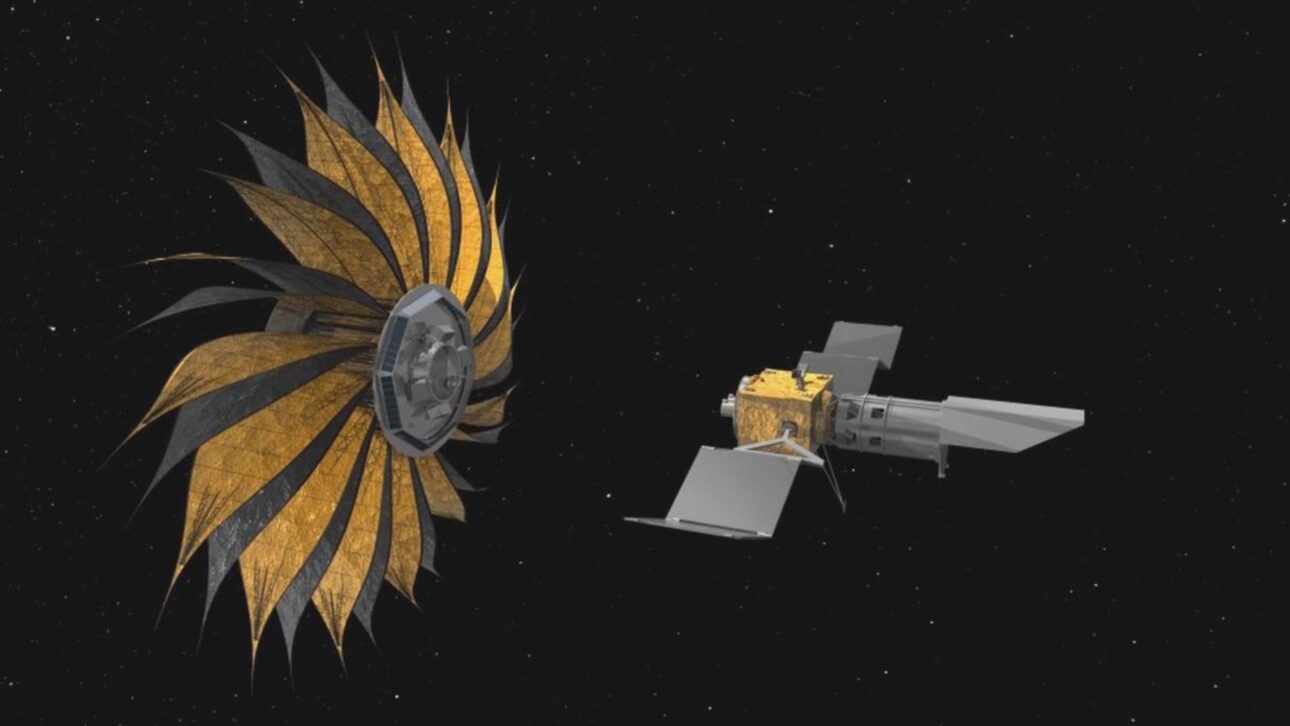
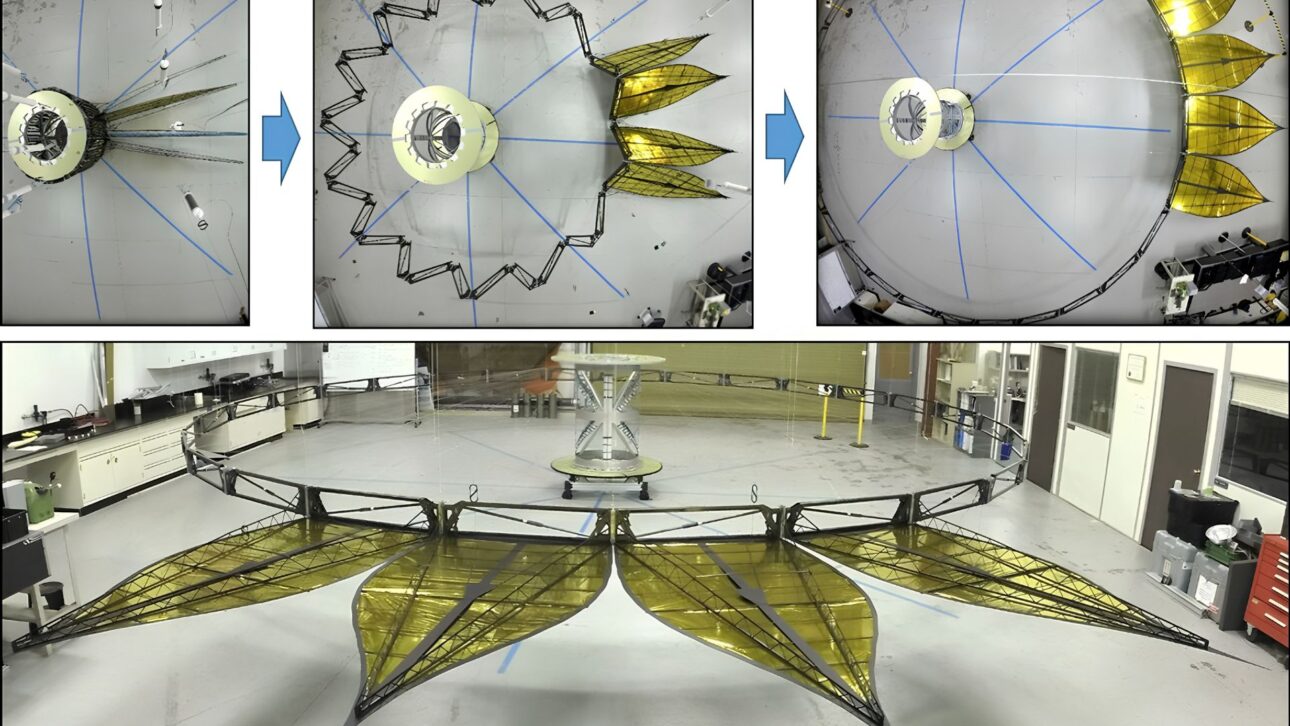
The Jet Propulsion Laboratory, the JPL, also highlights that the petals were designed to diffract the intense light of stars away from the telescope. In a prototype displayed by the laboratory, the agency also reports that these petals have been redesigned to be rolled up and accommodated for launch.
Two-spacecraft system requires extreme alignment between telescope and occulter
One of the most important features of the Starshade is that it is part of a two-spacecraft system. NASA states that, unlike many onboard instruments, the concept works in conjunction with a separate space telescope, while the Starshade moves with thrusters to block different stars.
This operation requires an extremely delicate orbital choreography. In official NASA technical material, the reference concept appears with a 34-meter Starshade, separated from the telescope by 30,000 to 50,000 kilometers, with lateral control in the range of ±1 meter to keep the shadow in the correct spot.
This helps to gauge the real size of the challenge. Even tens of thousands of kilometers away, the structure needs to remain aligned with extremely high precision to hide the star without covering the light of the planet around it.
Earth-like exoplanets are the main scientific target of the Starshade
Today, many exoplanets are found by indirect methods, such as transits and gravitational wobbles. The Starshade was designed to tackle another frontier: the direct imaging of exoplanets, visually separating the planet’s light from the overwhelming light of the host star.
According to NASA, directly observing the light of an exoplanet helps measure properties such as size, orbit, albedo, and surface and atmospheric spectra. This data can offer clues about habitability and even about possible signatures associated with the presence of life.
That’s why the concept is often associated with the search for Earth-like worlds. The focus is not just to discover that they exist, but to obtain enough physical and chemical information to understand what these planets are like and if they have conditions favorable to life as we know it.
Unfolding the petals in space is one of the greatest engineering challenges
Besides the optical problem, the Starshade faces a huge mechanical barrier. NASA states that one of the central tasks of the project is figuring out how to open the structure in space so that all the petals end up exactly in the right place, with millimetric precision.
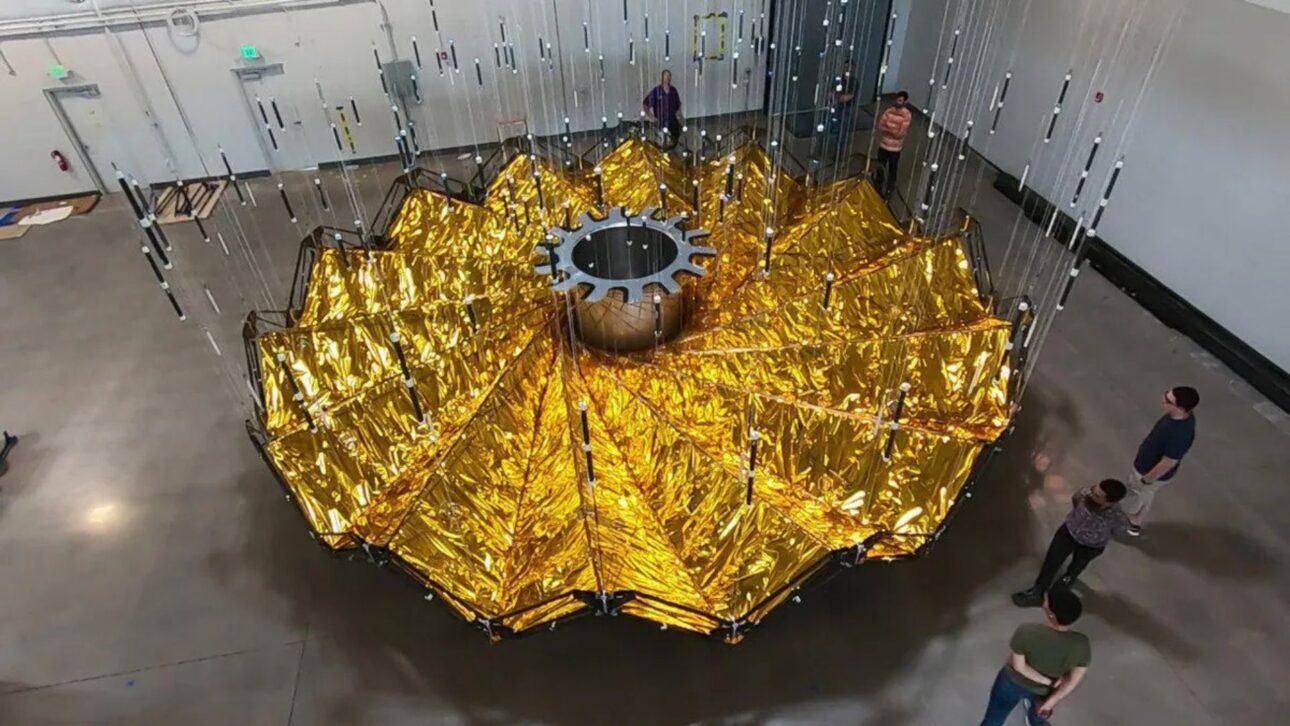
The JPL has already presented partial scale prototypes and describes systems in which the petals can be rolled up for launch and then unfolded in orbit. In the program’s technical material, the agency addresses deployment precision and shape stability as two of the critical points to make the technology viable.
NASA also frames the development of the Starshade in a focused technological maturation activity called S5, approved to bring the concept to higher levels of readiness. Among the three critical areas officially listed are starlight suppression, sensing and formation control, and deployment precision with structural stability.
Starshade project remains in development and still represents a conceptual mission
The Starshade does not currently appear as a ready-to-fly operational mission. NASA’s official page describes it as part of a technological development effort, with tests, maturity reports, in-flight formation simulations, and animations of a possible rendezvous mission concept with a space telescope.

This means that the project has already advanced significantly in modeling, prototypes, and component validation, but it still depends on future decisions regarding mission architecture and integration with space telescopes.
NASA itself presents the Starshade as a technology capable of serving future observatories, and not as a system already approved for immediate launch.
Even so, the concept remains among the boldest ideas in modern astronomy. If it reaches space, the structure could hide the brightness of entire stars to directly reveal worlds that today remain practically invisible, opening a new phase in the observation of Earth-like exoplanets