Portuguese
  Spanish


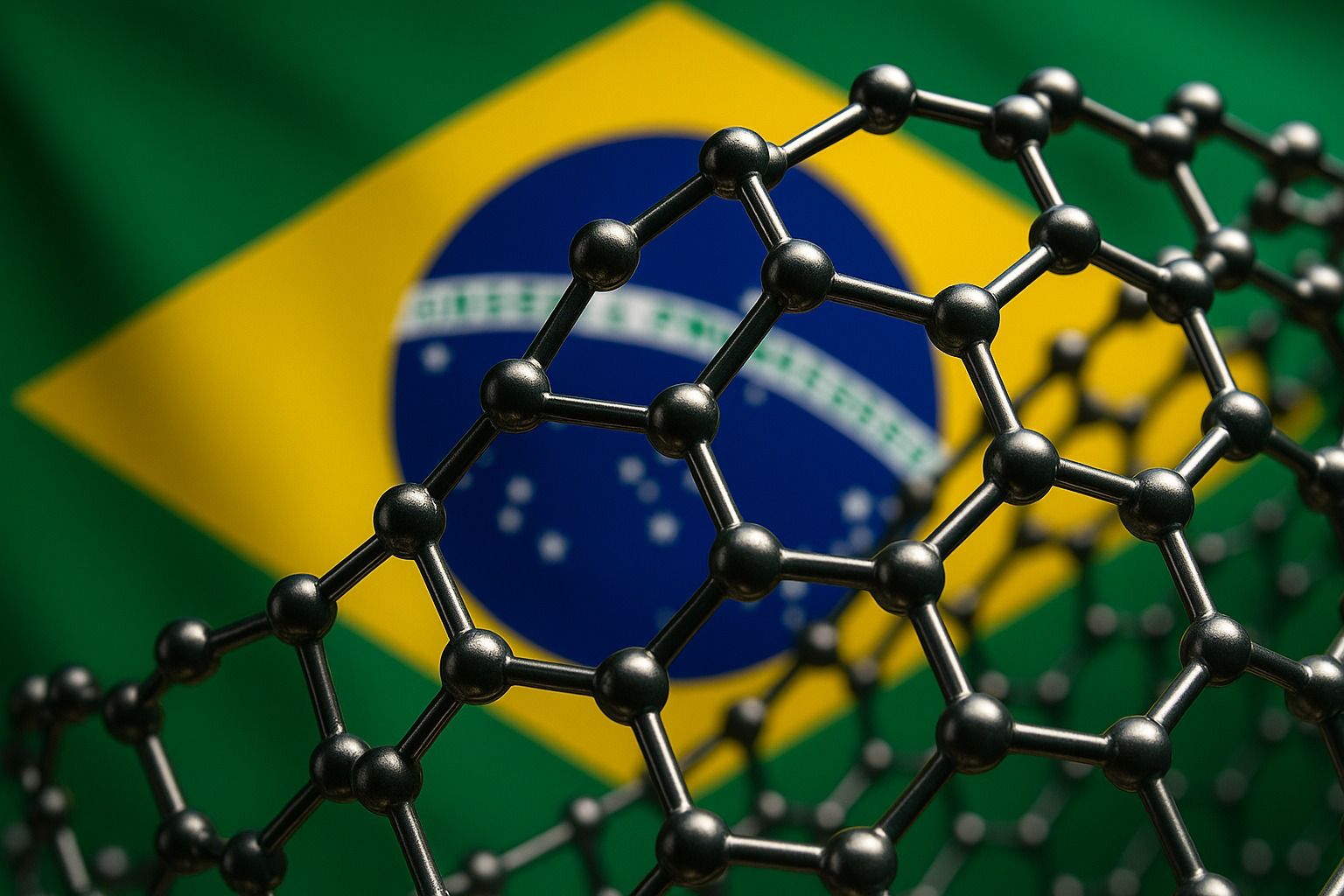

Researchers from the International Iberian Nanotechnology Laboratory proved that graphene improves precision in lithium detection, while Brazil stands out with 74 million tons of natural graphite, an essential base to produce the material.
Despite recent advances in sensor technology, developing devices that combine high precision, reliability, and durability remains a significant challenge for science.
Researchers from the International Iberian Nanotechnology Laboratory (INL) — Olesia Dudik, Renato Gil, and Raquel Queiros — presented a promising solution by demonstrating that the integration of graphene in solid contact electrodes significantly improves lithium detection.
This discovery could boost the development of more reliable next-generation sensors, applicable in areas such as medical monitoring and energy storage systems.
-
Antarctic Sea Creature Yields Promising Compound Against Melanoma, Captivating U.S. Researchers

-
Underwater Guardian: The Autonomous Robot Monitoring Submarine Cables, Self-Returning, Wirelessly Charging, and Transmitting Data Without Onboard Crew

-
Robots Clean Solar Panels in Desert Power Plants Without Water, Preventing Energy Losses
-
AI Radar Built with Old Camera and $20 Gains Attention After Alleged $317,000 Sale to Chinese Government, But Lack of Documentation and Official Confirmation Raises Questions




The findings were published in the Microchemical Journal and are part of the NGS–New Generation Storage project, reinforcing the potential of graphene to revolutionize lithium measurement technologies.
Advances in Electrode Design Improve Electrical Performance
In sensor technology, solid contact ion-selective electrodes play an essential role: transforming the chemical signal of an ion into an electrical signal.
At the center of this operation is the ion-electron transducer, positioned between the ion-selective membrane and the electronic conductor.
This layer serves to ensure stable voltage readings, prevent the formation of water layers, and increase the overall robustness of the sensor.
However, choosing the ideal material for the transducer is still a hurdle, as different candidates vary in electrical performance, surface characteristics, and long-term stability.
In this context, the INL study showed that graphene-modified electrodes outperform other available options, offering highly electroactive and hydrophobic surfaces.
These characteristics allow for greater capacitance and minimal potential drift, decisive factors for measurement accuracy.
Graphene acts as a kind of “super highway” for ionic signals, efficiently conducting them to the electronic system. This way, lithium levels can be measured quickly and reliably, representing an important leap in sensor performance.
The Exceptional Properties of Graphene Make It Perfectly Suited
According to Olesia Dudik, the unique properties of graphene make it an ideal transducer for solid contact lithium-selective electrodes.
The researcher explains that the material not only improves the electrical performance of the sensor but also ensures long-term stability, a fundamental requirement for practical applications involving health, energy, and industry.
The combination of high electroactivity and hydrophobicity allows lithium ions to move efficiently to the electronic system, reducing potential drift and improving measurement reliability. This innovation paves the way for a new generation of lithium sensors, more robust and capable of operating accurately under various environmental conditions.
Dudik emphasizes that the study’s results provide valuable insights for advancing potentiometric sensors, indicating that incorporating graphene as an ion-electron transducer enables unprecedented sensitivity, reproducibility, and overall robustness.
Furthermore, the researcher highlights that this achievement supports a wide variety of applications — from lithium monitoring in medical contexts to enhancing battery technologies and high-reliability environmental measurements.
By exploring the unique electrical and surface properties of graphene, scientists can design sensors with consistent precision and performance, even under demanding conditions.
This combination of resilience and stability broadens the potential for use across multiple sectors, solidifying graphene as a key material for the future of chemical measurements.
The Potential of Brazil in Graphene Production
Brazil ranks among the countries with the largest reserves of natural graphite, the essential raw material for graphene production.
According to data from the United States Geological Survey (USGS), the country has about 74 million metric tons (MT) of reserves. In 2024, Brazil’s graphite production was estimated at 68 thousand metric tons, with a growing trend.
The national scenario provides a favorable foundation for industrial graphene production, as the material can be obtained from high-quality graphite.
However, the transformation process requires specialized industrial steps, involving high technology and stringent control.
With the advancement of research and the expansion of the supply chain, Brazil has the potential to establish itself as a significant global supplier of strategic inputs for sensors and graphene-based technologies — an increasingly decisive element in scientific and energy innovation.