Portuguese
  Spanish


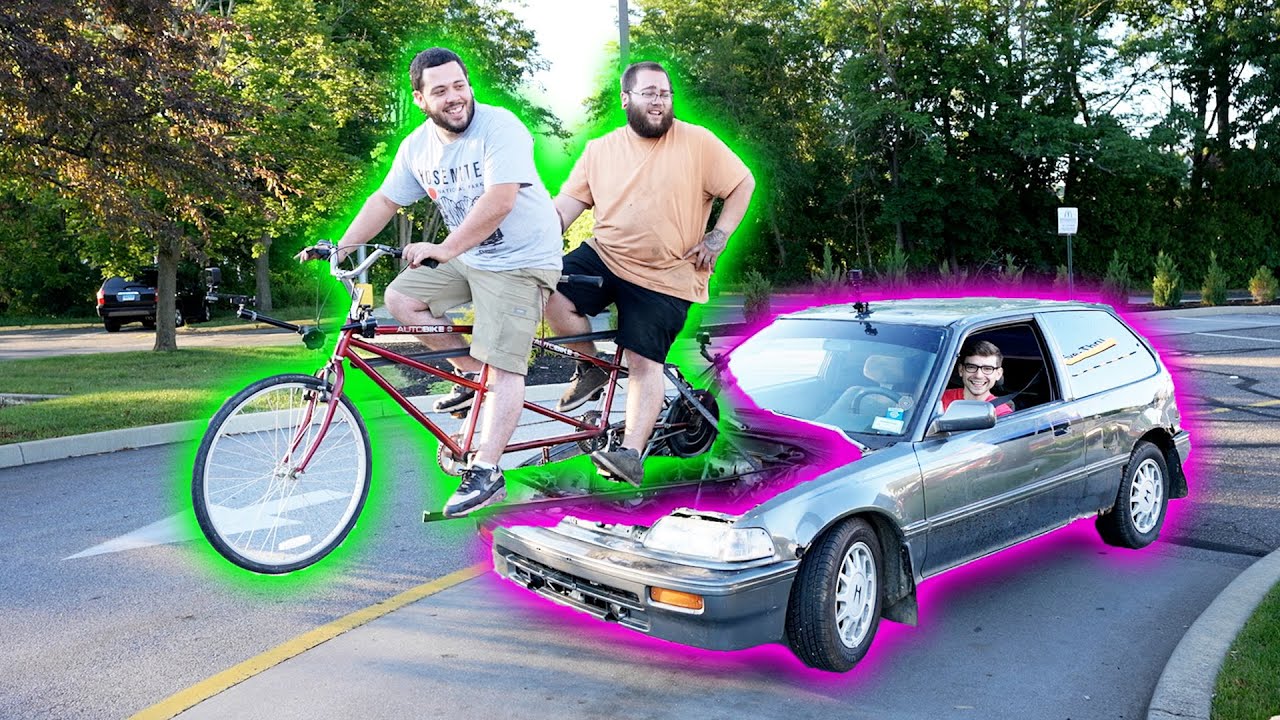

The Honda Civic, Joined to a Bicycle, Gained Great Success on the Streets of the United States. Would It Be the Origin of a 100% Sustainable Car? Follow the Story Below
A group of friends from the United States proved that friends can be just as good at makeshift solutions as Brazilians. The young people combined a 3rd generation Honda Civic hatch, which was sitting in the garage, without an engine and no utility, with a two-seater bicycle, creating a fully functional contraption.
Read Also
Understand How the Pedal-Powered Car Was Made


Without much complexity, it is not difficult to explain how the “sustainable car” was made. Since the engine was already out of the Honda Civic hatch, as well as peripheral elements, it made it much easier for the group of friends to start the process of transforming the car into a sustainable version. The friends decided to keep the original transmission system of the Honda Civic.
Moving on to the creation of the pedal-powered sustainable car, the first step for the group was to attach the bicycle to the car. To do this, they removed the car’s hood and chose the necessary iron bars to create the support base for the bicycle.
-
Suitcase-sized hydrogen engine spins at 25,000 rpm, nearly doubling the efficiency of conventional cars and replacing exhaust smoke with water vapor

-
1983 Chevrolet Runs Over 100,000 km Without Gasoline, Powered by Wood Chips, Reaches 125 km/h in Airport Test

-
Workshop Converts Giant Tractor Tire Tricycle into a Three-Wheel Drive Hybrid with 36,000-Watt Electric Motor Capable of Climbing Hills

-
Sales of Brazil’s Cheapest Electric Car Halted Before First Deliveries: E-Motors Suspends Emova Easy Due to Import Tax Increase and Rising Freight Costs




The iron bars were joined through welding, and the entire structure was supported on the location where the hood used to be, fixing it between the headlights, at the top of the Honda Civic hatch’s suspension assembly. It is important to note that the friends did not make any precise measurements to assemble this “puzzle.”
Adapting the Honda for the Bicycle
Since the bicycle was already factory-ready, the group of friends only needed to devise a strategy to support the bike over the engine compartment. To do this, the friends initiated a modification process on the bicycle, which served to transmit the same rotational movement performed on the pedals to the wheels.
The inventors of the sustainable car made two pulleys: one was attached to the freewheel of the bicycle’s old rear wheel, and the other was attached to the transmission of the Honda Civic hatch. The pulleys were connected by a kind of belt and, thus, the movement is passed to the car whenever someone pedals.
Tests of the Car and Success on the Streets
With everything in its place and the bicycle positioned and secured, it was time to carry out the tests. The friends, who were also YouTubers, divided up: two of them got on the bicycle to do the heavy work of pedaling enough to create the force to propel the car, while the third friend was inside, handling the normal steering controls at the wheel.
The initial focus of the project was to drive the car to the nearest McDonald’s fast food chain. And indeed, it worked! However, the maximum speed achieved was around 3 km per hour, so they didn’t reach McDonald’s very quickly, but they did arrive!
After much effort, the friends managed to reach McDonald’s and place their order for their snacks. In return, they were rewarded with the excitement and enthusiasm of the people on the street, throughout the journey, who took many photos of the brilliant contraption.