





 Portuguese
  English
  Spanish
  3 min of reading
  0 comments


Honda EV Plus, Launched Almost 30 Years Ago, Had 130 Km Range Limited to 300 Units
The Honda is known for its long-term vision in sustainability and innovation, especially when it comes to alternative fuels. However, while many associate these models with Honda’s journey towards clean mobility, few know that this journey began much earlier, with the EV Plus, a small urban electric car launched in California in the 90s.
The Birth of Honda’s EV Plus
It all started when the California Air Resources Board distributed environmental regulations requiring that at least 2% of cars sold be zero emission vehicles. In response, Honda developed the EV Plus, one of the first fully electric cars to hit the streets of California.
The launch was in 1997, and at that time, it already featured innovative resources like regenerative braking, an efficient heating and air conditioning system, and even a thermal windshield.
-
The 2012 Mitsubishi Pajero Dakar diesel shows 314,000 km and still draws attention for its reputation for durability; the seven-seater 4×4 SUV handles trails, but signs of severe use may conceal losses for used car buyers.

-
Peugeot publicly acknowledged the errors of the PureTech engine, which caused serious failures in hundreds of thousands of cars, and introduced the new Turbo 100 as a definitive solution, a 1.2 turbo tested for over 3 million kilometers that replaces the faulty belt with a more durable chain.

-
Automatic cars become ‘cheap’ in Brazil, and models from Toyota, Hyundai, Nissan, and Honda appear for R$ 65,000 with up to 120 hp, CVT transmission, 482 liters of trunk space, keyless entry, and six airbags to tackle traffic without a clutch.
-
Honda revives a classic from Brazilian streets with a new name, TFT panel, and reprogrammed engine in the 2027 lineup; see the first impressions of the CB500 Hornet, which arrives with 49.6 hp, 4.5 kgf.m torque, 6-speed gearbox, 175 kg, and Showa suspension on Brazilian streets.


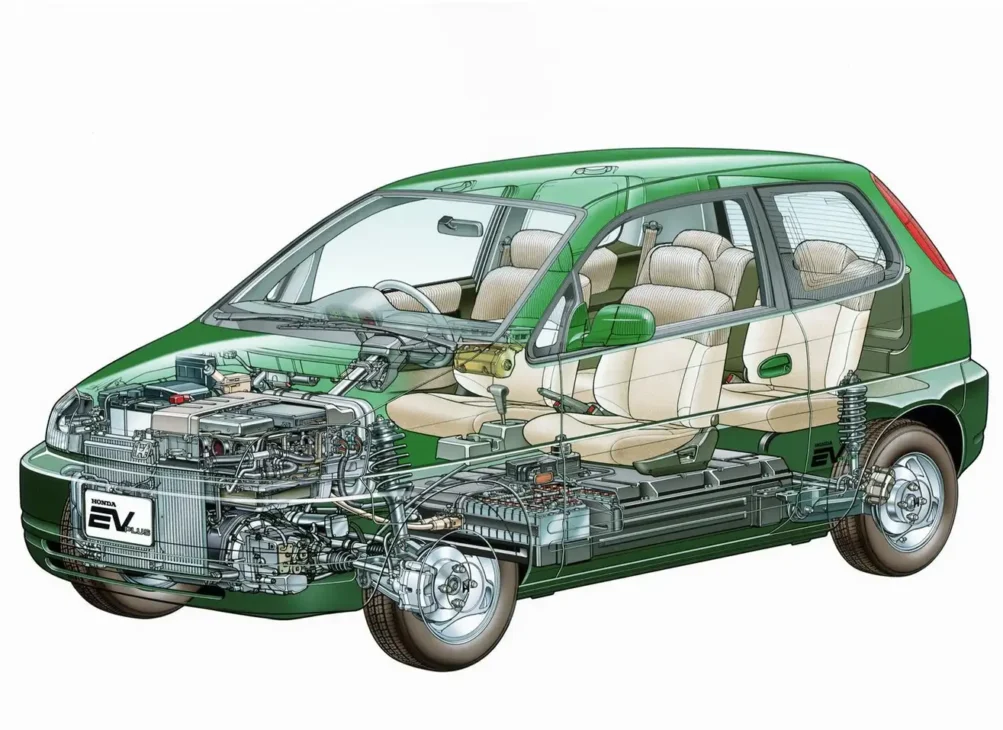
For most people, these features are commonplace in today’s electric cars, but over two decades ago, they represented the future. The EV Plus boasted an electric motor with 66 horsepower, which was impressive for a compact car from the 90s.
Its range also caught attention: with a 28.7 kWh battery, it could travel between 100 km and 130 km, something revolutionary for the time. Testing the model on the streets and highways of Southern California further confirmed its efficiency, revealing a range of 170 km in the city.
A Car Ahead of Its Time
Imagine the scenario: a fully electric car, at a time when the standard was still the combustion engine. The EV Plus was equipped with a 240 V charger that, surprisingly, charged 80% of the battery in just two hours – practically a “modern” feat in the 90s.
Of course, for those relying on the conventional 120 V outlet, the story was different; charging could take up to an entire day.
But despite all this innovation, the EV Plus was a niche product, and few had the opportunity to drive it. Honda offered the model only through leasing at a cost of US$ 455 per month, and the estimated total price hovered around US$ 54,000.
Moreover, there was the battery issue: it needed to be replaced every three years, at a cost of approximately US$ 20,000, making its maintenance economically unviable.
The Legacy of the EV Plus
The story of the EV Plus didn’t end well for the few who opted for this pioneer. After the leases ended, Honda reclaimed all the cars and unfortunately destroyed the majority of them. Nonetheless, the EV Plus left an important legacy. It marked the beginning of an era, inspiring technologies and standards we see in today’s electric cars.
Victoria Scott, a passionate writer for Motor1, recently had the opportunity to explore one of the last remaining EV Plus vehicles at Honda’s museum in California. Her visit reminds us of how ahead of its time the EV Plus was and the impact it had on Honda’s journey toward electrification.
If you’re an electric vehicle enthusiast or just curious about what was necessary to reach what we have today, it’s worth checking out Victoria’s detailed video and learning a little more about this forgotten pioneer.
The EV Plus may not have achieved commercial success, but its importance in the development of electric cars is undeniable. It paved the way for the hybrid and electric models that followed and are now part of our daily lives.








-

1 person reacted to this.