Portuguese
  Spanish


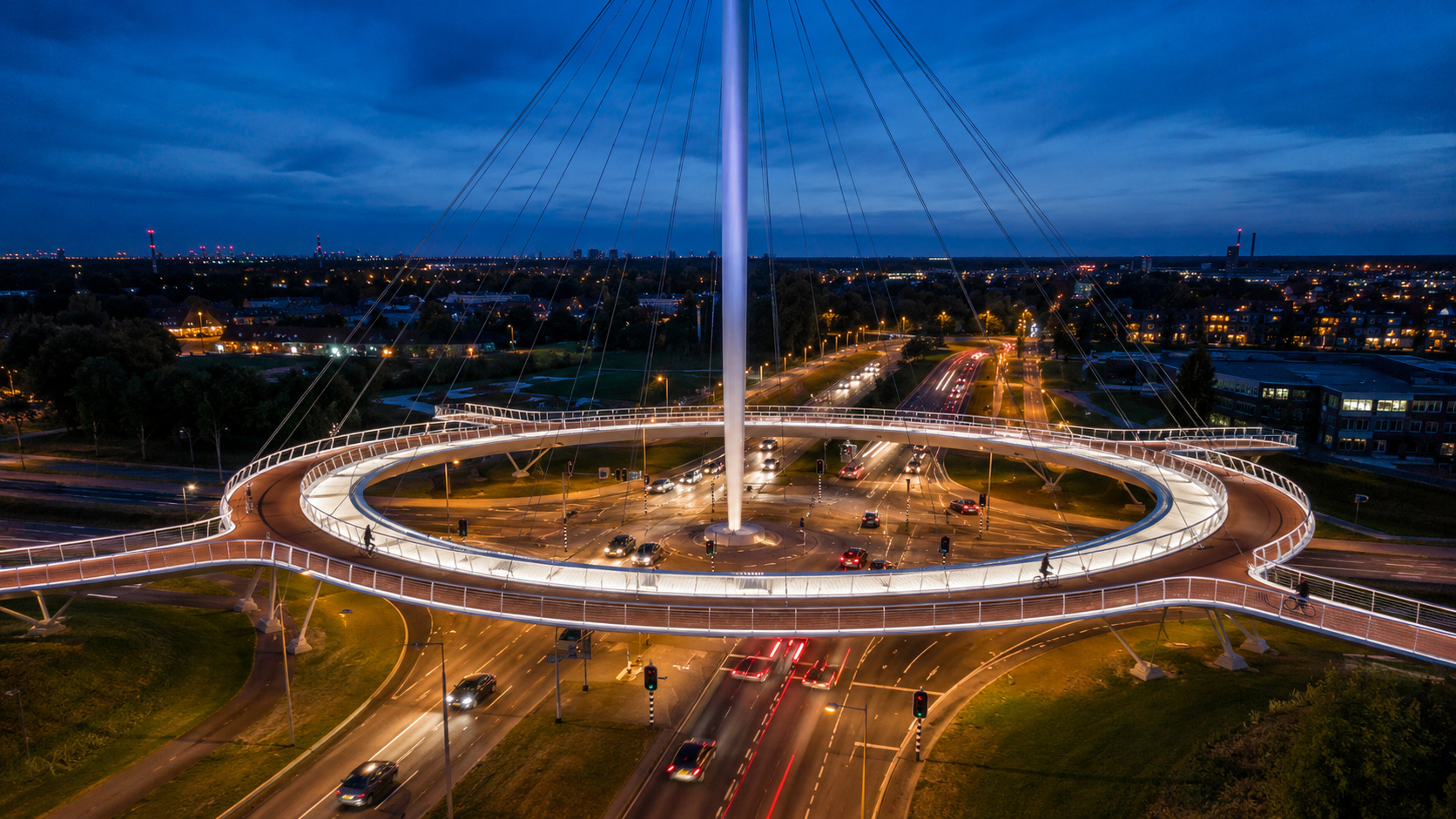

The suspended bicycle roundabout Hovenring separates cyclists from cars in Eindhoven and Veldhoven with an elevated circular bridge, steel cables, urban lighting, and a design that catches the attention even of those who never thought about engineering
A suspended bicycle roundabout looks like a flying saucer over cars in the Netherlands. The Hovenring uses a 70-meter mast, 24 steel cables, and a 72-meter elevated circular track to take cyclists and pedestrians over the traffic.
The information was released by ipv Delft, an engineering and urban design office. The structure is located between Eindhoven and Veldhoven and appears as a cable-stayed circular bridge, a name given to a bridge supported by cables attached to a central mast.
The solution draws attention because it transforms a road intersection into an easy-to-understand image. While cars pass underneath, bicycles and pedestrians make the journey above, away from direct conflict with vehicles.
-
18-Year-Old Student Designs Modular Microhouse from Fiberglass and PET to Combat Homelessness in Brazil, Plans to Live in Prototype for a Year to Demonstrate Quick Assembly

-
The Frenchman Who Brought the World Cup to Life: Overcoming Resistance and Crossing the Atlantic with the Trophy to Create Football’s Biggest Tournament

-
Archaeologists Reexamine 4,500-Year-Old Tombs in Ancient Mesopotamia, Suggesting Some Early Kings May Have Been Powerful Women
-
The North Face Co-Founder Donates Vast South American Lands to Create National Parks in Patagonia, Turning Private Wealth into Environmental Legacy


The elevated roundabout places bicycles above and lets cars pass underneath
The Hovenring functions as an exclusive circular bridge for cyclists and pedestrians. Instead of crossing at the same level as cars, cyclists enter the structure via ramps and circulate on the suspended ring.


The traffic flows underneath, while the bicycle track forms an elevated circle over the avenue. This design helps explain why the work is often compared to an urban flying saucer.
The project shows an alternative for intersections where cars, bicycles, and pedestrians need to share space. The separation of flows reduces the direct encounter between vehicles and moving people.
The 70-meter mast and the 24 steel cables support the circular ring
The structure features a 70-meter mast at the visual center of the work. From this mast, 24 steel cables extend, helping to support the elevated circular track.
The track has a 72-meter diameter and was made of steel. In simple terms, the cables hold part of the track’s weight and help the ring remain stable over the intersection.
This type of construction is called a cable-stayed bridge. The term might seem technical, but the idea is straightforward: cables attached to a central tower help keep the bridge suspended.
The intersection was lowered by about 1.5 meters to smooth the ramps
One of the most important decisions is not just in the suspended ring. The level of the intersection below was lowered by about 1.5 meters to improve the bridge’s fit at the location.
This lowering helped create more comfortable ramps for cyclists and pedestrians. Without it, the climb could become heavier and less practical for daily use.
The work shows that a beautiful bridge also needs to function well. The futuristic look draws attention, but the experience of those cycling depends on smooth ramps and clear paths.
The circular lighting transforms the Hovenring into a striking point at night
The Hovenring was also designed to stand out at night. The lighting is integrated into the ring and creates a luminous band around the bridge.
The result reinforces the appearance of a flying saucer. The illuminated mast and circle of light make the structure visible even to those just passing by in a car.

The light is not just for aesthetics. It also helps users see the path and makes the bridge more present in the urban landscape.
The project cost € 6,300,000 and became a visual landmark between Eindhoven and Veldhoven
ipv Delft, engineering and urban design office, detailed the main data of the Hovenring: 72 meters in diameter, 70 meters in mast height, 5 meters in width, and a construction cost of € 6,300,000.
The bridge was opened in the summer of 2012 and came to mark the entrance to the cities of Eindhoven and Veldhoven. The circular design helped transform a mobility project into a recognizable landmark in the landscape.
The impact comes precisely from this mix. The structure solves a crossing, organizes traffic, and still creates a strong image for those who see the bridge from afar.
What a suspended bicycle roundabout teaches about dangerous intersections
The Hovenring shows that intersections with many conflicts can be thought of differently. The central idea is simple: separate bicycles, pedestrians, and cars when coexistence on the same level creates risk or discomfort.

This does not mean that every intersection needs a circular bridge. Each city has different space, budget, and needs. Even so, the project shows how an engineering solution can be clear, useful, and visually striking.
In Brazil, many crossings still place cyclists and pedestrians in front of fast avenues. The Hovenring helps remind us that mobility does not only depend on making room for cars but also on creating safe paths for those who move by bicycle or on foot.
The suspended bicycle roundabout in the Netherlands became known because it combines function and image in a single structure. The 70-meter mast, the 24 steel cables, and the 72-meter circular track make the bridge appear larger than its urban scale.
More than a curious work, the Hovenring shows how infrastructure can change the perception of an intersection. When cyclists pass above and cars go below, the city gains a clearer, safer, and more easily recognizable solution.
If such a suspended roundabout were built at a dangerous intersection in your city, would it be seen as a real advancement in safety or as too expensive a project for the Brazilian routine?