






 Portuguese
  Spanish



A giant meteorite, the size of four Everest mountains, collided with Earth 3 billion years ago, causing profound changes in life. See the impact of this historical event and its consequences for the planet!
Billion years ago, Earth was frequently bombarded by meteorites, drastically altering the planet’s surface and paving the way for the forms of life we know today. About 3.26 billion years ago, one of these meteorites collided with Earth, and the analysis of its effects continues to provide valuable clues about the early development of our planet.
Geologist Nadja Drabon, an expert in primitive Earth and a professor at Harvard, is among the scientists dedicated to unraveling the mysteries of this turbulent period.
During a time when Earth was inhabited only by microorganisms, the impact of large meteorites played a key role in the geological and biological evolution of the planet.
-
World’s Most Powerful MRI Machine in France, Weighing 132 Tons and Generating 11.7 Tesla Magnetic Field, Offers Unprecedented Clarity of the Human Brain

-
Hong Kong Converts Former Coastal Landfill into Desalination Plant Producing 135 Million Liters of Drinking Water Daily
-
Texas Teens Win $50,000 at World’s Largest Science Fair for Developing Non-Surgical Brain-Controlled Bionic Prosthesis with 98% Accuracy
-
Samsung Galaxy A27 Launches with 6.7-inch Super AMOLED Display, Full HD+ Resolution, Android 16, Six Years of Updates, Snapdragon 6 Gen 3, and Dust and Splash Resistance; Available for Pre-order in the US for $350


Questions like “when did the first oceans form?” or “how did tectonic plates begin to operate?” continue to fascinate researchers like Drabon.
The Great Meteorite Impact That Changed Earth
A recent study published in Proceedings of the National Academy of Sciences details the effects of a large-scale meteorite impact, known as S2, which occurred over 3 billion years ago. Evidence of this event was found in the Barberton Greenstone Belt in South Africa, where geological marks are still visible.
Drabon’s team, through sedimentary and geochemical analyses, managed to reconstruct the devastating impact of this event. The S2 meteorite was immensely large — up to 200 times larger than the asteroid that wiped out the dinosaurs.
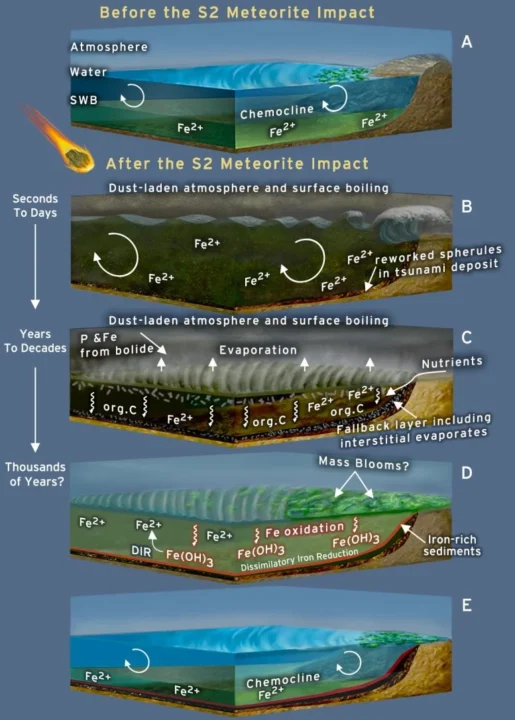
The collision generated a gigantic tsunami that devastated the coastal ecosystems of the time, in addition to launching a massive amount of debris into the atmosphere and heating both the water and air.
Drabon describes the scene: “Imagine yourself on a calm beach, without strong currents. Suddenly, a gigantic tsunami comes and destroys everything in its path. It was something similar to what happened.”
Biological Consequences: Life Survived and Thrived
Despite the destruction, the bacteria present on Earth at that time showed an incredible capacity for adaptation. According to Drabon’s analysis, after the impact, populations of microorganisms that fed on iron and phosphorus rapidly increased.
These elements, essential for bacterial survival, were brought to the surface by ocean agitation and the meteorite itself.
The study suggests that the meteorite impact not only did not eliminate life but also created conditions for its flourishing. Iron-metabolizing bacteria thrived after the impact, benefiting from the abundance of nutrients in the altered environment.
These findings are startling, as they show that catastrophic events like this may have had positive effects on life, especially during its early stages.
“Usually, we think of meteorite impacts as catastrophic events,” explained Drabon. “But this study shows that, in certain contexts, these events may have offered opportunities for life to grow.”
Preserved Geology: The Ongoing Work of Scientists
The Barberton Greenstone Belt, where Drabon and her team conduct their research, preserves evidence of at least eight major meteorite impacts. These records are crucial for scientists to understand the geological history of Earth and how these events shaped the planet we inhabit today.
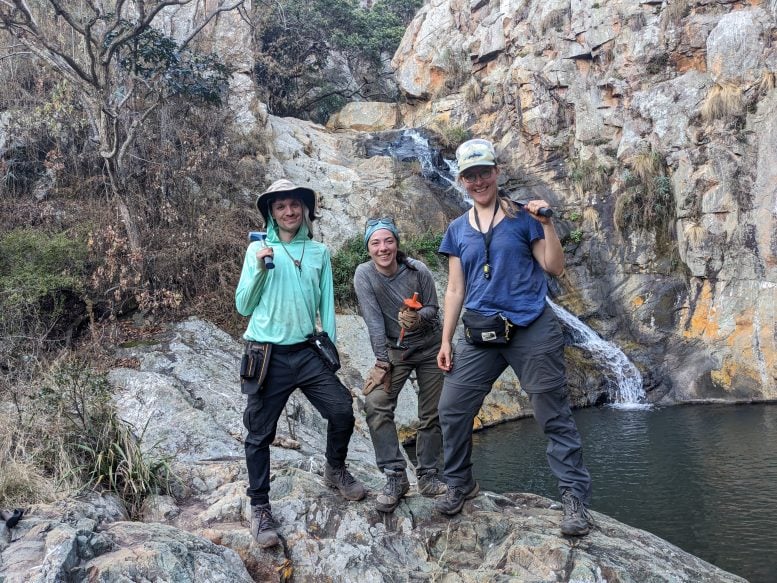
Geologists walk through mountainous terrain, analyzing layers of rock that contain chemical and sedimentary records of ancient impacts. These layers, preserved over billions of years, allow researchers like Drabon and her team to reconstruct the catastrophic events that occurred on primitive Earth.
The S2 impact is just one example of how cosmic events may have played a crucial role in the evolution of our planet. Through detailed studies, scientists are beginning to better understand the impact of meteorites on Earth’s geology and its primitive life.
The Search Continues
Drabon and her team’s next steps in research include studying other areas of South Africa in search of more evidence of ancient impacts. These studies will help build a clearer picture of Earth’s history and the effects of meteorites on its evolution.
The resilience of life and how it adapts to catastrophic events continues to surprise scientists. The S2 meteorite impact, which once caused devastation, is now seen as one of many elements that helped shape the history of our planet. Research continues, with the promise of new discoveries that may reveal more about the mysteries of Earth’s past.


