






 Portuguese
  Spanish


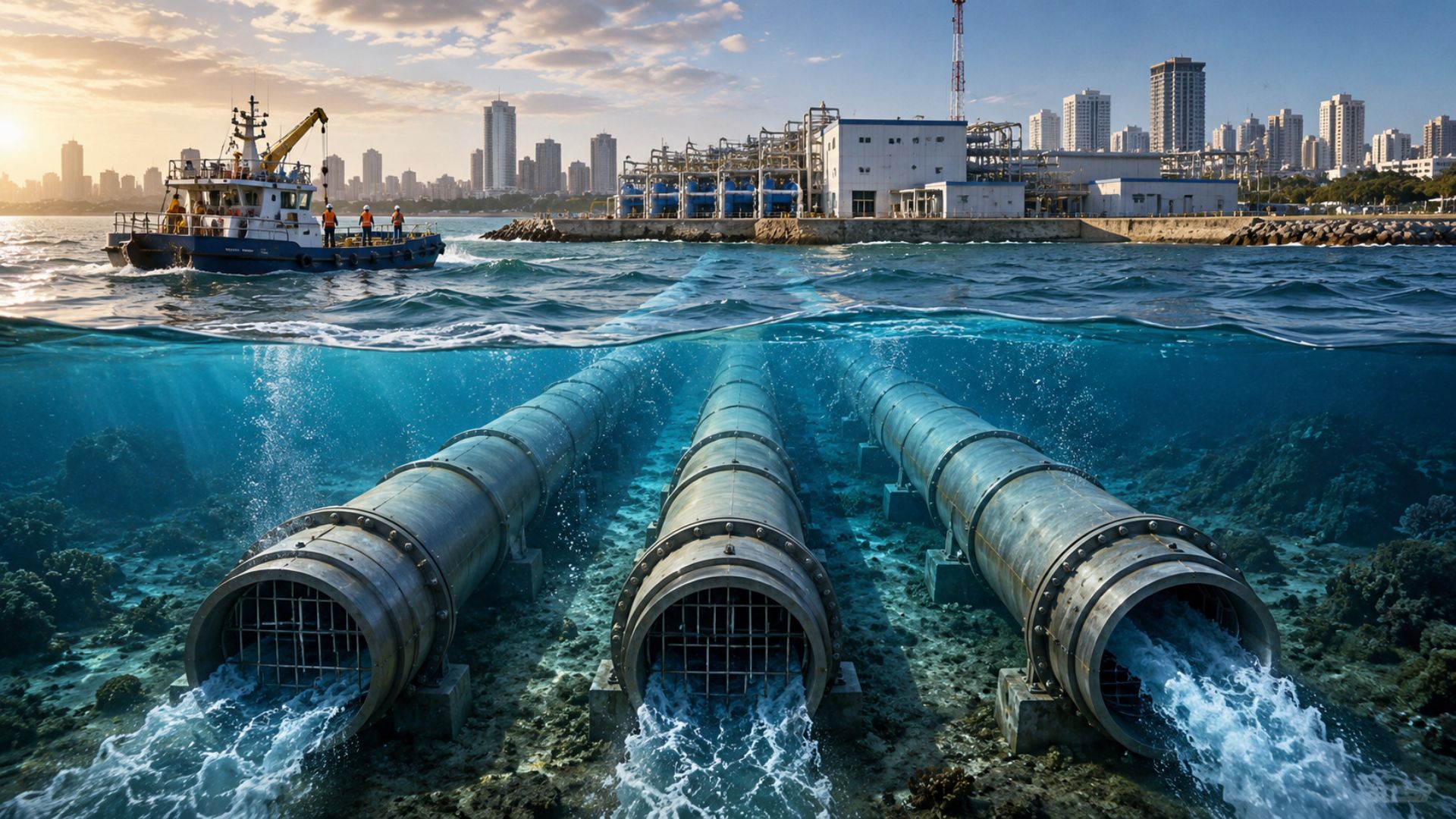


Project in Mumbai plans underwater tunnels, reverse osmosis, and collection in the Arabian Sea to expand the city’s water supply, with part of the infrastructure installed below sea level.
Mumbai is preparing a desalination plant in Manori, on the city’s west coast, with an initial capacity of 200 million liters of drinking water per day.
The project by the Brihanmumbai Municipal Corporation, the municipal body responsible for Mumbai’s administration, includes three 2.5 km underwater tunnels in the Arabian Sea and was planned with the possibility of expansion to 400 million liters daily.
The structure is designed to capture seawater and transform it into drinking water through reverse osmosis, a technology used to remove salts and impurities in desalination plants.
-
Oceanographer Turns Abandoned Fishing Nets from Brazilian Waters into Bags, Creating Jobs and Earning Over $7,000 Monthly

-
Australia deploys poisoned sausages and uses traps, shooting, and fences in a battle against invasive cats that kill over 1.5 billion native animals annually, threatening more than 200 species.

-
NASA Rover Captures “Tired Face” on Mars, Highlighting Human Brain’s Tendency to See Faces in Rock Formations

-
Ancient Stone City in the Desert, Once Home to 30,000, Puzzles Scientists with Nabateans’ Water Mastery 2,000 Years Ago





In this system, two tunnels will be used to conduct ocean water to the treatment unit, while the third will be connected to the discharge associated with the industrial process.
Work in Manori advances on Mumbai’s coast
The plant will be located in Manori, a coastal village in northern Mumbai, in an area of about 12 hectares designated for the installation of the treatment unit.
According to the Indian Express, the plant will be implemented on state government land, while the collection will occur a few kilometers from the coast, in an operation that will keep part of the infrastructure below sea level.
The project advanced in 2026 after receiving authorization related to the Coastal Regulation Zone, a regulation governing interventions in coastal areas in India.
According to the Times of India, the release from the Union Ministry of Environment, Forests and Climate Change was granted with specific environmental conditions for the installation and operation of the system.
The coastal assessment determined precautions related to mangroves, tidal flow, fishing areas, and potential impacts of brine on the marine ecosystem.
The committee also required the involvement of research institutions to study the long-term effects of discharge and alternatives for reuse or better utilization of this waste.
Underwater tunnels will connect the ocean to the plant
According to the project design, the saltwater will follow the intake tunnels to the reverse osmosis plant, where it will undergo treatment stages before being incorporated into the municipal system.
Although the plant is installed on land, the connection with the ocean will depend on an underwater construction prepared to operate in permanent contact with sediments, currents, and saltwater.
The third tunnel planned in the project is linked to the controlled disposal of the saline concentrate generated by desalination.
This material, known as brine, returns to the marine environment with a higher salt concentration than the water originally captured and, therefore, requires environmental management according to regulatory requirements.
To reduce interference with the seabed, the installation of intake and discharge lines should use tunneling methods.
The environmental authorization also provides for restrictions on activities in Manori Creek, a region associated with local fishing, as a way to reduce impacts on coastal communities and sensitive ecosystems.
Production capacity can reach 400 million liters per day
The first phase of the plant was sized for 200 MLD, an acronym used in India for “million liters per day.”
However, the infrastructure for capturing, discharging, and storing treated water was planned to allow future expansion up to 400 MLD, double the initial capacity.
IDE Technologies reported in December 2025 that it received an engineering, procurement, and construction contract to develop the Manori reverse osmosis plant.
According to the company, the unit is part of a strategy to enhance Mumbai’s water security in a scenario of growing demand and greater climate variability.
In the municipal budget for 2026-27, desalination also appears within a set of projects aimed at expanding water supply.
According to the Times of India, the BMC projected an increase of about 800 MLD in water supply in four to five years, with an allocation of 500 crore rupees for the Manori project in the 2026-27 fiscal year.
Desalination seeks to reduce dependence on monsoons
The choice for desalination occurs in a city whose water supply depends on reservoirs filled by monsoons.
In a previous budget document, the BMC stated that delays or failures in the rainfall regime could lead to supply cuts, a scenario used by the agency to justify the search for an additional water source.
The proposal does not replace dams, lakes, and water transfer works but adds a complementary source to the urban system.
In practice, Mumbai is trying to reduce its exclusive dependence on freshwater accumulated in reservoirs by using the Arabian Sea as a permanent source for controlled potable water production.
The implementation involves different technical requirements from those observed in conventional intakes in rivers or reservoirs.
Besides pumping seawater through underwater tunnels, the operation needs to consume energy, protect equipment against corrosion, control the brine, and meet the environmental conditions imposed on the coastal project.
The scale of the enterprise places Manori among the main waterworks planned for Mumbai in the coming years.
With 200 million liters per day in the initial phase, the plant will be able to reinforce the supply of a metropolis with a high population density, while the expansion to 400 MLD will depend on the next stages of execution and operation.


