Portuguese
  Spanish


The abandoned factory of the former Vulcan, in Colégio, has become a focus of garbage, standing water, and fear among residents of the North Zone of Rio, while the land still awaits a new inspection and possible notification to the owner.
The abandoned factory of the former Vulcan, in Colégio, has become a focus of garbage, standing water, and fear among residents of the North Zone of Rio. The case gained new weight in April 2026, when the public authorities announced sanitary inspection actions and technical inspection on the private land.
Residents of Colégio, in the North Zone of Rio, are dealing with a scenario that mixes ruin, dirt, and health concerns. The land where the former Vulcan plastic factory operated has been stripped over the years, and today only walls and beams remain, after successive looting at the site.
In the area, there is garbage, debris, tall vegetation, and accumulated water after recent rains. Those living near the land say the situation has become a daily problem, with reports of rodents and fear that the abandoned space continues to serve as a focus for health and safety risks.
-
The U.S. Navy Conducts Submarine Tests in Idaho Lake to Detect Underwater Noises Hidden by the Ocean

-
British Factory Transitions from Mechanical Parts to Producing 420,000 Electric Power Units Annually, Supplying 70% of Ford’s Electric Cars Sold in Europe
-
France Launches Network to Recycle 20 Million Cookware Pieces by 2027, Accepting All Brands for Aluminum and Coating Separation
-
Ancient Mines in Spain Reveal Tools and Metals That May Explain Bronze Age Trade with Scandinavia


According to g1, the former factory was located on Estrada do Colégio, near Para-Pedro, and was once one of the largest producers of plastic laminates in Latin America. The property occupied an area of 120 thousand square meters and ceased activities in 2018, after bankruptcy was declared.
Residents report abandonment and fear of disease proliferation
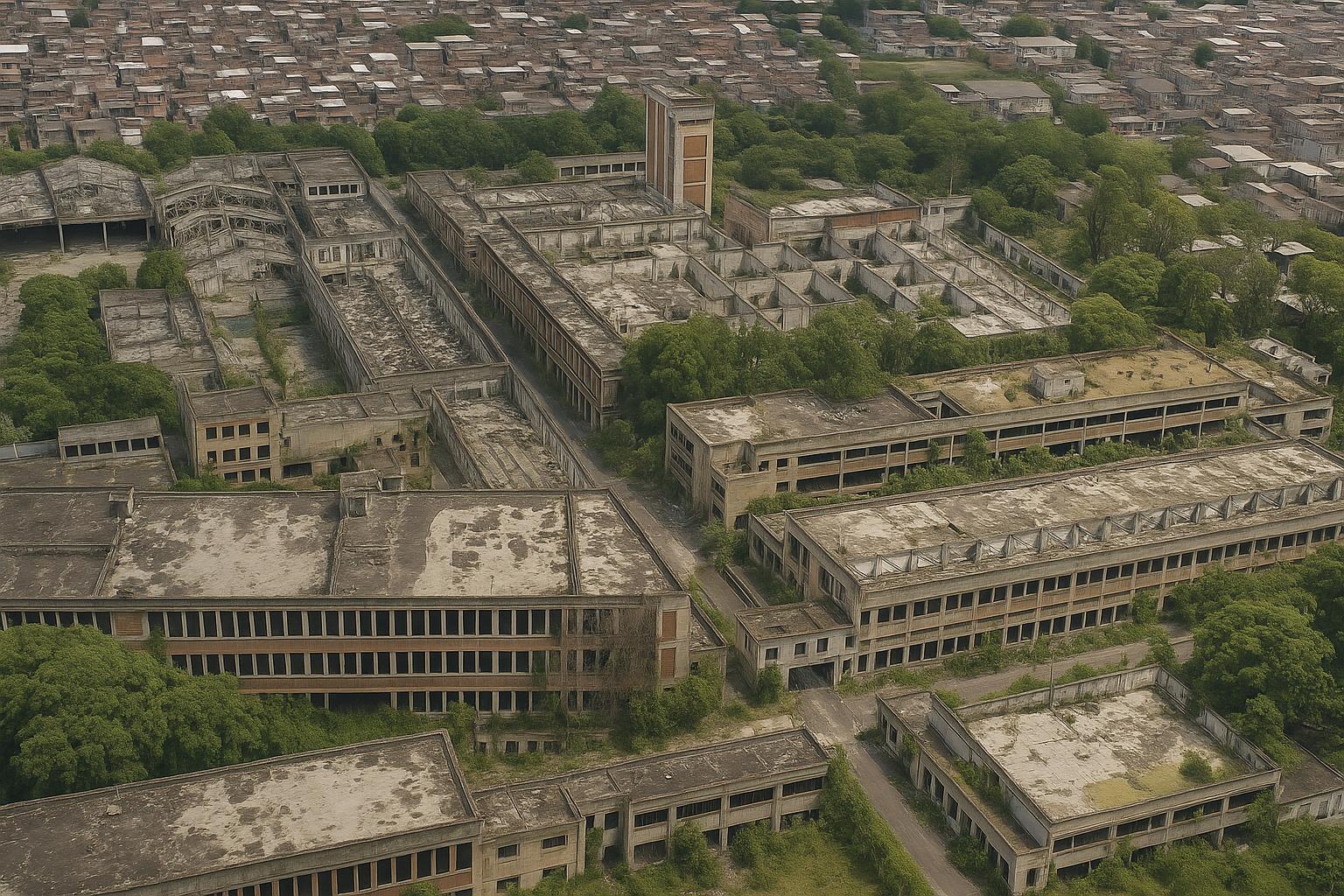
What was once an industrial symbol of the region has become a degraded space open to criminal activity. Roofs and frames were also taken in the looting, and the structure today shows clear signs of prolonged abandonment.
The point that most concerns the neighborhood is the standing water. After the rains, the accumulation on the land increases the fear of mosquito proliferation and reinforces the feeling of neglect with an area that should be isolated and under control.
Residents also report the presence of rodents, which has increased apprehension in the surroundings. The combination of garbage, tall grass, and remnants of the old construction creates a conducive environment for pests and dispels any impression of care for the location.
The factory that occupied 120 thousand square meters and closed in 2018
Vulcan was, for years, an important name in the plastics industry in Rio. The plant operated in an extensive area of 120,000 square meters and had regional significance until it ceased operations in 2018.
Since then, the property has entered a path of deterioration. What remained after looting and abandonment was an industrial shell, unused, with no visible maintenance and no signs of recovery in the short term.
This type of urban void usually takes a toll on the surroundings: besides the loss of economic reference, residents are left to deal with insecurity, dirt, and the risk of a new accumulation of pests.
Health reported inspection in March and new visit scheduled for April 2026
The Municipal Health Department reported, at the time of the investigation, that the location was considered a strategic point for Aedes aegypti control and underwent periodic inspections.
According to the department, a visit had been made on March 19, 2026, when treatment was carried out to eliminate deposits that could serve as mosquito breeding grounds.
Still according to the information released at that time, a new inspection was scheduled for April 15, 2026. Setting this date showed that the land remained on the public authorities’ radar, but also reinforced that the problem still required monitoring.
Comlurb reported inspection and possible notification of the owner
Comlurb reported that it would send a technical team to inspect the area. As it is a private and closed property, the company explained that it could not act directly in the cleaning.
Even so, the company said that the owner would be identified and notified to clean the space. If the order was not complied with, there could be a fine, according to the Urban Cleaning Law.
The case exposes how an old industrial area can become an urban problem when left unused, without maintenance, and without effective control. For residents, the concern is not only in the memory of a factory that closed but in what was left behind: stagnant water, garbage, insecurity, and the wait for a concrete solution.