Portuguese
  Spanish


At a school in Assam, India, no one pays tuition in money: the fee is paid with plastic. Each student brings about 20 items of plastic waste per week, and the Akshar Foundation model increased school attendance from 20 to 110 children, turning waste into education.
The most original rule of this school is right at the entrance. Instead of a bill, the student arrives with a bag of plastic collected at home and in the neighborhood, and that’s what counts as payment. The idea turned an environmental problem into a passport to the classroom and made the school grow quickly.
According to Global Citizen, the Akshar Forum, near Dispur, in the state of Assam, adopted the fee paid with plastic and saw demand soar. When it opened, only 20 students could attend; today there are about 110 enrolled. Each one brings a handful of plastic items weekly, which the school sends for recycling.
How the fee paid with plastic works
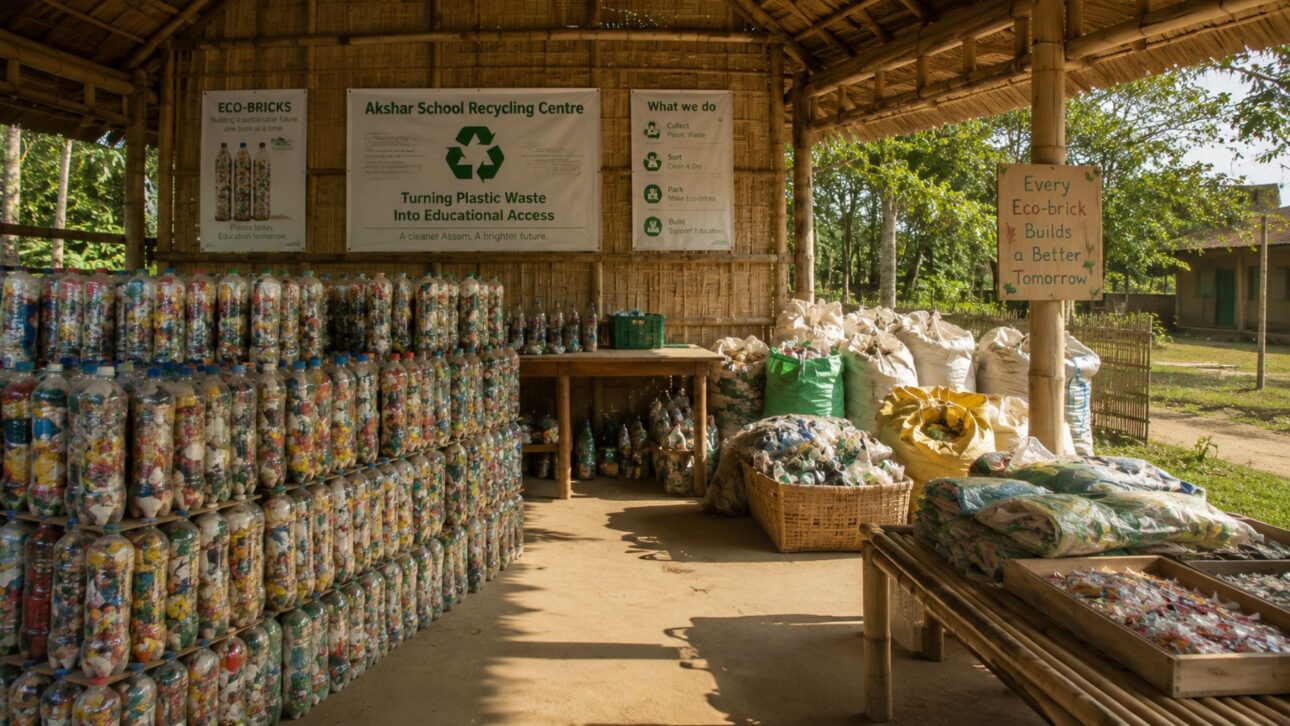
Each student commits to bringing about 20 to 25 plastic items to school per week.
-
Parintins Festival 2026 Celebrates Amazonian Tradition with Three Nights of Competition Between Caprichoso and Garantido, Highlighting Its Cultural Significance in Brazil

-
Brazilian Mayor Goes Undercover as a Person with Disability, Exposes Public Service Flaws

-
Brazilian Siblings Transform Invasive Algaroba into Sustainable, Cost-Effective Lobster Fishing Solution, Winning Youth Challenge
-
Spain Offers Free Housing and Jobs to Attract New Residents to a Remote Mountain Village Seeking a Fresh Start Away from Major European Cities.



This material acts as the fee paid with plastic, replacing the traditional cash fee.
The agreement has an important detail: families commit to no longer burning plastic waste at home.
Before the project, it was common to burn waste in the yard, releasing toxic smoke near homes and the school itself.
By exchanging burning for delivery, the fee paid with plastic tackles pollution and funds education at the same time.
In practice, the waste that dirtied the neighborhood became the currency that opens the classroom door.
From 20 to 110 students: the leap in school attendance
The number that gives the story its title is that of growth.
The school started small, with only 20 students at the beginning of its operation.
After the tuition fee stopped being charged in cash, school attendance rose to about 110 children.
Removing the financial cost lowered the main barrier that kept many families away from school.
With the fee paid in plastic, studying no longer competed with the tight household budget.
This leap in school attendance is the most concrete and measurable effect of the Akshar model.
More than filling the classroom, the increase shows that the project design resonates with the local reality.
What the school does with the collected plastic waste
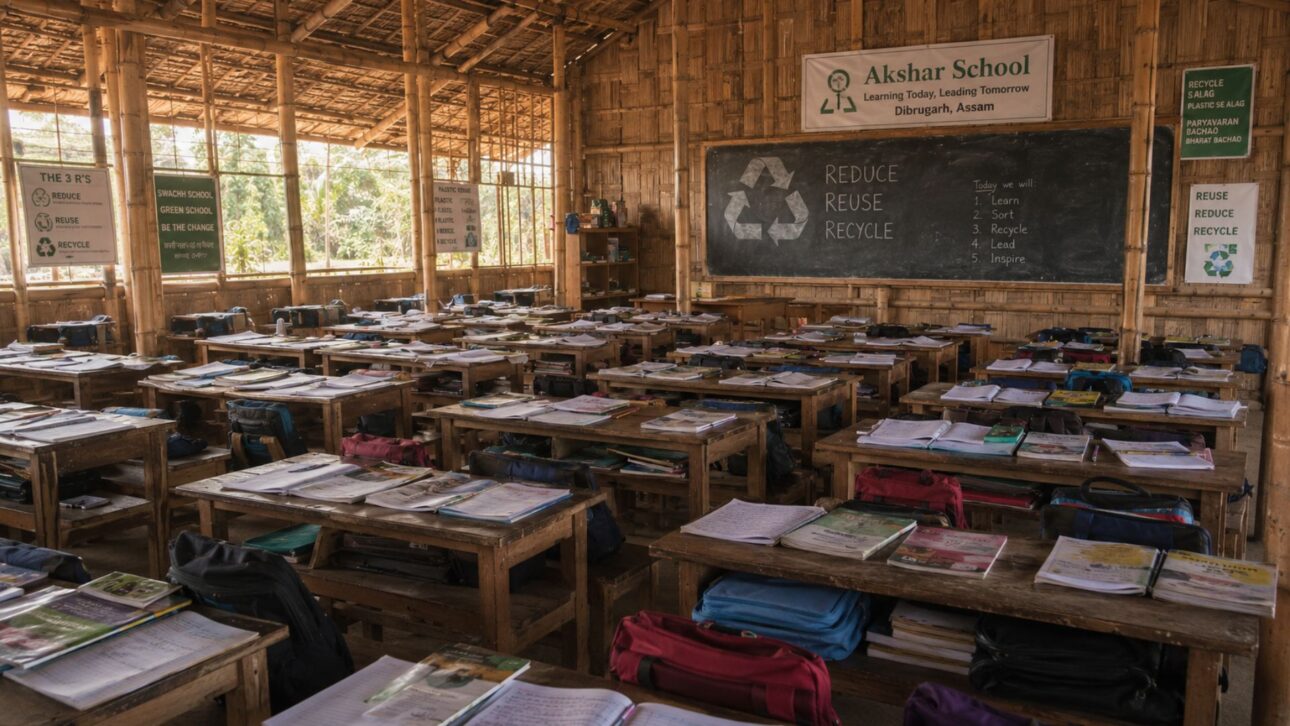
The Akshar Foundation maintains a recycling center within the school’s own structure.
There, plastic waste is transformed into eco-bricks, blocks made from bottles compacted with waste, used in small constructions.
Older students learn to recycle and also help teach the younger ones, in a mentoring system.
This arrangement gives students technical training while reducing the volume of plastic waste in the region.
Every kilo of plastic that becomes an eco-brick is one less kilo burned or thrown into the environment.
The waste, once a nuisance, has become both raw material and a teaching tool.
Who is behind the Akshar Foundation
The school was born from a concrete concern of two educators.
The Akshar Foundation was created in 2016 by Parmita Sarma and Mazin Mukhtar, in Pamohi, in the Guwahati region.
The couple says they got tired of smelling burning plastic invading the classroom from neighboring houses.
Instead of just complaining, the two designed a model that connected education, income, and the environment.
The proposal united three things that usually remain separate: free school, recycling, and job training.
The Akshar Foundation thus became a laboratory of how a school can solve the community’s own problems.
What was a small unit in Assam ended up attracting attention both inside and outside of India.
The expansion: from the Akshar Foundation towards 100 schools
The founders’ plan was never to stop at just one school.
The Akshar Foundation signed an agreement with the Assam government to bring the model to public schools in the state.
The declared goal is to reach about 100 schools with the same system in the coming years.
The expansion phase to the public network is expected to advance from 2025 and 2026.
Sources vary on the current number, citing several dozen schools already involved in the process.
Bringing the tuition paid with plastic to the public network is what can transform a good local idea into a scalable policy.
If it succeeds, the model ceases to be a curious exception and becomes a replicable alternative for other regions.
Why the Assam model gained worldwide attention
The story has ingredients that explain its reach.
India is one of the countries that produces the most plastic waste on the planet, so the underlying problem is huge.
Solving pollution and access to education with a single measure is the kind of solution that travels well on social networks.
The model is easy to explain: exchange money for plastic and get a cleaner and fuller school.
For public managers, it attracts by combining circular economy, school attendance, and technical training.
The strength of the Assam case lies in showing that sustainability and education can finance each other.
It’s the kind of social innovation that other countries observe to try to adapt to their own reality.
What the case of tuition paid with plastic shows
The Akshar school is a powerful example of creativity applied to a real problem.
It proves that it is possible to align the environment and education in a simple and replicable design.
But it’s worth keeping your feet on the ground.
The plastic pays the symbolic tuition, but it does not cover salaries, infrastructure, and school materials alone.
Like most social projects, Akshar also relies on donations, partnerships, and public support to sustain itself.
The numbers of students and schools vary according to the source, so it is advisable to treat them as an order of magnitude.
Even so, few models summarize so well how turning plastic waste into school attendance can change a community.
From a small school in Assam to the goal of 100 units, the Akshar Foundation bets that waste is worth education.
And you, would you take plastic waste from home if it paid for your neighborhood school? Comment here if you think tuition paid with plastic could work in Brazilian cities.