






 Portuguese
  Spanish


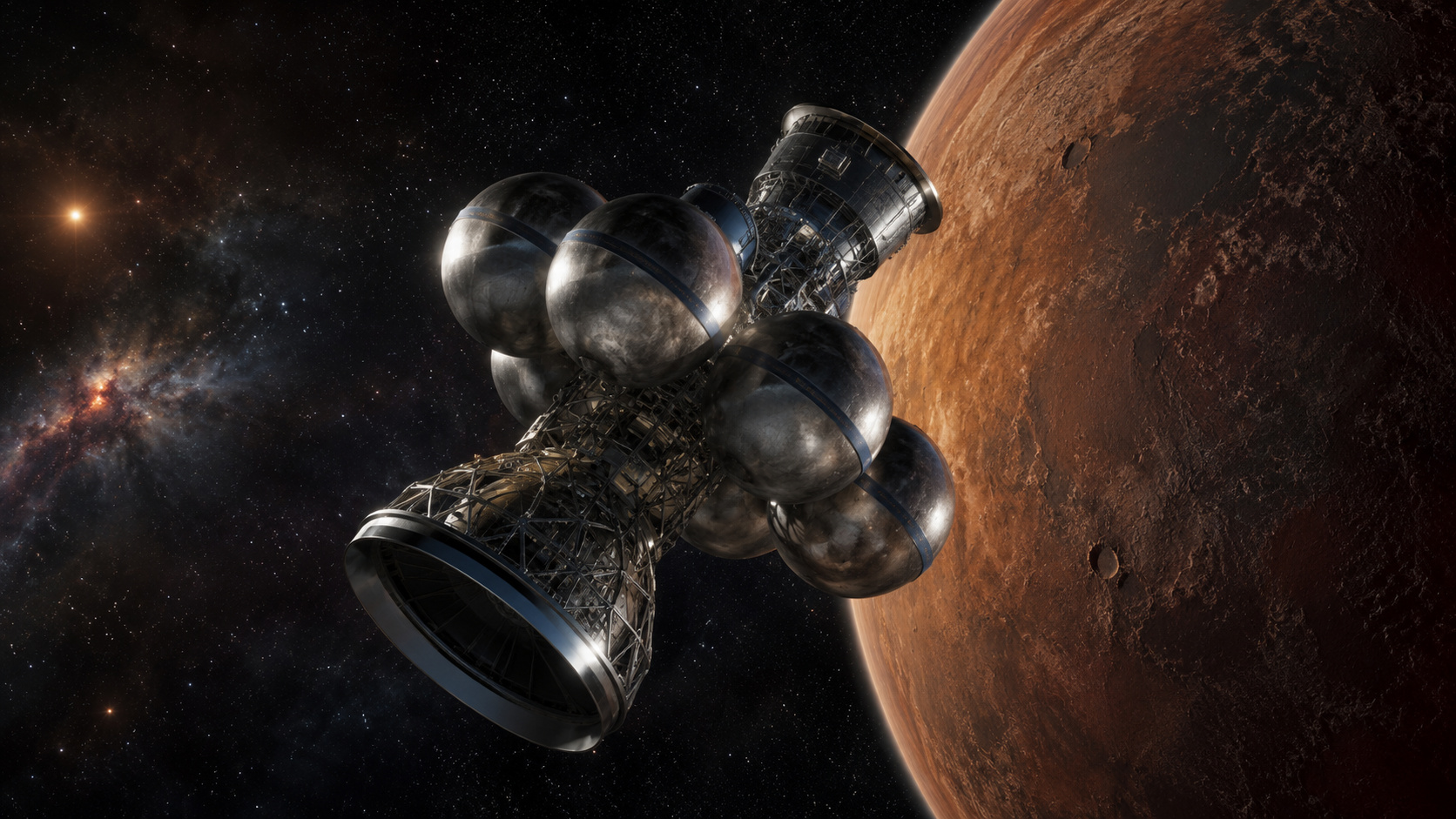

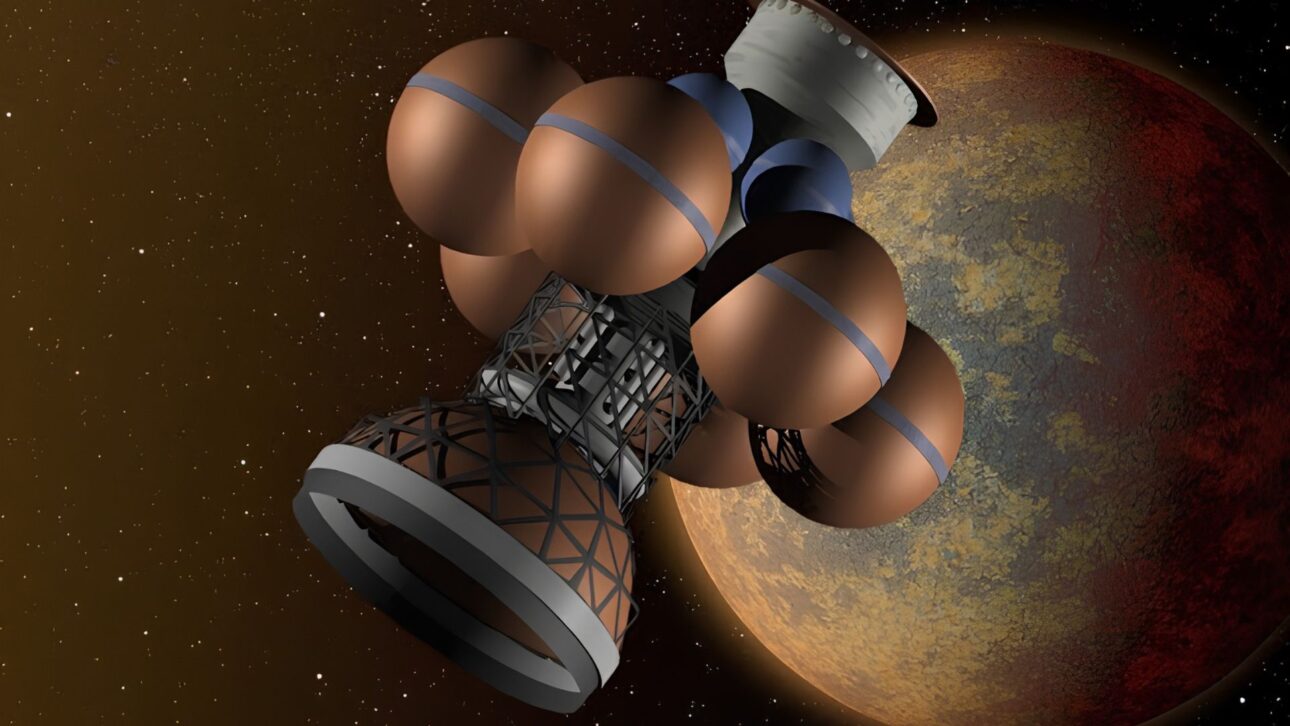
Project Daedalus was a study by the British Interplanetary Society for a 190-meter interstellar probe powered by nuclear fusion.
Between 1973 and 1978, the British Interplanetary Society assembled a team of volunteers to tackle a question that seemed unreachable for space engineering at the time: would it be possible to design a probe capable of traveling to another star on a scale compatible with a human lifetime? The result was the Project Daedalus, one of the most ambitious studies ever conducted on interstellar travel.
The concept was not of a manned ship, but of an unmanned scientific probe designed to show that interstellar travel could be treated as an engineering problem, not just science fiction. The target was set as Barnard’s Star, about 5.9 light-years away, within a mission conceived to use existing or near-future technology.
Project Daedalus and the 190-meter interstellar ship designed for another star
The Project Daedalus envisioned a spacecraft about 190 meters long, assembled in space with an initial mass of 54,000 tons. Of this total, approximately 50,000 tons would be dedicated to fuel, while the scientific payload would be in the range of hundreds of tons.
-
Giant 2.2 km Device Sweeps Plastic from Pacific Ocean, Cleaning an Area the Size of a Football Field Every 5 Seconds to Contain World’s Largest Ocean Garbage Patch

-
Brazil’s Public Health System Launches Study on Semaglutide’s Impact on Obesity
-
NASA’s Giant “Space Flower” to Unveil Earth-like Planets by Blocking Distant Stars’ Light

-
A 13-foot robot nicknamed Godzilla is assembling the world’s largest nuclear fusion reactor piece by piece.



The study also started from a colossal scale by astronautics standards. Technical material associated with the project summarizes Daedalus as a ship twice as tall as the Saturn V, which helps to gauge the size of the challenge proposed back in the 1970s.


More than a visual exercise, this size was a direct consequence of the chosen mission. To cross interstellar space in decades, the probe would need to carry fuel in gigantic proportions and an architecture capable of supporting prolonged acceleration, long-duration cruising, and protection against the interstellar environment.
Nuclear fusion propulsion was the heart of Project Daedalus
The project’s foundation was a nuclear fusion propulsion system by inertial confinement. According to the British Interplanetary Society and the subsequent study Project Icarus, the Daedalus would be a two-stage vehicle powered by deuterium and helium-3 pellets, compressed and detonated by electron beams.
In practice, this concept was far beyond traditional chemical rockets. Instead of relying on chemical combustion, the spacecraft would use successive fusion pulses to generate enough thrust for a mission to another star, a theoretical solution much more energetic than any conventional launch architecture.
The BIS records that this process would be maintained at a rate of 250 detonations per second, during a long thrust phase. It was a radical proposal, but built within the logic of showing that interstellar travel could be described with concrete technical parameters.
Two-stage spacecraft would accelerate for almost four years up to 12% of the speed of light
The design of the Daedalus divided the spacecraft into two stages. The BIS reports that the acceleration phase would last more than 3.8 years, followed by a long interstellar cruise of about 46 years.
At the end of this sequence, the probe would reach a speed exceeding 12% of the speed of light. In technical synthesis material related to the study, this appears as a cruising speed of 12% of c, a figure that made Daedalus one of the boldest proposals ever formulated for an interstellar robotic mission.
This is one of the points that most explains the project’s enduring fame. Daedalus did not promise a slow journey of centuries, but a crossing in a few decades, within a time scale that would still allow humanity to follow the scientific outcome of the mission.
Mission to Barnard’s Star would be a high-speed scientific flyby
The Project Daedalus was not designed to slow down upon reaching its destination. The BIS itself describes the mission as a flyby, that is, a high-speed flyover of the Barnard’s Star system, with passage in a matter of days.
This means that the spacecraft would not land or enter orbit. The focus was to transport a large scientific probe to another star, quickly traverse the target system, and transmit data back to Earth after the passage.
This choice made sense within the energy limitations of the project. Braking a ship of this size after accelerating it to more than 12% of the speed of light would make the mission even more complex, heavy, and difficult to justify within the original goals of the study.
British Interplanetary Society wanted to prove that interstellar travel was engineering, not fantasy
The BIS summarizes the study with three central goals: the ship should use current or near-future technology, should reach the destination within a human working lifetime, and should be flexible enough to allow adaptation to different target stars.
These premises help understand why Daedalus became so influential. The goal was never to sell a vague fantasy about exploring the galaxy, but to build a demonstration of theoretical feasibility with clearly defined mass, propulsion, mission time, flight architecture, and engineering requirements.

It was this approach that turned the project into a historical reference. Even without leaving the drawing board, Daedalus showed that the discussion about interstellar probes could move from the realm of imagination to the field of technical calculation.
Project Icarus updated the legacy of Daedalus decades later
Decades later, the study Project Icarus emerged precisely as a continuation of this legacy. In the article published on arXiv, the authors describe Icarus as a successor designed to redesign Daedalus with similar terms of reference, but in light of more recent scientific and technological advances.
The BIS itself also states that the goal of Icarus was to advance the concept of Daedalus to a more credible and updated design. This shows that the 1970s project was not treated as a historical curiosity, but as a real basis for a new generation of interstellar studies.
This legacy helps explain why the name Project Daedalus continues to appear in debates about nuclear fusion, interstellar probes, and missions to nearby stars. The study did not build a ship, but left a reference standard for everything that came after.
Legacy of Project Daedalus keeps alive the idea of a real mission to another star
More than four decades later, the fascination around Daedalus remains strong because the project brought together almost everything an interstellar mission would require in conceptual terms: ship length, total mass, fuel, stages, speed, mission duration, and defined destination.
The image of the 190-meter probe powered by nuclear fusion, launched as a colossal artifact towards a star 5.9 light-years away, remains powerful precisely because it was born from a real technical effort. Project Daedalus was not a ship ready for immediate construction, but one of the most detailed engineering exercises ever conducted to transform interstellar ambition into something measurable.
This is why the project still occupies such a unique place in the history of space exploration. Few concepts have managed to so well condense the distance between what seems impossible and what, at least on paper, can be described as a viable mission architecture.


