





 Portuguese
  English
  Spanish
  5 min of reading
  0 comments


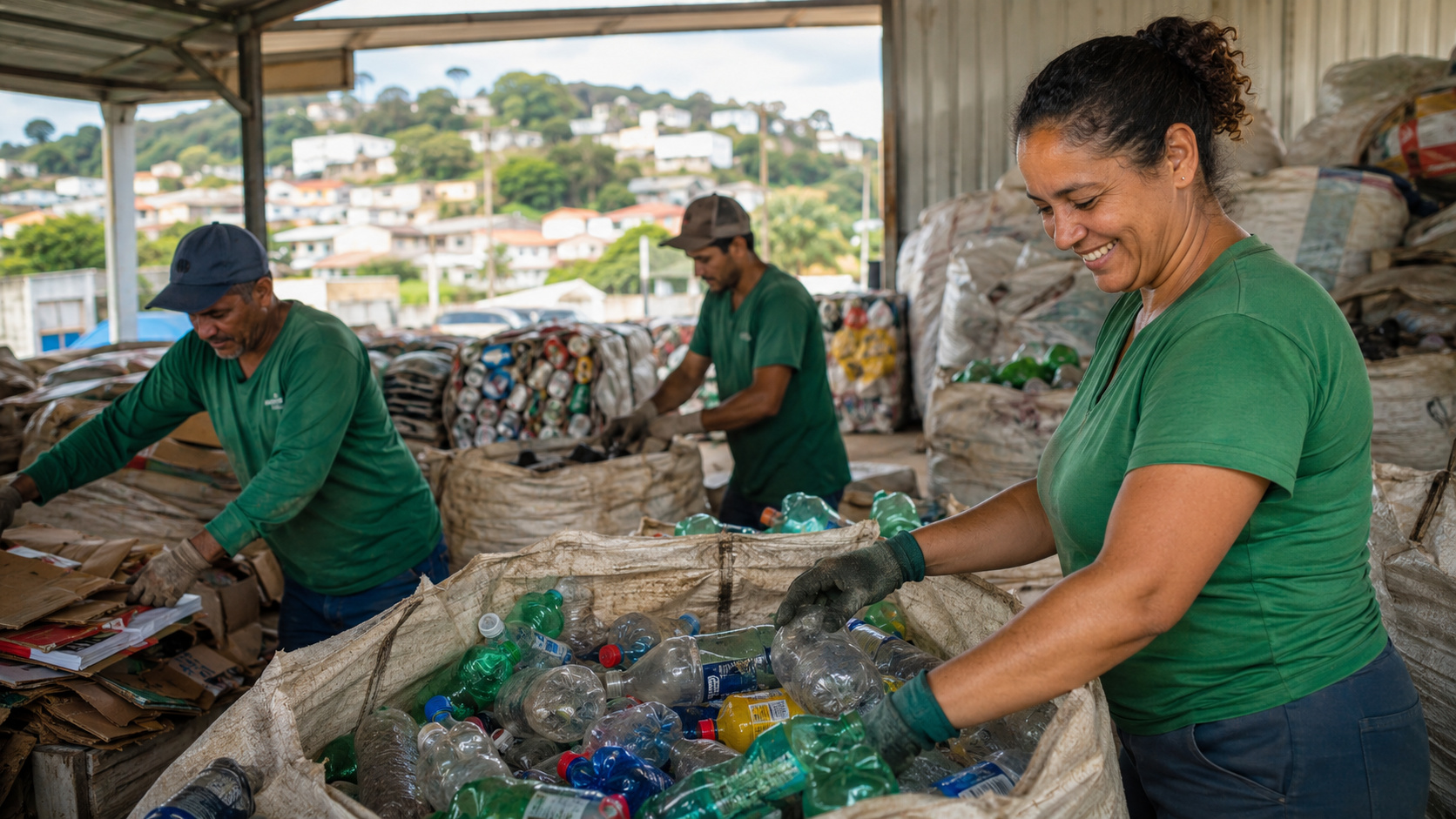
Recycling Project in Montenegro aims to turn recycling into income for waste pickers, improve selective collection, engage residents, and provide more structure to families living off recycled materials in Rio Grande do Sul
The Recycling Project in Montenegro was approved by the Recycling Incentive Law and enters a new phase to strengthen the work of waste pickers in Rio Grande do Sul.
The initiative directly benefits 28 families of waste pickers in the Estação neighborhood and impacts more than 1,000 residents of the community. The information was released by Global Communities Brasil, the organization responsible for publishing the project.
The proposal draws attention because it treats recycling as something beyond waste separation. It involves income for families, environmental education, structure for the cooperative, and stronger selective collection within the city.
-
A Brazilian city decided to treat waste as currency, created an app that gives points for recyclables, and included cooking oil, coffee capsules, electronics, and even large appliances in the environmental account.

-
While many people change tires and forget the destination of the old rubber, Brazil sent 384,391 tons of used tires in 2025 and revealed the hidden mountain that cars, buses, and trucks leave behind after driving.
-
The gravity of the Earth was factored into the calculation, and now scientists say that sea levels may rise more than many coastal cities imagined by 2100.
-
RN faces barriers to eliminate 176 dumps spread across the state, and the difficulty in implementing modern waste treatment solutions exposes a problem that continues to affect the environment, public health, and regional development.


How the Recycling Incentive Law can turn taxes into direct support for waste pickers
The Recycling Incentive Law was created by Law No. 14,260, of December 8, 2021. The rule allows companies to allocate part of their Income Tax to projects approved by the Ministry of the Environment.


In practice, a company can support a recycling initiative without creating an extra cost, as long as it is within the rules of the law. The tax that would already be paid starts to help a project with social and environmental impact.
In the case of the Recycling Project, this approval paves the way to raise funds in 2026. The money can strengthen the cooperative’s structure and improve the working conditions of those who live from collecting and sorting waste.
The 28 families of waste pickers gain more strength with headquarters, equipment, and organization
The 28 beneficiary families are part of a common reality in many Brazilian cities. These are people who work with recyclable materials, often with little infrastructure, but who help reduce waste and stimulate the local economy.
The project was created in 2021 and focuses on productive inclusion, circular economy, proper waste management, and the autonomy of the cooperatives. In simple terms, the idea is to turn discarded material into income in a more organized way.
Over five years, the project mobilized R$ 6.5 million in investments. The publication made on March 2, 2026 by Global Communities Brazil, the organization responsible for the project’s dissemination, reports that the resources were allocated to training the collectors, legalizing the cooperative, purchasing equipment, providing technical support, and constructing the headquarters of the Cooperativa Estação Reciclar, already inaugurated in February 2026.
What changes with the new phase of the Recycling Project in Montenegro
Global Communities Brazil, the organization responsible for the project’s publication, detailed that the new phase includes machinery, vehicles, continuous training, management support, and strengthening of local partnerships.
Among the planned items are presses, conveyors, forklifts, trucks, tricycles, scales, and PPE. PPE is personal protective equipment, used to protect the worker during the collection, separation, and handling of materials.
With this structure, the cooperative will be able to accommodate up to 60 cooperatives and manage up to 780 tons of waste per year. This number shows how a local initiative can scale up when provided with adequate infrastructure.
Environmental education makes selective collection move from discourse to inside homes
Recycling works better when residents understand what to separate, why to separate, and how to deliver the material correctly. Therefore, the project also works with socio-environmental education.
In 2025, more than 500 children were reached through educational activities at the Reciclarte space. The proposal is to teach from an early age that properly separated waste can return to the production chain and still generate income for families in the city itself.
Since 2023, the cooperative has been conducting door-to-door solidarity collection in condominiums, residences, schools, and businesses. This work helps to reuse materials that could end up in landfills.
Real Profit Companies can support recycling at no additional cost
Companies taxed under the Real Profit regime can support the Recycling Project through the Recycling Incentive Law. The rule allows allocating up to 1% of the Income Tax due to the initiative.
For those unfamiliar with this type of mechanism, the idea is simple. Part of the tax that the company would already pay can be directed to an approved project, with a direct impact on collectors, cooperatives, selective collection, and environmental education.
The project receives sponsorship from John Deere, support from Sicredi Ouro Branco, the Municipality of Montenegro, and Braskem, in addition to a partnership with the Banco do Brasil Foundation. This support network helps explain how recycling has gained strength within the city.
What other medium-sized cities can learn from Montenegro
Montenegro shows that recycling can be a local policy of income and inclusion. Instead of treating collectors as invisible workers, the project places these families at the center of the solution.
The experience also leaves a simple lesson for other medium-sized cities. Selective collection does not depend only on trucks or bins. It requires education, organization, equipment, and appreciation of those who work with recyclable materials every day.
When a cooperative has headquarters, training, and support, waste ceases to be just an urban problem. It becomes an opportunity for work, income, and environmental care.
The Recycling Project in Montenegro unites 28 collector families, more than 1,000 residents, environmental education, and tax incentives in a single strategy. Approval by the Recycling Incentive Law makes it possible to expand this structure in 2026.
If it reaches up to 60 cooperators and manages up to 780 tons of waste per year, the initiative can transform the way the city views waste. More than just separating waste, the project shows that recycling can also mean giving dignity to those who live from this work.
Do you think every medium-sized city should have a structured cooperative to transform recycling into income for local families? Comment and share this story.


Be the first to react!