






 Portuguese
  Spanish





The Exemption Up to R$ 5,000 Comes with Compensations (Minimum Effective Rate and Taxation of Dividends), Without Spending Cuts. For Financial Educator William Ribeiro, Someone Will Pay the Bill.
The income tax exemption for those earning up to R$ 5,000 per month was announced by the government as a fiscal relief measure for salaried workers. However, this new measure comes with compensations that increase the burden on high-income professionals and on dividends, without any cuts in public spending, analyzes William Ribeiro.
According to the proposal, there will be a new progressive table between R$ 5,000 and R$ 7,350, with automatic deductions to avoid distortions. The range between R$ 7,350 and R$ 50,000 remains unchanged, maintaining the maximum rate of 27.5%. Above R$ 50,000, a minimum effective rate of 10% will be applied. In addition, profits and dividends above R$ 50,000 per month will be taxed, both in Brazil and when sent abroad.
How the New Income Tax Table Works
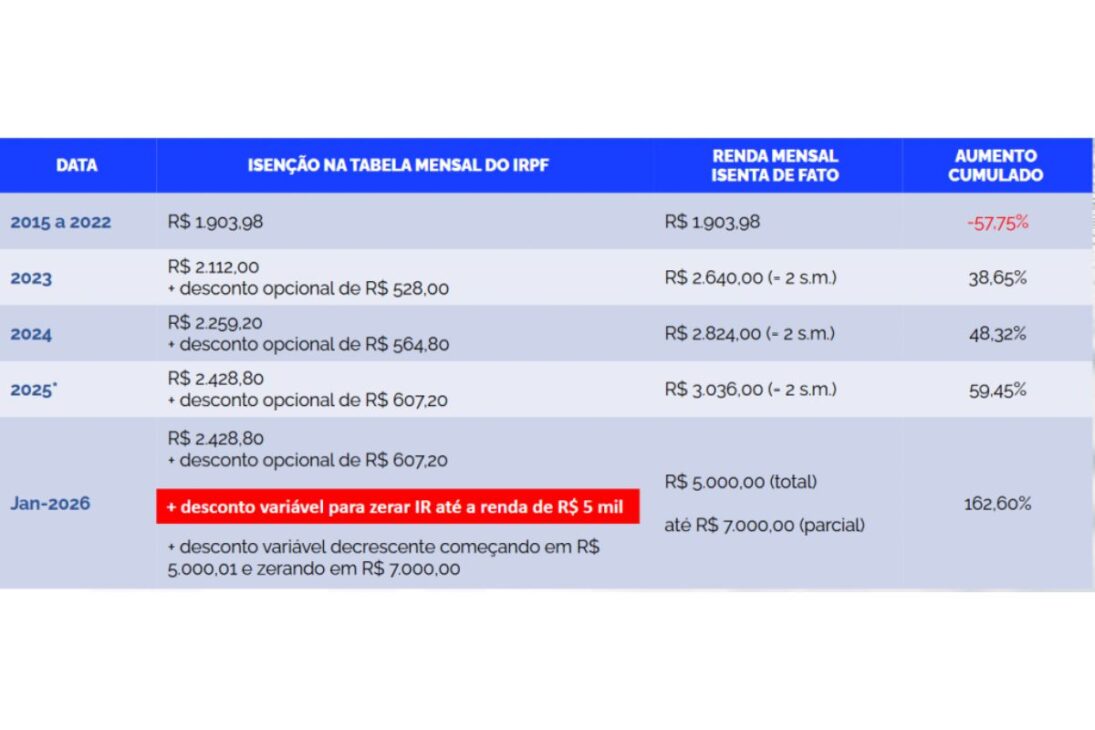
In practice, the change guarantees total exemption for those earning up to R$ 5,000 monthly under the CLT regime. For incomes between R$ 5,000 and R$ 7,350, an intermediate table will be created that corrects distortions and prevents someone earning R$ 5,100, for example, from taking home less than someone who is fully exempt.
-
Brazilian Workers and Instructors to Train in China on Electric Car Technology Ahead of New Factory Opening in Brazil

-
Viral Message Claiming Government Will Deposit Money for Registering CPF as Pix Key Debunked

-
Embraer Acquires Full Control of Mexican Aircraft Interiors Manufacturer EAI to Reduce Supplier Dependence and Protect Margins Amid Global Aviation Competition

-
Controversial Amazon Highway BR-319 to Receive $1.3 Billion for Road Upgrades and $570 Million for Territorial Governance in Brazil


For salaries of R$ 7,350 to R$ 50,000, nothing changes: the current table remains in effect, with progressive brackets up to 27.5%. Above that value, even those who already pay income tax may see an increase due to the minimum rate of 10% on declared income.
Dividends Are Included
The greatest impact falls on self-employed professionals and business owners who receive via Legal Entity (PJ). Currently, after paying taxes at the company level, distributed dividends are exempt in the individual’s tax return. With the new rule, monthly dividends above R$ 50,000 will be taxed, with rates that can reach 10%.
An example cited is that of a doctor who receives R$ 55,000 in monthly dividends: currently, he pays nothing in his individual tax return; with the proposal, he will begin to pay around 2.5%, which may increase depending on the bracket. In addition, dividends sent abroad will incur an additional rate of 10%.
Super Rich in the Crosshairs


According to data reported by economist William Ribeiro, the so-called “super rich” (about 200,000 people in Brazil, 0.1% of the population) have an average income of R$ 392,000 per month and pay, on average, only 7.4% in individual income tax.
Among the top 10% of this group, the average rate is only 3%. The minimum rate of 10% aims to correct this distortion but may face political resistance in Congress.
The government, through the Civil House, argues that the measure promotes “more tax fairness,” but without cuts in public spending, which raises alarms among specialists regarding the sustainability of the policy.
Parties such as União Brasil and Progressistas are already moving to try to alter the compensations, while the opposition is pressing for the exemption to be financed by cuts in expenditures.
Political Debate and Economic Impacts
The project will still be discussed in Congress, where it is expected to face resistance from sectors linked to businesspeople and high-income professionals.
For the governing base, the priority is to lighten the load for the middle class and expand the exemption, even if that means taxing more those who earn above R$ 50,000.
Economists warn that, without cuts in spending, the measure is simply a reallocation of the tax burden, not a reduction. The risk is that the discussion becomes electoral, already targeting 2026, instead of structural, which could hinder a genuine tax reform.
And you, do you consider the income tax exemption up to R$ 5,000 justified by the taxation on dividends and high income, even without cuts in public spending? Do you think this redistribution solves or merely delays the fiscal problem? Leave your opinion in the comments — we want to hear from those living this experience.









Acho justo principalmente porque no Brasil salário sempre foi considerado renda, quando deveria ser tratado como sobrevivência, o seu uso aplicado aí sim, se constituiria em renda, agora que o governo tenha consciência e ao isentar quem ganha ateR$ 5 mil, não jogar nas costas dos que ganham R$ 5.001,00 até R$ 7,500 mil um desconto para compensar sua perda de receita, essa tabela precisa ser feita com criterios nao sacrificando os que ganham até R$ 10 mil.
Na verdade não era para ter esse tal Imposto de Renda. É um absurdo se pagar um valor mensal sobre a renda que se recebe, principalmente no Brasil, que é tomado de CORRUPÇÃO, onde o desvio de recursos públicos acontece diuturnamente, prejudicando assim o retorno para a sociedade.
Para mim este ajuste no IR é mais do que Justo pois não houve aumento na tabela do desconto por muitos anos. E o desconto sobre os dividendos também. Só acho que deveriam também diminuir os gastos públicos, começando com retirada de regalias dos políticos e diminuição dos salários dos políticos.