Portuguese
  Spanish


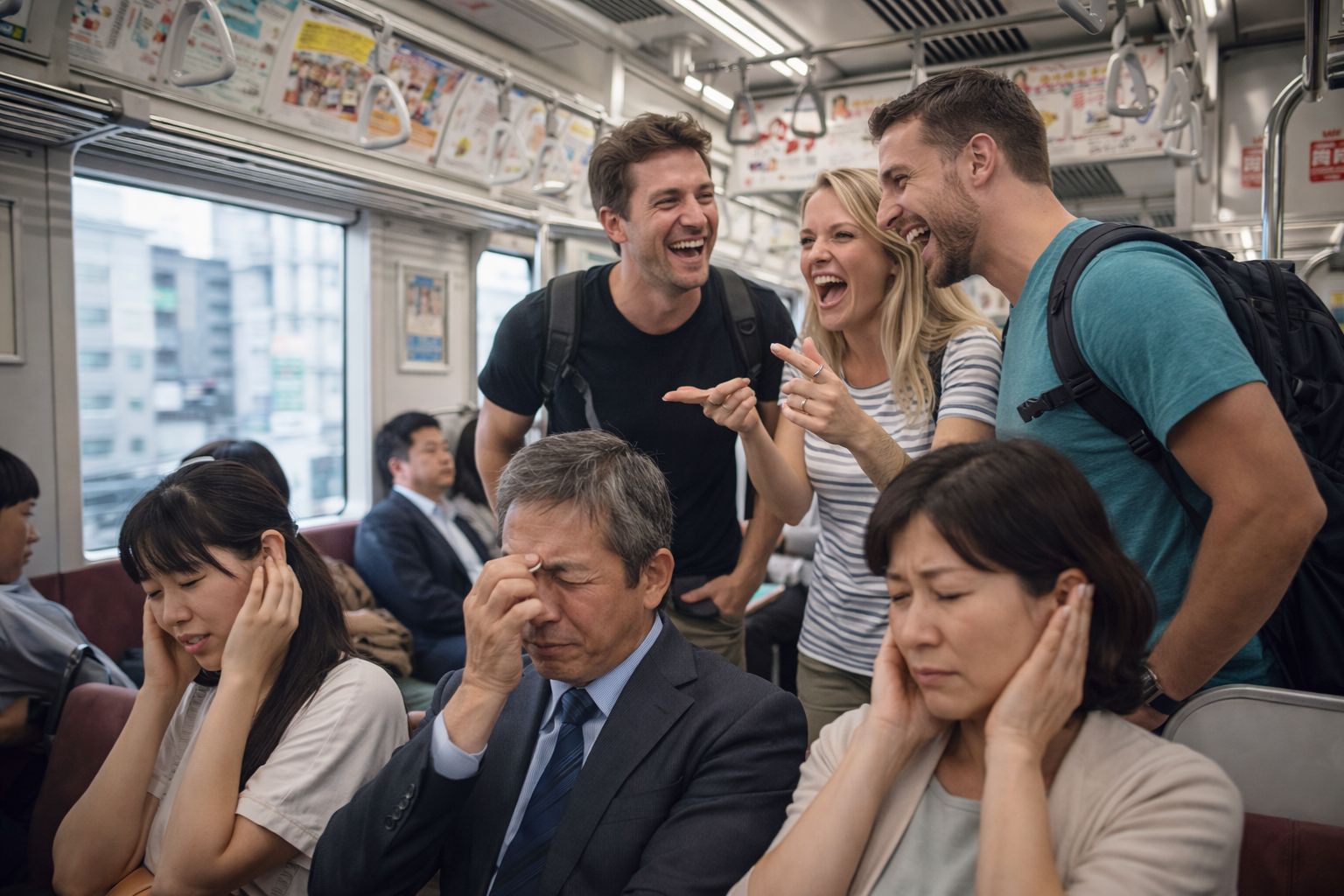


For the second consecutive year, Japan asked citizens what bothers them most about tourists. The answer was the same: 69.1% point to loud conversations on trains as the main problem. The survey reveals that the discomfort does not change because the root is cultural and the clash between Japanese silence and foreign expressiveness has no simple solution.
The Japan has just repeated a social experiment that reveals much more than it seems. For the second consecutive year, the country asked its citizens what bothers them most about the behavior of tourists, and the answer was practically identical to the previous year: speaking loudly and behaving disorderly on trains is the main point of friction, cited by 69.1% of respondents. In a country where millions of people travel daily on one of the most punctual railway networks in the world and where delays of mere seconds generate public apologies, the volume of a visitor’s voice is not just noise; it is a transgression of deeply rooted social norms.
What makes this survey particularly revealing is not the response of the Japanese but the fact that it has not changed. The repetition of the result suggests that the problem is not evolving because the root is cultural and deep: Japan values silence, discretion, and respect for personal space as pillars of collective coexistence, while more expressive cultures treat conversation in public as something natural and even necessary. This clash has no simple technical or educational solution, and Japan seems to be beginning to understand that the issue is not correcting tourists but deciding how its culture adapts to an increasingly globalized world.
What the Japanese survey revealed about discomforts on trains
According to the portal Xataka, the survey confirmed that loud conversations and disorderly behaviors lead the list of complaints for the second consecutive year. But they are not the only problems that Japanese citizens identify with tourists on trains. Poorly positioned luggage blocking aisles and doors, people sitting taking up more space than necessary, strong odors, and the habit of not giving way when the doors open appear frequently in both years of the survey.
-
After 18 years of development, Bridgestone launches the AirFree airless tire, which requires no inflation and is puncture-proof, into daily service in Japan, starting with autonomous vehicles up to 20 km/h, used for transporting elderly people.

-
Couple buys 1905 colonial house, plans to tear down walls to unite three rooms, but finds hidden service staircase and rethinks the entire renovation to preserve details that have survived for over a century.
-
Couple receives a quote of $50,000 to install a built-in refrigerator, decides to do the work themselves, spends $6,000, and claims to have saved over $100,000 by renovating the house.
-
At 77 years old, an elderly woman lives alone in an almost ghost village in the French Alps, at an altitude of 1,000 meters, where there is a town hall, a mayor, and an entrance sign, but only she lives there every day in a place destroyed by a landslide and almost erased from the map.


What impresses in the comparison between the two years is the stability of the results. The list of annoyances has changed very little, which suggests that they are not isolated incidents, but recurring patterns that residents of Japan easily identify in visitors. Even seemingly minor issues, such as not respecting the flow of people inside the train or blocking the doors during boarding and alighting, reinforce the perception that the problem is not punctual, but structural. Japan is not discovering new annoyances: it is confirming the same ones.
Why silence on trains is so important to Japanese culture

To understand the reaction of the Japanese, it is necessary to comprehend what a train represents in Japanese culture. Japanese urban trains function as almost silent spaces, where talking on the phone is socially unacceptable and even conversations between friends are kept at a minimum volume. During peak hours, when some trains exceed 180% occupancy, passengers optimize every gesture to minimize discomfort to others. In this environment, a conversation at a normal volume by Western standards sounds like a transgression.

image: anacassiano
This behavior is not imposed by laws or enforcement, but by an unwritten social norm that the Japanese absorb from childhood. In Japan, discretion in public spaces is a value as fundamental as punctuality, and breaking it generates collective discomfort even when no one verbalizes the complaint. A tourist who speaks loudly on the train is not committing a crime, but is violating a social contract that everyone around respects. The difference between being noisy on a subway in São Paulo and being noisy on a train in Tokyo is not in the volume, but in the meaning that each culture attributes to silence.
What Japan does not attribute to tourists and why it matters
An interesting nuance of the latest research is the distinction that the Japanese make between inconveniences caused by tourists and problems caused by their own citizens. When analyzing the general inconveniences, those attributed to all passengers, elements emerge that are not associated with visitors, such as traveling while intoxicated or certain inappropriate uses of mobile phones. In the new research, coughing or sneezing disrespectfully has become the main inconvenience among the Japanese themselves, something that does not appear on the tourists’ list.
This differentiation reveals maturity in the way Japan analyzes the problem. The country is not solely pointing the finger at visitors as responsible for everything, but clearly separating its own problems from those of others. This distinction was already implicit in the previous research, but now it appears in a much more defined way. Japan acknowledges that it has its own internal inconveniences and does not project them onto foreigners, a degree of honesty that makes the research more credible and its results more useful for any cultural analysis.
What the two consecutive researches reveal about Japan
The decision to repeat the research for the second year was not accidental. Japan is using this data to measure whether the cultural shock between residents and tourists changes over time or remains stable. And the answer is clear: it remains stable. The differences between the two years are smaller than the similarities, indicating that the conflict is not diminishing with more information, more signs in English, or more awareness campaigns. The root of the problem is cultural, and cultures do not change in a year.
Perhaps the most surprising thing is not what tourists do, but what Japan reveals about itself by repeating the research. The responses again revolve around respect for personal space, silence, and collective order, fundamental pillars of Japanese culture that come into direct conflict with the behavior of visitors from societies that value expressiveness, spontaneity, and extroversion. Japan is not asking tourists to become Japanese, but by documenting the inconvenience, it is making it clear where the limits of what it considers acceptable lie.
The dilemma of Japan between tourism and cultural identity
Japan has received record numbers of tourists in recent years and is increasingly relying on tourism as a source of economic revenue. At the same time, the research shows that the massive presence of visitors generates frictions that touch the heart of Japanese cultural identity. Silence on trains is not a preference, it is a value. Order in boarding is not a suggestion, it is a principle. And when millions of tourists each year do not share these values, Japan finds itself facing a dilemma that has no easy answer.
The question that the research raises is deeper than “tourists are noisy.” It is to what extent a model of coexistence based on extreme discretion can adapt to an increasingly globalized world, without Japan losing what makes it Japanese. The two consecutive researches do not resolve this dilemma, but document it with an honesty that few countries demonstrate. And in doing so, Japan reveals as much about itself as it does about the tourists it receives.
Japan asked for the second time what bothers them about tourists, and the answer was the same: speaking loudly on trains. Do you think tourists should fully adapt to local culture or that Japan needs to accept diverse behaviors? Have you ever experienced culture shock while traveling? Share in the comments.