Portuguese
  Spanish


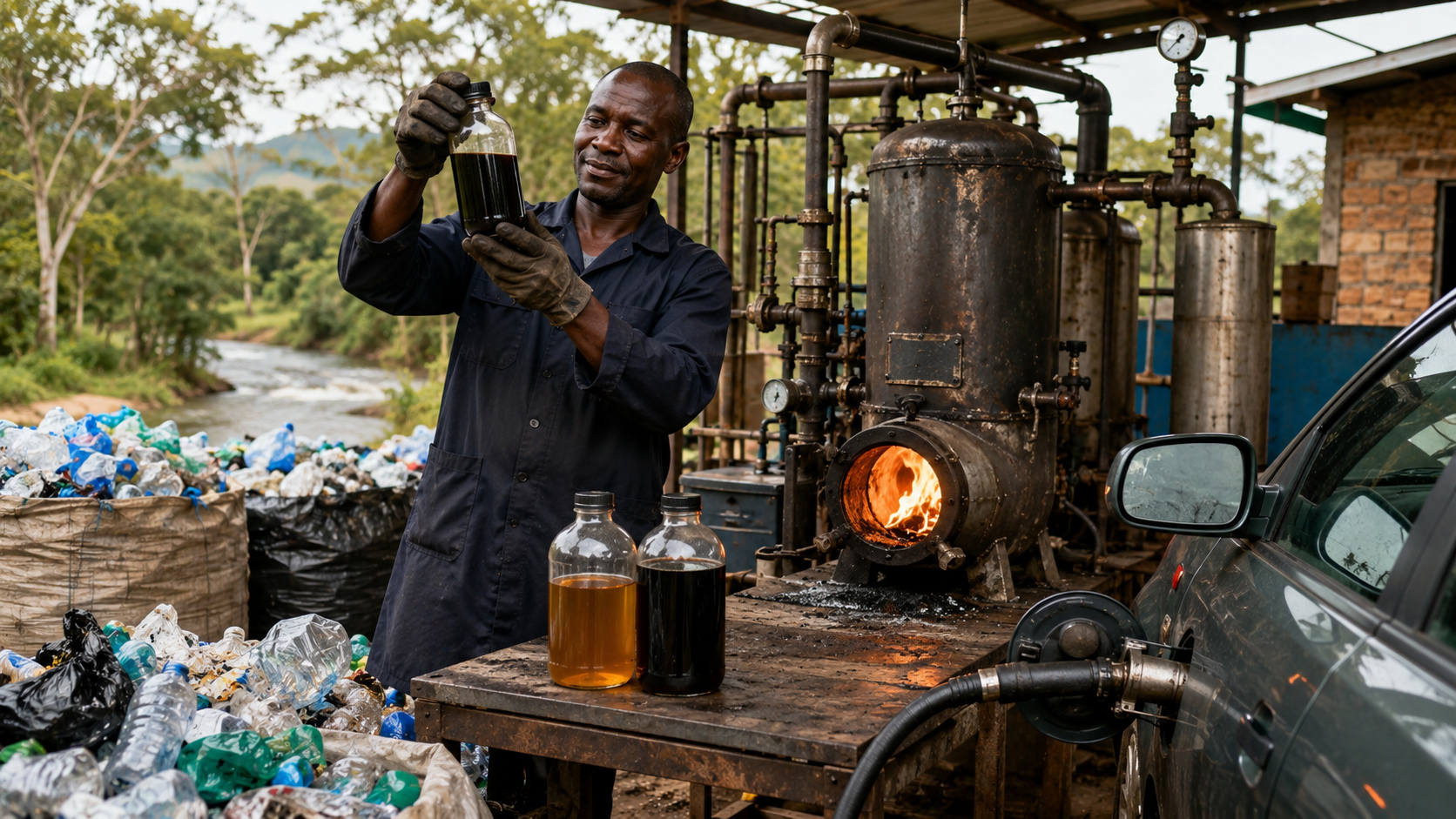

By transforming plastic waste into alternative fuels, Joseph Muritu shows how innovation, sustainability, and entrepreneurial vision can convert a serious environmental problem into a promising and practical energy solution.
According to Africanews, the plastic waste that most people see as an unsolvable problem has become, in the hands of a Kenyan entrepreneur, a source of fuel capable of powering cars and machines of all kinds. Joseph Muritu, leading a project called Progreen Innovations, found a way to heat plastic to extremely high temperatures in the absence of oxygen — a process known as pyrolysis — and, with this, transform the waste back into an oily liquid, similar to petroleum, from which fuels are extracted.
The result is impressive: Muritu produces two types of alternative fuel. “The first is an alternative gasoline, used in small and medium-sized machines. And there is the alternative diesel, used by heavy diesel engines: generators, and also vehicles — in my own car, that’s what I use,” he told the publication.
In other words, the fuel that comes from discarded bags and bottles is not just theoretical: it already powers the inventor’s own car. Joseph Muritu’s story is proof that, with ingenuity and science, it is possible to see treasure where others only see trash — and transform one of the planet’s greatest environmental threats into part of an energy solution.
-
Brazilian State Sets Example by Replacing Asphalt with Concrete Roads, Offering Durability Over 40 Years in Challenging Mountain Terrain

-
Security Guard Rescued Alive After Over 150 Hours Trapped in Collapsed Venezuelan Mall Following Earthquakes
-
Mystery of the Crooked Forest: Hundreds of Pine Trees in Poland Grow with Identical J-Shaped Curves
-
Chinese Buildings Use Mist System to Combat Extreme Heat, Cooling Surfaces by Up to 8°C; Water Consumption Limits Use in Drier Cities





A discovery born from an accident
As with many great ideas, Muritu’s journey towards plastic fuel did not begin with a grand plan, but with curiosity sparked by a happy accident in his backyard. According to Business Daily Africa, Muritu spent over 20 years building software and hardware systems in Africa, North America, and Australia before dedicating himself to this new venture. He says he entered the manufacturing field purely by chance.


“In the last three years, I developed an interest in chemistry and started an experiment in the backyard to recover aluminum from discarded aluminum materials. And, by pure chance, once, we melted plastic, which gave us a kind of gelatinous liquid, and from there an interest arose, and we started researching,” recalls Muritu. “With that, we dove into deep research in the field, and we haven’t stopped since.”
It was from this “failed” experiment of accidentally melting plastic that the seed of an innovative business was born. Based in Kenol, in the Murang’a region of Kenya, Muritu set up a reactor locally to carry out the process. To bring the idea to life and finance the business, he delved into his own savings, investing over 5 million Kenyan shillings — and, according to him, this investment continued to grow. His partner, Michael Nthenge, a mechanical engineer, was responsible for manufacturing all the compartments of the project.
How Plastic Turns into Fuel
The heart of Muritu’s invention is a chemical process that, although it may sound complex, is based on a relatively simple principle — and it is crucial to understand it to not confuse it with mere burning of waste. According to Africanews, pyrolysis involves heating plastic to very high temperatures in the absence of oxygen. Without oxygen, the plastic does not catch fire: instead of burning, it decomposes, reverting to its origin — after all, plastic is derived from petroleum.
The result of this heating is an oil, or hydrocarbon liquid, which can then be refined into different types of fuel. One of the by-products of the process is called biochar (a type of charcoal), which, ingeniously, is reused to fuel the reactor’s own furnaces, making the system more efficient. According to Business Daily Africa, the process has well-defined stages. First, employees separate the plastic waste to obtain the ideal type of plastic needed for fuel production.
Next, the raw material is shredded into smaller pieces, which are washed to remove any impurities. Only then does this material go to the reactor, where the heat, in the absence of oxygen, works its chemical magic. The process yields a product equivalent to gasoline, suitable for small and medium-sized engines, and an equivalent to diesel, which works well in all diesel engines, including those in vehicles, generators, and heavy machinery.
An Army of Collectors and the Waste Economy
Muritu’s operation goes far beyond chemistry: it has created a small economic gear that generates jobs and mobilizes entire communities around plastic collection. Muritu has already hired seven employees and works with groups of volunteers, scrap metal dealers, and women in collecting the plastic material used for fuel production in Kenol. This arrangement transforms waste into a resource with value: what once clogged drains and polluted rivers now has a purpose and a destination. The context of the problem he tackles is enormous.
Global waste production reaches 400 million tons per year, according to the United Nations Environment Programme. Of this total, only 12% is incinerated and only 9% is recycled. The rest — the vast majority — ends up in landfills or in nature, where it can take hundreds of years to decompose, if it ever does, due to the resistant and durable chemical structure of plastic. It is in the face of this practically eternal mountain of waste that solutions like Muritu’s gain relevance: each kilo of plastic transformed into fuel is one less kilo polluting the environment for centuries.
Environmental caveats: not everything is simple
It would be irresponsible to present Muritu’s technology as a magical and cost-free solution. Experts make important considerations, and it is fair to acknowledge them to understand the real scope — and limits — of this innovation. According to Africanews, the expert Otieno, interviewed by the publication, makes a fundamental caveat: “The most carbon-effective way to deal with plastic waste is not to produce any plastic at all. So, we need to innovate to find alternatives to plastic.”

But he acknowledges the value of the solution for the problem that already exists: “As long as we have plastic — those we’ve already produced — we need to explore all options. And I think pyrolysis and locally produced low-tech processes, like what this innovator has developed, should be encouraged.” There is also the issue of emissions. There is a legitimate concern about the harmful gases released during the pyrolysis reaction.
However, Otieno clarifies a crucial technical distinction: it is necessary to understand the difference between pyrolysis and incineration. “Incineration is burning in the presence of air; pyrolysis is heating in a closed system,” he explains. Therefore, according to him, the amount of toxic gases released is, by itself, limited — and Otieno adds that most of these gases produced in pyrolysis are redirected back into the process itself, which helps mitigate the impact. It is worth noting for the reader that the fuel obtained from plastic and its combustion are still subjects of environmental study and debate, and that the technology, although promising, does not replace the broader need to reduce plastic production at the source.
A solution that points the way
Muritu’s work is part of a larger movement that has been gaining strength across the African continent — and that can transform the way the world views both waste and energy production. The Kenyan case is not isolated. Similar initiatives to transform plastic into fuel through pyrolysis have been emerging in various African countries, from Ghana to Nigeria, driven by the same logic: to simultaneously tackle two chronic problems — the accumulation of plastic waste and the scarcity or high cost of fuel.
What makes Muritu’s approach especially inspiring is its local and replicable nature: a reactor assembled with self-acquired knowledge, powered by waste collected in the community, generating fuel used right there. It is the circular economy in its most concrete and tangible form. Of course, it’s important to keep perspective: this is still a modest-scale solution, with technical, environmental, and economic challenges to be overcome before it can be adopted widely and safely. But the symbolic and practical value of the initiative is undeniable.
The story of Joseph Muritu is, in the end, a powerful reminder that humanity’s most stubborn problems often hide, within themselves, the seeds of their own solutions — provided that someone, with curiosity, knowledge, and determination, is willing to see them. An engineer who spent his life among software and circuits found, in an accident with melted plastic in the backyard, a new mission: to prove that what we throw away every day, without a second thought, may contain the energy that makes the world move. And that sometimes, the fuel of the future might be exactly where you least expect it — at the bottom of a trash can.