Portuguese
  Spanish


Technology adopted on Santa Catarina highways draws attention for its resistance, unusual thickness, and promise to reduce maintenance in mountain sections where curves, trucks, and terrain increase demands on the pavement used daily.
Santa Catarina has expanded the use of concrete pavement on mountain highways to increase track resistance and reduce the need for frequent maintenance in sections marked by inclines, sharp curves, and heavy traffic.
In areas like Serra Dona Francisca, in northern Santa Catarina, the solution has gained prominence because the rugged terrain, braking on descents, and cargo circulation increase pavement wear over the years.
According to a report by ND Mais published on April 24, 2026, engineer André Torrens, regional infrastructure coordinator in the North of the State, states that concrete can be up to five times more resistant than conventional asphalt.
-
Security Guard Rescued Alive After Over 150 Hours Trapped in Collapsed Venezuelan Mall Following Earthquakes

-
Mystery of the Crooked Forest: Hundreds of Pine Trees in Poland Grow with Identical J-Shaped Curves
-
Chinese Buildings Use Mist System to Combat Extreme Heat, Cooling Surfaces by Up to 8°C; Water Consumption Limits Use in Drier Cities

-
German Shepherd Fails Guide Dog Test Due to Attachment to Plush Elephant, Viral Moment Captured at Train Station





Concrete gains ground on mountain highways in Santa Catarina
The choice of concrete does not represent abandoning asphalt, but a technical decision according to the needs of each section, taking into account vehicle volume, terrain, initial cost, execution time, and maintenance planned during the road’s lifespan.
On mountain highways, this type of pavement tends to be prioritized because it forms a more rigid and thick structure, prepared to withstand repeated stresses from trucks, buses, and trailers at points of greater pressure on the track.
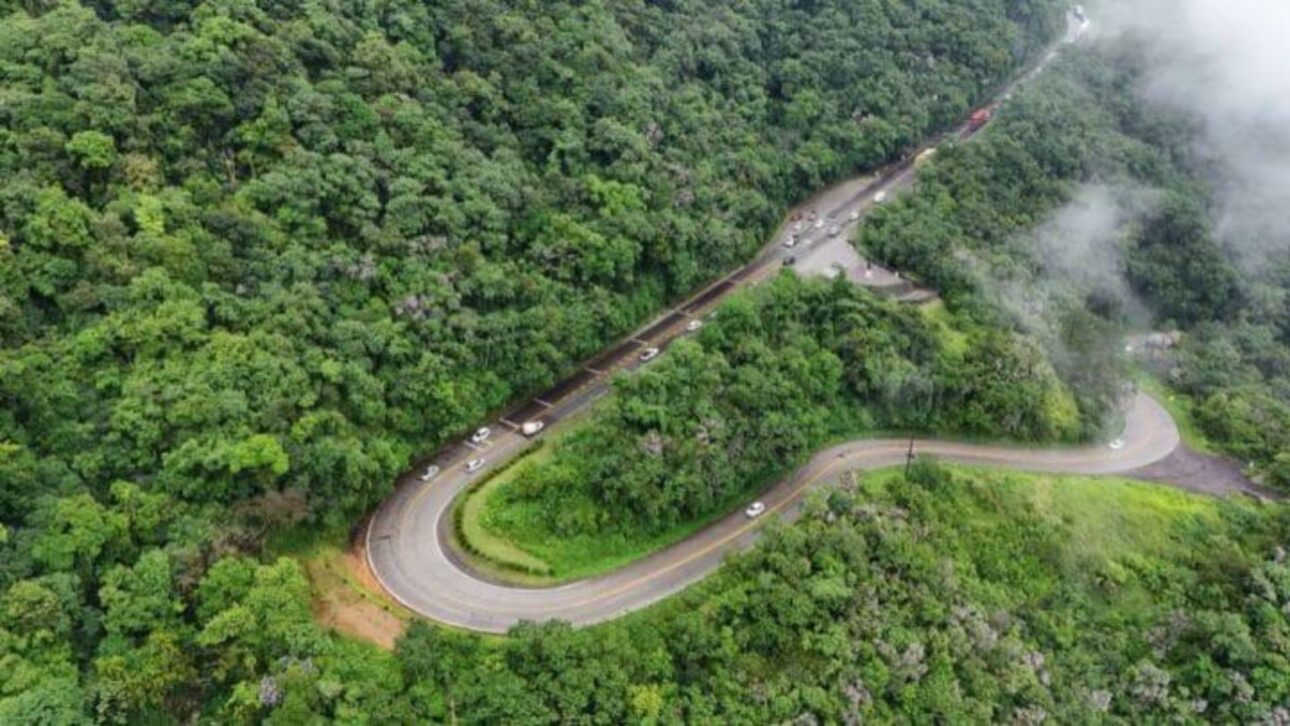
While a common layer of asphalt is about 6 centimeters, concrete pavement can reach approximately 26 centimeters in thickness, a difference that improves load distribution and helps preserve the structure for longer.
This resistance becomes more important in mountains because heavy vehicles reduce speed, face curves in low gear, and require greater grip, a combination that intensifies tire friction and accelerates deformations in less rigid materials.
In Serra Dona Francisca, curves executed in concrete have been in operation for about 46 years, according to the same report, which reinforces the use of these sections as a technical reference in road projects in Northern Santa Catarina.
Greater resistance can reduce interventions on the road
Among the main advantages of concrete is its structural durability, as the rigid slab better withstands the repetition of loads and the variations imposed by long descents, sharp curves, and traffic concentrated in specific lanes.
With fewer deep deformations, the highway tends to require less frequent repairs, reducing blockages, operational detours, and disruptions for drivers who depend on these sections for cargo transport and commuting between cities.
Although the initial cost is usually higher than asphalt, the Government of Santa Catarina acknowledges this difference in recent rigid pavement works within the Estrada Boa Program, aimed at the recovery and implementation of state highways.
On SC-477, between Canoinhas and the access to BR-116, in Monte Castelo, most of the 34.5 kilometers received rigid concrete pavement with more than 22 centimeters of thickness, according to the state government’s News Agency.
The official publication reported on May 29, 2025, that the SC-477 section was opened to traffic and that urban areas received flexible pavement, while other points of the project adopted concrete.
Difference between rigid pavement and white topping
Concrete can be used in different ways on highways, depending on the condition of the existing road and the objective of the intervention planned by the technicians responsible for the engineering project and the execution of the work.
When the concrete slab is executed directly on a prepared base, the solution is called rigid pavement, a method applied in new constructions or reconstructions that need to support high loads for a longer time.
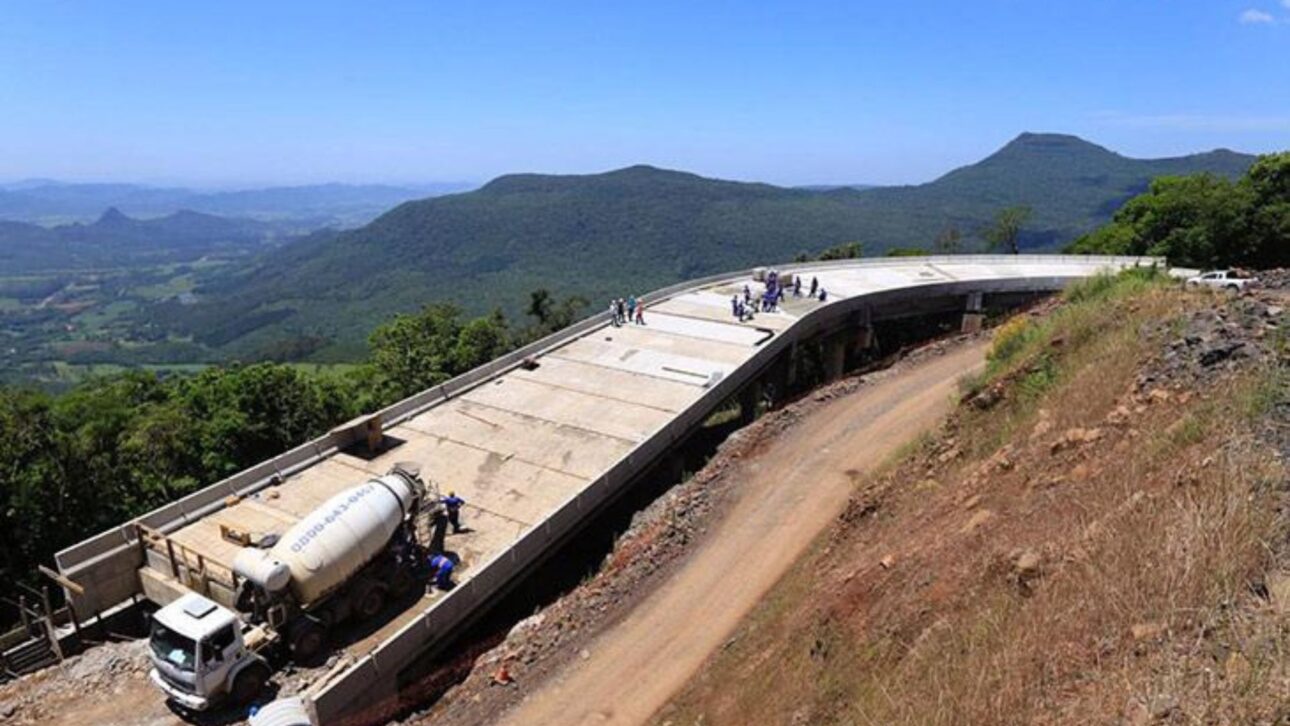
Another technique is white topping, used when concrete is applied over an existing pavement, forming a rigid reinforcement layer to extend the structure’s lifespan without requiring a complete reconstruction of the highway.
In both models, the base material is Portland cement concrete, different from asphalt concrete, which uses a petroleum-derived binder and exhibits distinct structural behavior under heavy traffic and temperature changes.
The technical difference matters because Portland cement concrete works with greater rigidity, while asphalt has a more flexible composition and is usually adopted in sections where cost, speed of execution, and scheduled maintenance weigh more.
Where concrete makes more sense on highways
In critical points, such as mountains, tunnels, ramps, high-stress curves, and logistical corridors, the use of concrete tends to be more advantageous when traffic interruption for maintenance can generate queues and operational impact.
In urban areas or sections with other execution requirements, asphalt remains relevant for allowing faster construction, localized interventions, and lower initial cost, provided the project considers the actual vehicle demand.
For this reason, the decision between asphalt and concrete depends on technical analysis, including expected resistance, soil conditions, drainage, truck flow, road safety, and accumulated cost during the track’s lifespan.
In the Santa Catarina mountains, the experience with concrete indicates that durability can offset the initial investment, especially when the alternative involves frequent repairs in locations with difficult operation and high impact on traffic.
The expansion of this technology in Santa Catarina places rigid pavement at the center of the debate on road infrastructure, mainly in regions where terrain, climate, and heavy traffic demand greater performance from the tracks.
With long-lasting examples in the mountains and new state projects adopting concrete in strategic sections, the discussion involves not only the cost of construction but also the real cost of keeping a highway operational for decades.
If concrete can reduce maintenance and increase lifespan in challenging mountains, should it be used on more Brazilian highways with heavy traffic?