






 Portuguese
  Spanish


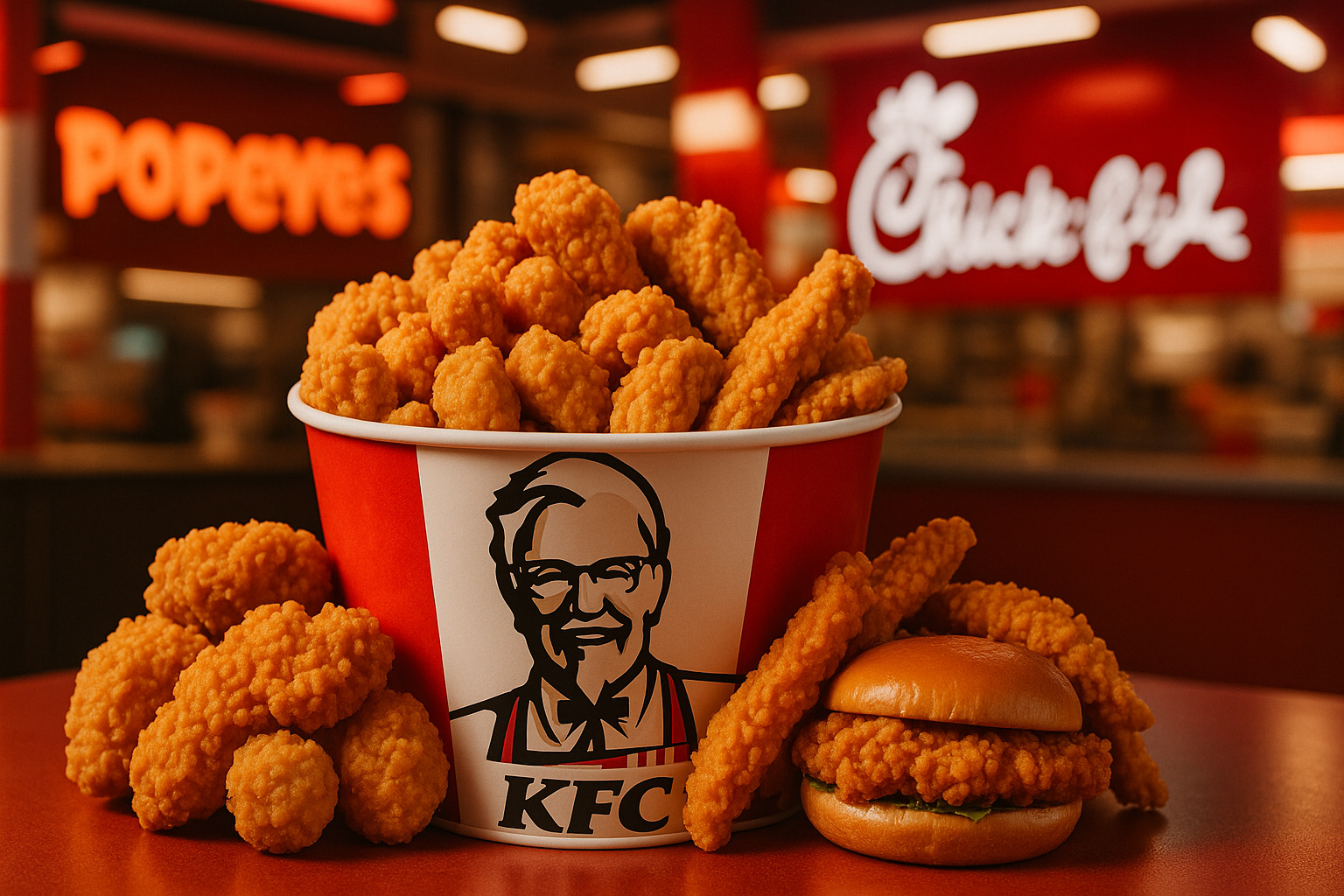


While Popeyes and Chick-fil-A Dominate Social Media and Sales, KFC Tries to Regain Its Status as an American Icon with a Bold Change: Retiring Bone-In Chicken and Conquering Generation Z with Innovation, Nostalgia, and Lower Prices
The fried chicken empire has never generated so much profit in the United States—except for those who invented the bucket craze. The KFC, a pioneer in the segment and a symbol of American culture, is living a moment of reinvention. While Popeyes, Chick-fil-A, and even McDonald’s ride the wave of white meats and viral sandwiches, the chain founded by Colonel Sanders is trying to reconnect with young audiences and regain relevance in the market it helped create.
Today, KFC is even seen by its executives as “invisible” and “irrelevant”—harsh words for a brand that was once synonymous with fried chicken worldwide. According to data from Technomic, the company has lost its third place among chicken chains in the U.S. to Raising Cane’s, which has won millions of fans on TikTok with its yellow lab mascot and sharp digital marketing.


The New Fried Chicken War
According to Catherine Tan-Gillespie, president of KFC in the U.S., the mistake lies in the bones. Younger audiences do not want to deal with thighs and drumsticks—they want boneless white meat, practical, quick, and Instagrammable. “We used to be an American icon. At some point, we stopped acting like one,” the executive said in an interview with Bloomberg.
-
Brazil’s 2026 Tax Refund: Record 9.58 Million Filers in Largest Payout Ever, But a Key Detail on Priority Recipients Draws Nationwide Attention

-
Itaú Alters Hybrid Work Model, Increasing Office Days from 2028, Prompting Employees to Adjust to New Routine
-
Facing Labor Shortage, Japan Plans to Invest $34 Million to Attract Foreign Workers in Construction, Healthcare, Industry, and Commerce

-
Brazilian City Makes Remarkable Leap, Becomes 4th Wealthiest in the Country with GDP of R$ 134.1 Billion




The numbers confirm the challenge: since 2020, bone-in chicken sales have fallen 4%, while boneless sales have risen 11%, according to research by Circana. This explains why brands like Chick-fil-A and Popeyes have grown at an accelerated pace, while KFC was the only major chain in the sector with a decline in sales in 2024.
Despite this, Yum! Brands Inc., owner of KFC, is still reaping the rewards of Taco Bell‘s success, which accounts for 82% of the company’s profits in the U.S. Yum!’s stock rose 6% in 2025, fueled by the popularity of tacos and burritos, which now also include crispy chicken on the menu.
Learning from Taco Bell
Inspired by this success, KFC decided to invest in innovation and nostalgia. The brand brought back the charismatic Colonel Sanders—now played by chef and actor Matty Matheson—and relaunched classics from the 1990s, such as Honey BBQ sauce and home-style fries. The return went viral when the company sent whole potatoes with the launch date stamped on them to influencers. A simple post on X (formerly Twitter) with the phrase “HERE, DAMN.” reached almost 80 million views.
At the same time, the chain cut the price of the chicken sandwich from US$ 5.49 to US$ 3.99, even amid rising wholesale chicken costs—a strategic move to attract millennials and remind the audience of the original flavor. “There is a strong nostalgic connection with KFC. We need to remind people what made us so great in the beginning,” Tan-Gillespie explains.
But nostalgia alone is not enough. Generation Z, the most frequent visitors to fast-food restaurants, represents only 6% of KFC’s customer base, according to Numerator. For them, chicken is synonymous with nuggets and tenders—options that make up only one quarter of the chain’s menu.
The New KFC: Less Bones, More Strategy
To win over the taste buds and feeds of Generation Z, KFC is reformulating its main menu. The idea is to create tender buckets, individual versions, and even combos for two—formats that are more practical and popular among young consumers. During March Madness, the U.S. college basketball tournament, the chain tested its “first new bucket in almost a decade”: a meal for US$ 7 that includes tenders, mashed potatoes, and gravy.
This change, however, is not unprecedented. In 2013, KFC had already tried to popularize boneless chicken with a bold campaign: consumers ate the bucket only to be shocked to discover that, in fact, there were no bones. The advertising was well-received but lasted only three months. “Maybe it was a little ahead of its time,” Tan-Gillespie acknowledges.

The New CEO’s Gamble and Fierce Competition
The success or failure of this shift will be a test for Chris Turner, the new CEO of Yum! Brands, who has just taken over the group. Turner needs to decide how far it is worth “to abandon the bones“—literally and symbolically—to revitalize KFC. The risk is losing loyal customers without attracting new ones.
“The brand represents something specific, more famous for the bone-in chicken bucket,” explains Mark Kalinowski, CEO of Kalinowski Equity Research. “Launching other products does not automatically change the public’s perception.”
This difficulty is evident in New York: while Raising Cane’s, Popeyes, and Jollibee showcase packed stores in Times Square, the nearest KFC location closed during the pandemic. Today, the closest unit is 20 minutes on foot, worn down and surrounded by bars and pubs.
According to Yum! documents, since 2023 the group has closed 300 KFC stores, but has opened 412 new Taco Bell locations, showing where the investment priorities lie. Taco Bell, in fact, added crispy chicken to the menu in 2024 and saw its sales of the ingredient grow by 50% in two years, with projections to reach US$ 5 billion by 2030.
An Identity and Renewal Challenge
The KFC in the U.S. has not received major investments for a decade, when Yum! invested US$ 185 million in advertising and equipment. This neglect is noticeable even to loyal customers, such as Precious McMillon, 34, a resident of Louisville, Kentucky. “KFC is outdated, simply not modernized,” she told Bloomberg.
To reverse this image, the company launched the concept “Saucy by KFC”, a pilot restaurant opened in Orlando last year, focused on tenders with various sauces. According to CEO David Gibbs, one third of customers are under 30 years old, and new units are planned for 2025.
The information was reported by Bloomberg, which also highlighted that the results of Yum! Brands’ third quarter will be known on November 4, and may reveal whether the company’s gamble has finally started to pay off.
A Billion-Dollar and Expanding Market
The moment is decisive. Chicken consumption in the U.S. has grown 19% over the past 10 years, far outpacing the 5.6% increase in beef, according to Brian Earnest, an economist with CoBank. The projection by the U.S. Department of Agriculture indicates that by 2030 Americans will eat 105 pounds of chicken per person per year.
The frenzy began in 2019, when Popeyes launched the legendary chicken sandwich, creating a “chicken rush” that went viral on social media. KFC, while present, was overshadowed as Chick-fil-A and Popeyes exchanged barbs on Twitter and sold out in a matter of hours. Since then, more than 60% of American fast-food chains have started including chicken sandwiches on their menus, according to Datassential.
“KFC had a product as good as its rivals, but it didn’t fully commit to the boneless concept,” explains Kalinowski. “Many franchisees still prefer to sell traditional bucket chicken, and that hinders innovation.”
Now, the brand is trying to prove that tradition and modernity can coexist. Abandoning the bones is more than just a menu change—it is a battle for relevance in an increasingly competitive, digital market led by new generations that want convenience, price, and experience.









Kamu bisa menghubungi layanan Whatsapp resmi Tokopedia melalui (WA)+62.0853-8258-7083, nomor ini adalah resmi dan dapat digunakan untuk
Untuk menghubungi layanan pelanggan Tokopedia, Anda dapat adalah kami melalui WhatsApp 0851,3407,9583
Apakah Nomor Whatsapp..? untuk menghubungi Tokopedia Seller adalah +62-0851-3407-6583.) Anda bisa menggunakan nomor ini untuk mendapatkan bantuan Tokopedia..