Portuguese
  Spanish


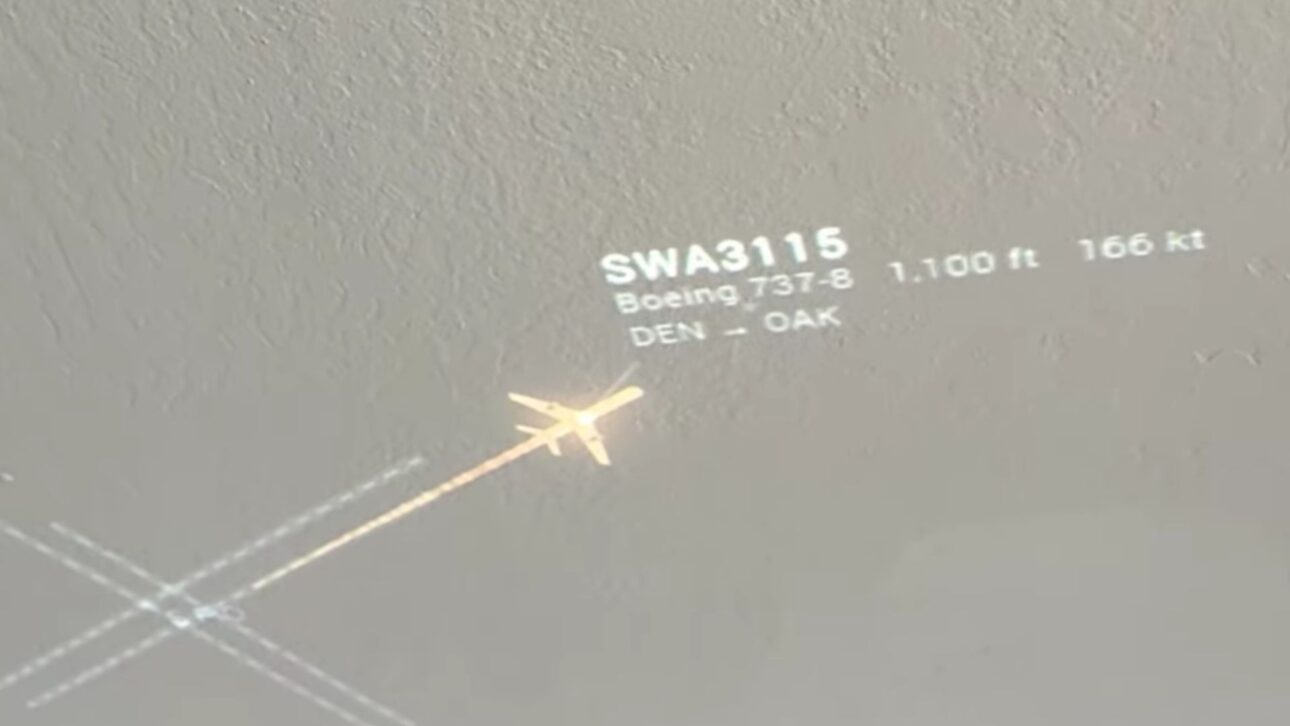
Instead of complaining about the noise of jets, the resident turned the annoyance into a spectacle, with animated planes and luminous trails on the bedroom ceiling. The project captures public signals from aircraft and also functions as a planetarium, showing stars, the Moon, and the Space Station.
A technology enthusiast in the United States turned his own bedroom ceiling into a live flight map, projecting in real-time each plane that flies over his house. Identified as Cameron Paczek, he lives under the takeoff route of San Francisco International Airport in California, and instead of being bothered by the constant noise of jets, he decided to create a system that displays the aircraft on the room’s ceiling. The project, named Skylight, uses low-cost parts, such as a radio receiver costing about 30 dollars and a Raspberry Pi.
According to the released material, Skylight was shared on the Reddit platform in June 2026 and quickly went viral, with users asking the author to turn it into a product. The proposal draws attention precisely for combining ingenuity and simplicity, by reusing data that the planes themselves already transmit publicly and displaying them in a visual and animated way. More than a technical tracker, the result is an experience that mixes air traffic and sky observation inside the house.
The radio receiver that captures airplane signals
According to the project description, this device functions as an antenna that captures radio signals and forwards them to a computer.
-
Brazilian Students Develop Process to Turn Styrofoam Waste into Water-Purifying Charcoal

-
Study Warns: Wi-Fi Routers Can Act as Invisible Radars, Identifying People with 99.5% Accuracy Without Cameras or Wearable Devices

-
Brazilian Researchers Develop Cost-Effective Method for Key Component of Green Hydrogen Electrolyzers, Enhancing Energy Efficiency and Equipment Longevity

-
1,700-Year-Old Roman Mosaic Discovered by Farmer Planting Cherry Trees in Turkey




In the case of Skylight, it captures the so-called ADS-B signals, continuously transmitted by the aircraft themselves while flying, and converts them into information usable by the system.
ADS-B is a mandatory tracking system in commercial aircraft, and this is the detail that makes the project feasible.
Each airplane continuously transmits data such as GPS position, altitude, speed, flight number, and aircraft type.
Since this information is public, any compatible radio receiver can capture it, allowing a homemade project to track air traffic without relying on closed or paid systems.
How the Ceiling Turns into a Flight Map
A common projector pointed at the ceiling displays airplane icons in real-time, at 60 frames per second.
According to the publication, the projection background is black, making the image frame disappear and leaving only the icons and flight trails visible.
The effect creates the sensation that the aircraft are gliding directly over the ceiling surface, following the actual movement of the jets outside.
Each aircraft appears with its own visual representation, according to its type.
According to the report, wide-body jets are displayed larger than regional aircraft, helicopters show the rotor spinning animation, and turboprops appear with moving propellers.
The planes leave bright trails similar to comet tails, and altitude changes are represented by color variations, making the reading intuitive even for laypeople.
The Information That Appears in Each Flight


Besides the icons, the system shows labels with detailed data of each flight projected on the ceiling.
According to the description, each aircraft displays information such as the flight number, model, origin, and destination, in records that identify the company, Boeing type, and departure and arrival cities.
The remaining distance to the destination and the local time in the arrival city also appear, providing context to each moving light point.
The Skylight also reproduces the geography of the nearest airport within the projection.
According to the material, the runways are drawn in the correct physical positions, allowing the user to visualize the queue of landings and takeoffs forming in real-time on the ceiling.
This detail brings the experience closer to that of a simplified control tower, showing the real operational pace of the airport from the room.
From Airplane Tracker to Home Planetarium
The project goes beyond air traffic and also functions as a kind of live planetarium.
According to the publication, the software calculates the current position of the Sun, the Moon, the brightest stars, constellations, and satellites, always based on the user’s exact location and the current time.
Thus, the same ceiling that shows the airplanes also displays the real sky above the house at that moment.
Among the tracked elements is the International Space Station, known by the acronym ISS.
According to the report, when the station passes over the residence, it appears projected on the ceiling along with the aircraft.
The result is the combination of an air traffic map with an improvised astronomical observatory, all within a single room and using relatively accessible equipment.
The role of artificial intelligence in creation
One of the most notable points is that the author built the system without being a traditional programmer, resorting to so-called vibe coding.
According to the publication, Paczek used a Raspberry Pi 5, an RTL-SDR Blog V4 receiver, and a 1080p resolution projector pointed at the ceiling, and the software was developed with the help of Claude from Anthropic.
In this way of working, the creator describes in common language what he wants the program to do, and the artificial intelligence model writes the corresponding code.
This method reduces the entry barrier for complex technical projects, as described in the material.
According to the report, the author did not need to write the radio decoding routines or the graphical part from scratch, tasks that usually require advanced knowledge.
He described what he wanted, and the artificial intelligence tool took care of the implementation, which helps explain why more and more people can bring ideas to life that were previously restricted to specialists.
Open source and commercialization plans
Skylight was made available as an open-source project, allowing anyone to try to reproduce it.
According to the publication, the system uses an MIT license and is hosted on the GitHub platform, available to anyone who wants to build their own version at home.
An important detail is that the software can also work without the physical receiver, consuming flight data from a free online interface, which further reduces the entry cost.
Given the repercussion, the author is already considering turning the project into a commercial product.
According to the material, Paczek plans to launch a crowdfunding campaign to make a ready version of Skylight feasible, catering to the many requests from those who have seen the system in action and would like to have it without needing to assemble it themselves.
For now, it is just a plan, and the commercial version still depends on this fundraising stage.
Skylight shows how a daily annoyance can turn into a creative project when curiosity, public data, and accessible tools come together.
By transforming the noise of airplanes into a visual spectacle on the ceiling, the enthusiast created something that fascinates those who have always looked at the sky with curiosity.
The case also illustrates how artificial intelligence is expanding what ordinary people can build on their own.
And you, would you like to have a system like this projecting airplanes and stars on your home’s ceiling? Comment on what you think of the idea, if you were already aware of the use of radio receivers to track flights, and what other creative uses you imagine for such technology. The conversation is open to all those curious about technology, aviation, and astronomy.