Portuguese
  Spanish




Suzano Just Inaugurated The Largest Pulp Mill In The World! With Record Production And Cutting-Edge Technology, The Plant Is A Milestone In Sustainability And Innovation. Discover How This Industry Giant Is Transforming Brazil And The Future Of Green Energy!
Imagine a facility so grand that, upon coming online, it promises not only to transform the economic landscape of a region but also to create thousands of jobs and generate an impressive amount of green energy. Sounds like science fiction?
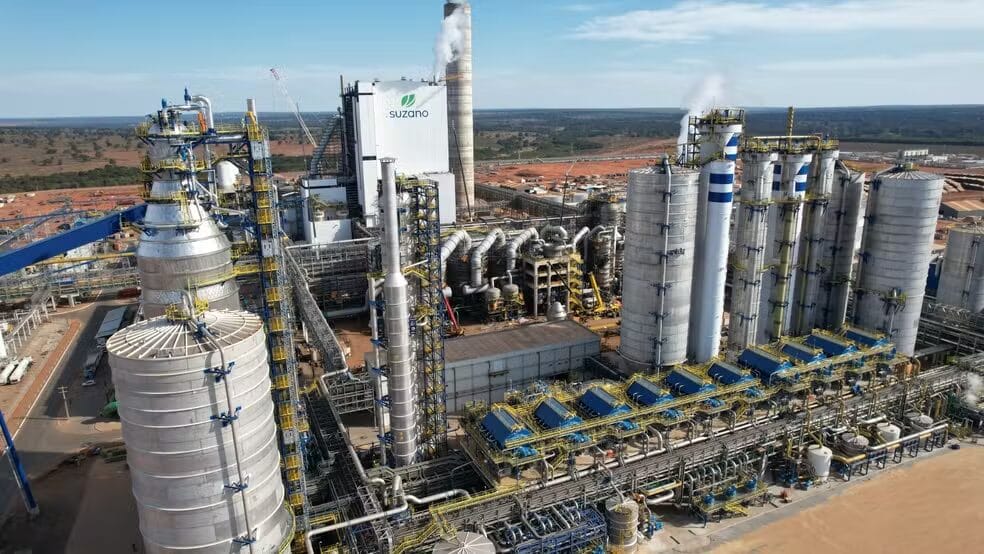
Well, this is the reality of Suzano’s new pulp mill, the largest in the world, recently inaugurated in Ribas do Rio Pardo, in the state of Mato Grosso do Sul.
Suzano Mill Begins Operations
-
After 79 Months and $145 Million Investment, Nepal Set to Open First 2.7 km Road Tunnel to Ease Traffic in Kathmandu Valley

-
In China, 23 Families Spent Over 4 Years Carving a 1.2 km Road Through a Cliff to Overcome Isolation and Transform a Remote Village

-
As Brazil Expands Social Welfare, Survey Reveals 40% Blame Poverty on Laziness, While 58% Cite Lack of Opportunities

-
Giant 3,600-ton Crane Breaks Two World Records by Installing World’s Largest Single-Piece Forged and Welded Hydrogenation Reactor, Weighing 3,037 Tons, in Chinese Petrochemical Plant in Just Six Days




The Suzano pulp mill, which began operations on Sunday, July 21, 2024, is designed for a promising future.
According to the company, by the end of this year, the plant is expected to reach a production of about 900,000 tons of pulp.
This amount represents a significant increase for the state, which, with three other lines already in operation in Três Lagoas, is expected to reach a total of 5.9 million tons by the end of 2024.
Production Capacity And Sustainability In Focus
In an interview with the G1 portal, Maurício Miranda, engineering director at Suzano and responsible for the implementation of the new mill, stated that the plant is in its initial learning phase, a process that is expected to last about 9 months.
After this period, the mill is expected to reach its maximum production capacity of 2.55 million tons per year, setting a new world record in terms of single line capacity.
In addition to the impressive production volume, the new plant stands out for its innovative and sustainable approach.
The mill utilizes cutting-edge technology, incorporating smart devices, asset monitoring, and artificial intelligence, as mentioned by Miranda.
One of the main advances is the use of biomass gasification to produce syngas, which will be used in the industry’s lime kilns. This is a milestone, as it will be the first Suzano plant to adopt this input.
Green Energy And Environmental Impact
One of the most notable aspects of the new mill is its commitment to sustainability. The plant will generate bioelectricity from solid and liquid biomass, becoming self-sufficient in energy.
The surplus of 180 MW will be exported to the National Interconnected System (SIN), enough to supply a city of approximately 2.5 million inhabitants.
Jobs And Local Community
During construction, the mill employed up to 10,000 workers, with an average of 5,000 people at the peak of the works.
However, with the construction phase completed, about 300 workers will still be engaged in complementary services, especially in the urbanization of the plant.
Currently, about 3,000 people are employed in the operation of the plant, including 2,000 in the forestry area and 1,000 in the industrial area.
According to Miranda, Suzano will continue to collaborate with the S System (Sesi, Senac, etc), to maintain the training of the workforce and ensure that demands are met efficiently. Link with 100 job openings from the company.
Social Actions And Production Logistics
The company claims it is implementing long-term projects aimed at generating income and improving the living conditions and education of the local population.
Regarding logistics, about 98% of the production from the new unit will be destined for the external market. The pulp will initially be transported by highway to a railway terminal in Inocência, and from there will follow by Malha Norte railway to the company’s terminals at the Port of Santos in São Paulo.