Portuguese
  Spanish


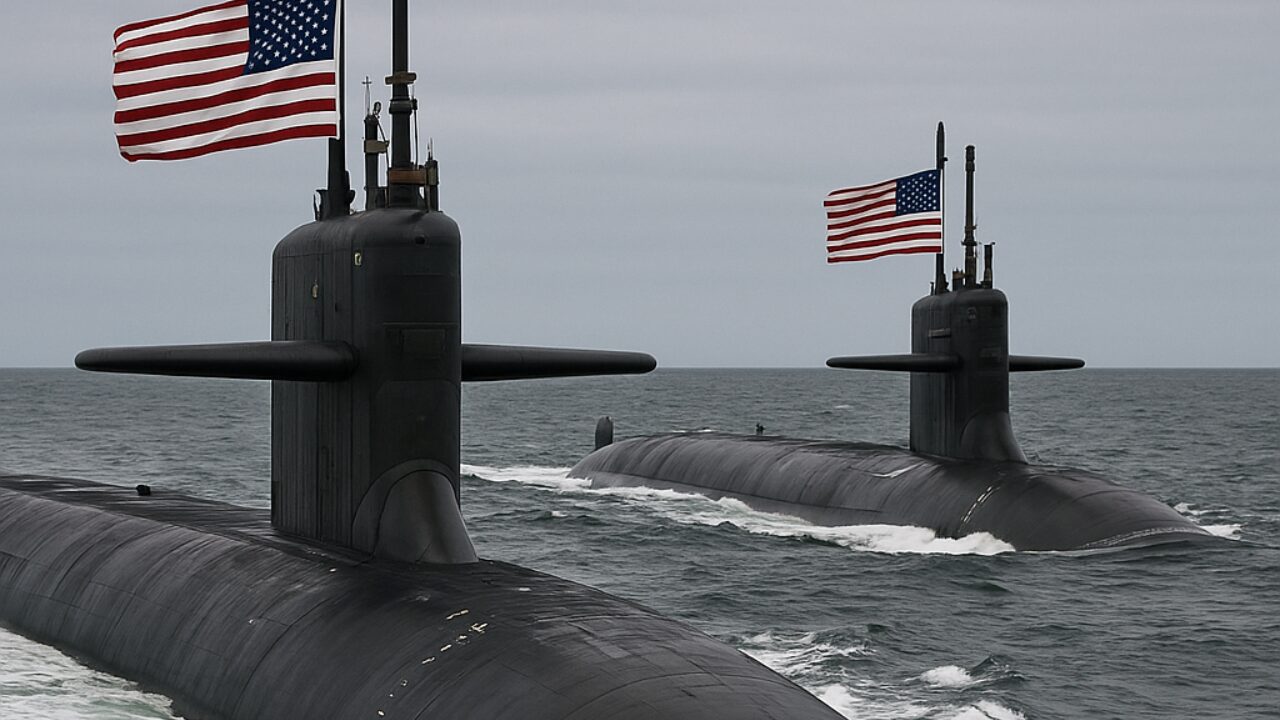

The Construction Of The Last Two Nuclear Submarines Of The Virginia Class Block V Was Contracted To Expand The Naval Workforce And Strengthen The US Navy Defense Capacity.
In a strategic move, the United States Navy signed contracts worth over US$ 18.5 billion for the construction of the last two nuclear submarines of the Virginia Class Block V.
The vessels, to be named USS Baltimore (SSN-812) and USS Atlanta (SSN-813), will be built by General Dynamics Electric Boat (GDEB) and Huntington Ingalls Industries (HII), marking the end of production of this important variant consisting of 12 units.
Virginia Class Submarines Block V Will Be An Advancement For The United States Navy
The new contracts represent a crucial step to maintain the strength and readiness of the United States Navy in the global arena.
-
The U.S. Navy Conducts Submarine Tests in Idaho Lake to Detect Underwater Noises Hidden by the Ocean

-
Nuclear Submarine USS Alexandria Retired After 35 Years, Having Completed Over 1 Million Miles in Missions

-
MODEC Introduces New Hull Design for FPSO Gato do Mato to Produce Up to 120,000 Barrels of Oil Per Day in Brazil’s Pre-Salt Region
-
This Massive 12-Meter, 21-Ton Underwater Drone Can Operate Autonomously for Up to Five Days


The Virginia Class is considered one of the most advanced today, designed for attack and surveillance missions in strategic areas.
The last two units of Block V aim to consolidate the modernization of the fleet and integrate cutting-edge technologies into the U.S. naval power.
According to the official statement, about US$ 17.15 billion will be allocated to General Dynamics Electric Boat, while HII will receive US$ 1.29 billion for the execution of the project.
In addition to the construction of the submarines, the contract includes investments in increasing salaries for the specialized workforce, as well as improvements in infrastructure and systems at the shipyards involved.
Investment Goes Beyond Construction: Focus On Labor And Industrial Structure
With the cost of submarines increasing by up to 20% in recent years—especially due to the shortage of skilled workers and rising wages in the naval sector—the U.S. Navy saw the need to increase contract amounts.
Mark Rayha, president of General Dynamics Electric Boat, highlighted the importance of the measure:
“In the last two years, we have formed successful partnerships with the Navy, Congress, and the Government to secure funding to increase the wages of the nuclear shipbuilding workforce and make additional significant investments in capacity, processes, and shipyard systems.”
This financial boost also reflects the Navy’s concern about maintaining a steady production pace, given the recent delays observed in other programs, such as the Constellation class frigates.
Redefining Contracts And Sharing Risks
Originally, the signing of contracts for the two Virginia Class submarines was scheduled for the fiscal year 2024. However, negotiations were delayed due to concerns over rising costs and the need to establish new control mechanisms.
The new Secretary of the U.S. Navy, John Phelan, commented on the change in approach:
“Recently, we renegotiated the planned contract to deliver this critical capability and adequately distribute the risks between the Navy and industry. We will review all future contracts with the same perspective to ensure an appropriate level of risk-sharing and value for the American taxpayer.”
This new stance aims to make the relationship between the government and the private sector more balanced, ensuring efficiency in delivering strategic projects for national defense.
Beyond These Two, More Submarines Are On The Way
Despite recent challenges, the United States Navy does not intend to slow down.
A new cycle of multi-year contracts is already being planned for the construction of up to 15 additional submarines, of which 10 would be from the Virginia Class Block VI and 5 from the new Columbia Build II class, aimed at strategic nuclear deterrence missions.