






 Portuguese
  Spanish


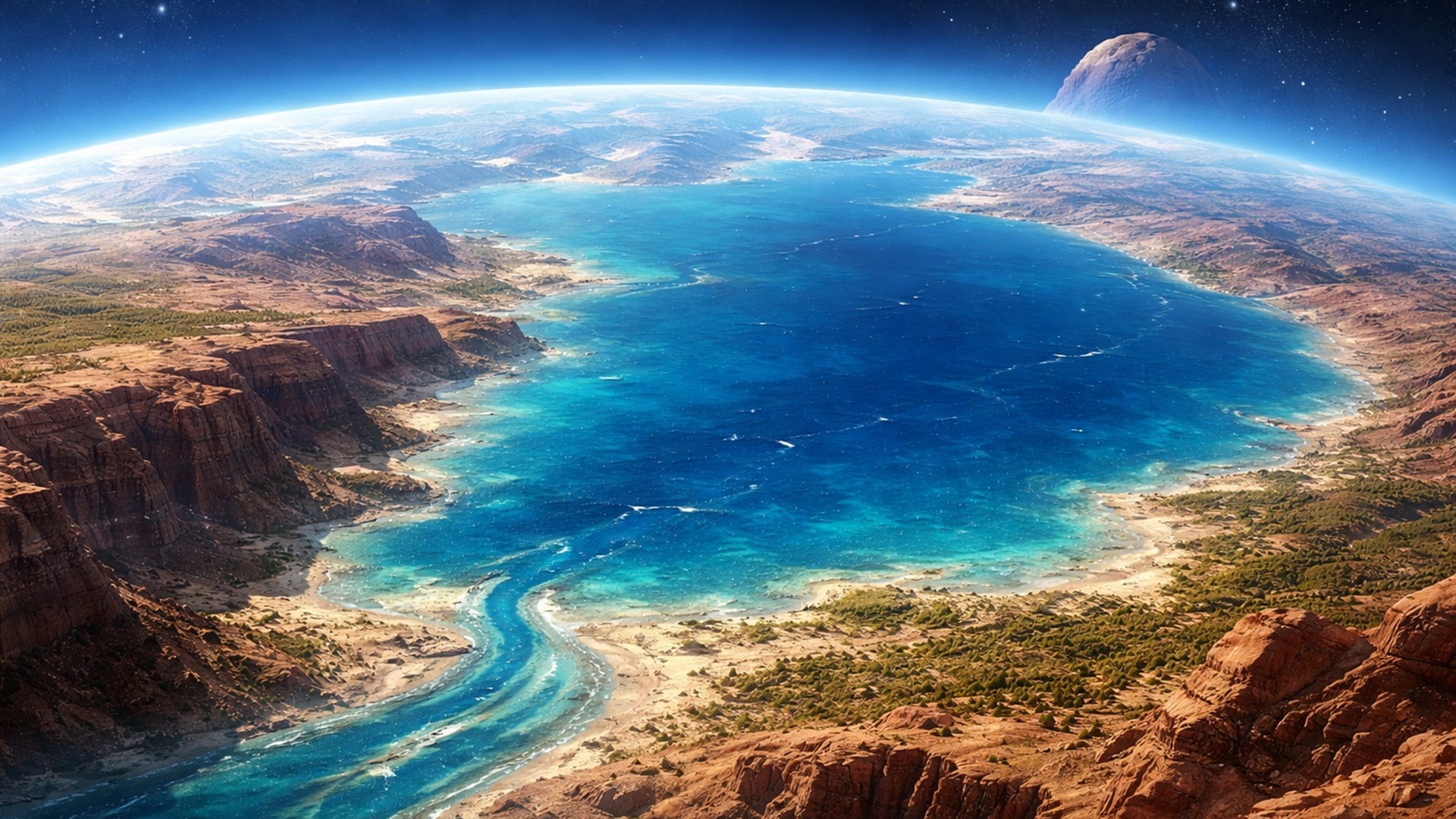


Research Conducted by Swiss Scientists from the University of Bern and the Astronomical Observatory of Padua Identifies, from High-Resolution Images and Orbital Data, Direct Evidence of a Martian Ocean the Size of the Arctic, with Preserved Coastline, River Deltas, and Indications of Stable Water About Three Billion Years Ago
The planet Mars may have been a “blue planet” similar to Earth about three billion years ago, according to a study by Swiss scientists who identified evidence of a vast ocean, comparable in size to the Arctic Ocean, and clear signs of an ancient coastline.
Geological Evidence Points to an Ancient Ocean in the Northern Hemisphere
The research was conducted by scientists from the University of Bern and the INAF – Osservatorio Astronomico di Padova. The work presents evidence of a deep and extensive ocean that would have occupied much of the northern hemisphere of Mars.
Previous studies had already indicated the presence of large rivers and possible oceans in Mars’ past. However, the new findings are based on more precise data, obtained from high-resolution images, allowing for the direct identification of structures associated with an ancient coastline.
-
NASA’s Plan to Dump ISS Debris in Ocean Sparks Environmental Concerns Among Scientists

-
14-Year-Old Invents Eco-Friendly Water Pump Using Recycled Materials to Aid Communities Without Water Access
-
Pigeons Trained to Detect Cancerous Changes in Medical Images Astonish Scientific Community

-
Plastic Waste from Beaches and Poor Communities in Kenya Transformed into School Desks, Replacing Wood in Classrooms and Turning Marine Litter into Durable Study Tables


Valles Marineris Region Reveals Structures Similar to Terrestrial Deltas
The scientists analyzed areas near Valles Marineris, the largest canyon system on the planet, located near the equator. In this region, geological formations resembling river deltas observed on Earth were identified.
The images reveal what may have been the mouth of a river flowing into an ocean. These structures reinforce the interpretation that there was a stable and extensive body of water capable of shaping the terrain similarly to terrestrial fluvial processes terrestrial.
Sea Level Reconstruction Confirms Largest Martian Ocean Ever Proposed
According to Fritz Schlunegger, a professor of Exogenous Geology at the Geological Sciences Institute of the University of Bern, the team was not the first to suggest the existence of an ocean on Mars. The difference, however, lies in the quality of the data used.
The sea level reconstruction was based on direct evidence of a clearly identifiable coastline. According to Schlunegger, this analysis provides proof of the deepest and most extensive ocean ever documented on the planet, widely covering the northern hemisphere, even today obscured by dusty dunes.
Space Probe Data Support Identification of the Formations
The investigation utilized the CaSSIS camera aboard the ExoMars Trace Gas Orbiter of the European Space Agency, as well as data from the Mars Express mission of ESA and Mars Reconnaissance Orbiter of NASA.
The structures identified in the images are described by the researchers as the mouth of a river entering an ocean. This interpretation is considered consistent with the observed morphology and with previous studies on the presence of liquid water on Mars.
Indications Reinforce Possibility of Favorable Conditions for Life
Ignatius Argadestya, a doctoral student at the Geological Sciences Institute and the Physics Institute of the University of Bern, stated that the results indicate that Mars may have had conditions capable of sustaining life in the past. Now known as a dry and red planet, Mars may have been a blue planet, similar to Earth.
The study also highlights that water can disappear over time on a planet, emphasizing its precious nature. The discovery contributes to the understanding of Martian climatic evolution and the fate of water in the solar system, even though today the planet presents an arid and inhospitable environment.


