Portuguese
  Spanish




Discover How the Naval Job Market Works, Its Opportunities, History, and Areas of Activity in One of the Most Strategic Sectors of the Global Economy.
The naval job market is an area full of history, opportunities, and challenges that span centuries.
Since the days when great navigations connected continents to the present, the naval sector continues to play a vital role in the global economy.
With the constant movement of goods, people, and technologies across the oceans, understanding how this market works and its professional possibilities becomes essential for those who want to enter this field or simply learn more about this strategic industry.
-
The U.S. Navy Conducts Submarine Tests in Idaho Lake to Detect Underwater Noises Hidden by the Ocean

-
Nuclear Submarine USS Alexandria Retired After 35 Years, Having Completed Over 1 Million Miles in Missions

-
MODEC Introduces New Hull Design for FPSO Gato do Mato to Produce Up to 120,000 Barrels of Oil Per Day in Brazil’s Pre-Salt Region
-
This Massive 12-Meter, 21-Ton Underwater Drone Can Operate Autonomously for Up to Five Days


Additionally, the naval market supports international trade, as approximately 90% of the world’s cargo travels by sea.
According to the International Maritime Organization (IMO), this percentage has remained stable over the last few decades, reinforcing the magnitude of this sector’s importance to the global economy.
The IMO, the body responsible for international navigation regulation, highlights the interconnection of the naval market with productive sectors such as industry, agriculture, oil, and tourism.
History of the Naval Industry and Its Evolution
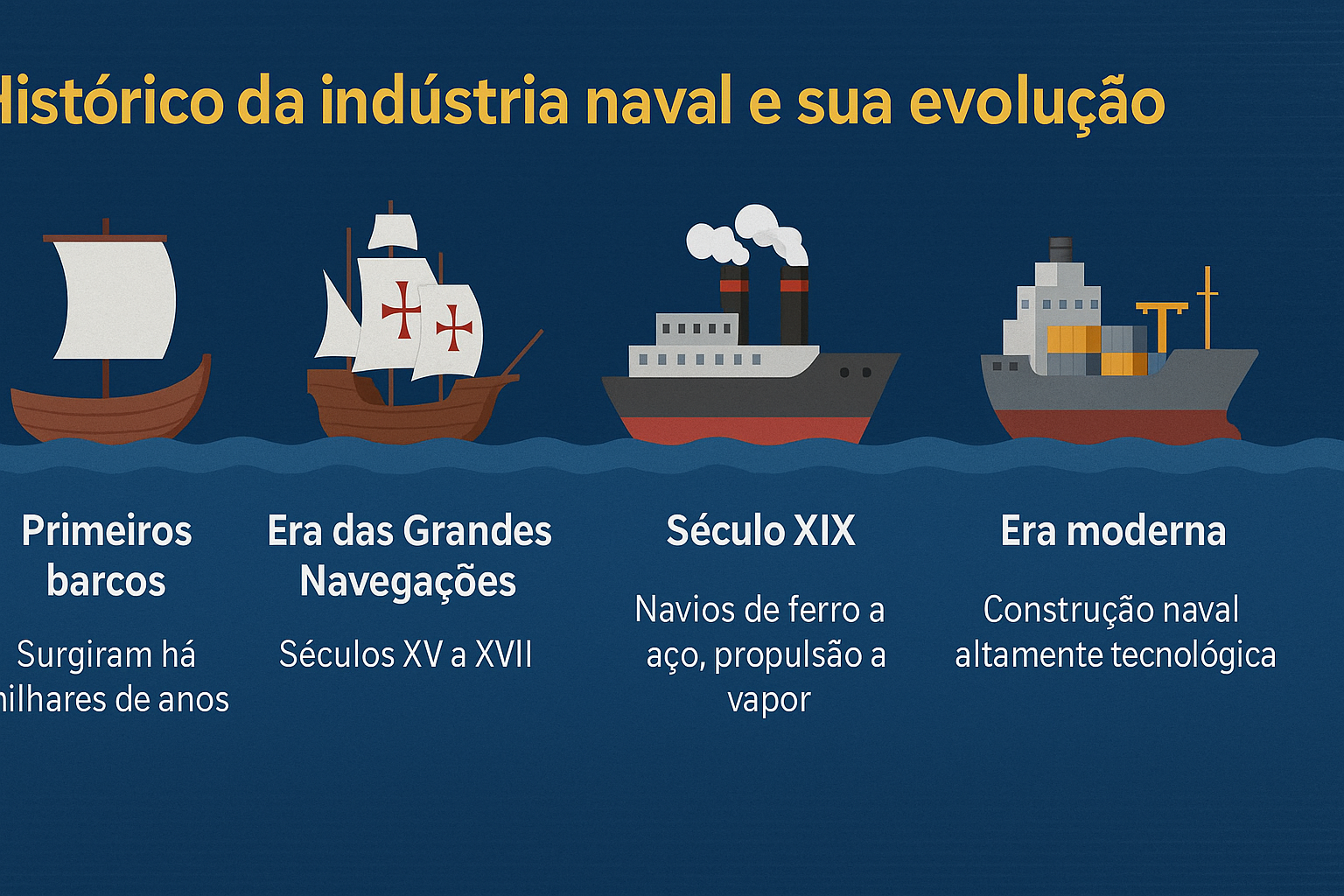
The relationship between humanity and the sea is ancient and fundamental to the history of human development.
According to the Lisbon Maritime Museum, the first boats appeared thousands of years ago, enabling fishing and transportation.
During the Age of Discoveries, between the 15th and 17th centuries, European countries such as Portugal and Spain became maritime powers.
They opened trade and colonial routes around the world, completely altering the global economy.
As recorded by the Lisbon Maritime Museum, this phase was decisive for the initial globalization and the strengthening of maritime trade.
With technological advancements, the 19th century brought a revolution in shipbuilding.
The National Institute of Technology (INT), a Brazilian research and innovation body, reports that between 1850 and 1900, there was a transition from wood to iron and steel in hull construction, allowing for larger and stronger ships.
Furthermore, the use of steam, followed by the diesel engine, transformed vessels into more efficient machines.
Throughout the Industrial Revolution, shipbuilding shifted from artisanal to highly technological.
According to the Brazilian Association of Naval and Offshore Industry (ABIN), this change boosted the emergence of modern shipyards that gathered multidisciplinary professionals, including engineers, technicians, and welding specialists.
What Comprises the Naval Job Market?
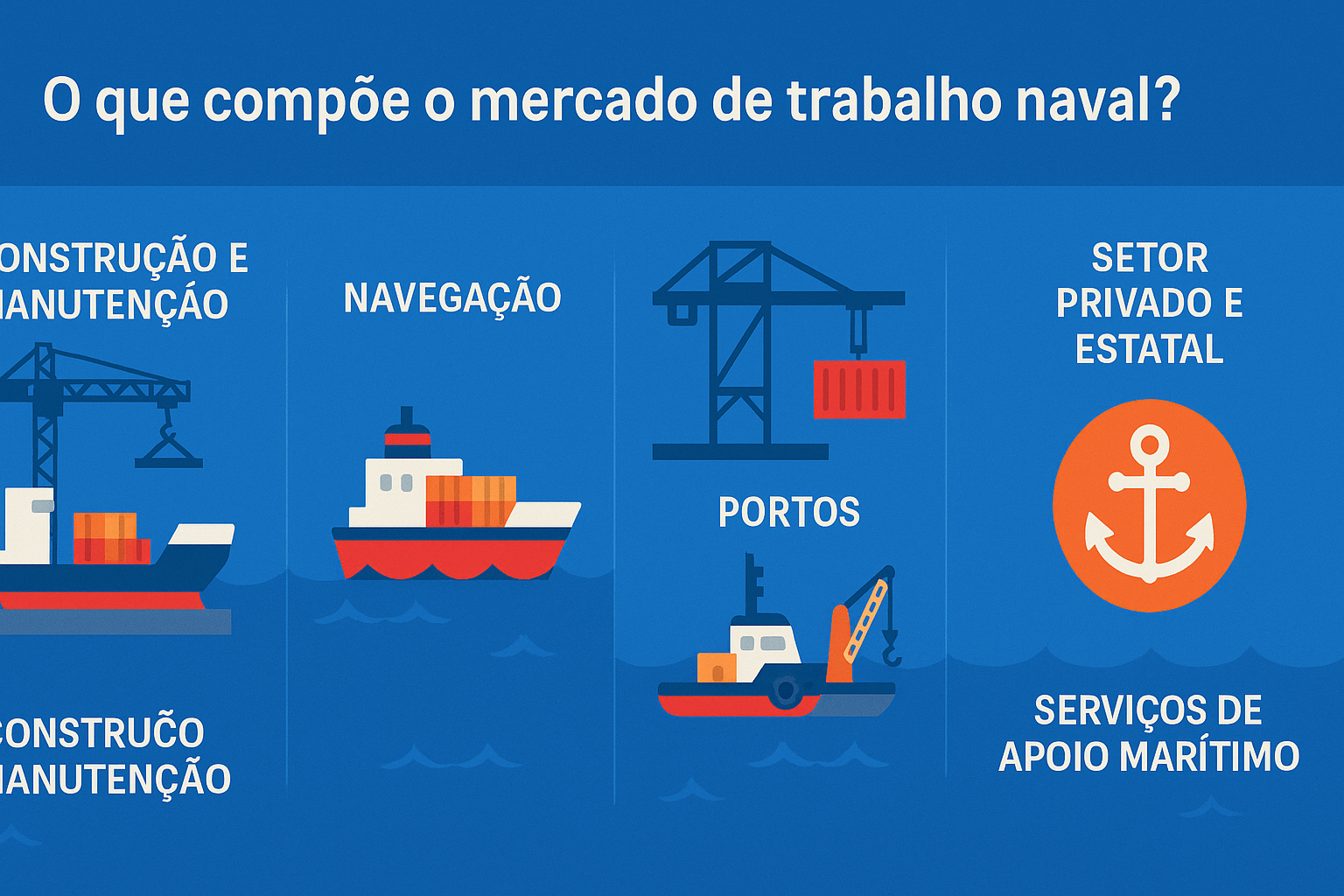
The naval job market encompasses various activities, from design and construction to maintenance and operation of vessels.
This includes cargo ships, tankers, cruise ships, fishing boats, submarines, military vessels, and offshore platforms.
According to the ABIN, the naval market is not limited to the sea but also includes ports, logistics, and maritime support services such as towing and salvage.
This sector involves both private and state-owned companies.
In Brazil, for example, the Brazilian Navy maintains an important presence in naval defense and training professionals, while private companies act in maritime transport, nautical tourism, and oil exploration.
Main Areas of Activity in the Naval Sector
Those looking to work in the naval sector find various opportunities. Among them, naval construction and repair, with engineers, technicians, and welders designing and maintaining vessels.
In navigation, commanders and crew operate ships on commercial and cabotage routes. In the port sector, professionals handle the operation and logistics of maritime terminals.
Additionally, the offshore segment related to oil exploration demands technicians, engineers, and specialized operators.
In tourism, the cruise industry generates jobs in hospitality, entertainment, and onboard operations.
Also, according to ABIN, technological innovation has created new areas, such as automated systems engineering, robotics, and environmental sustainability applied to the naval sector.
Training and Qualification to Work in the Naval Market
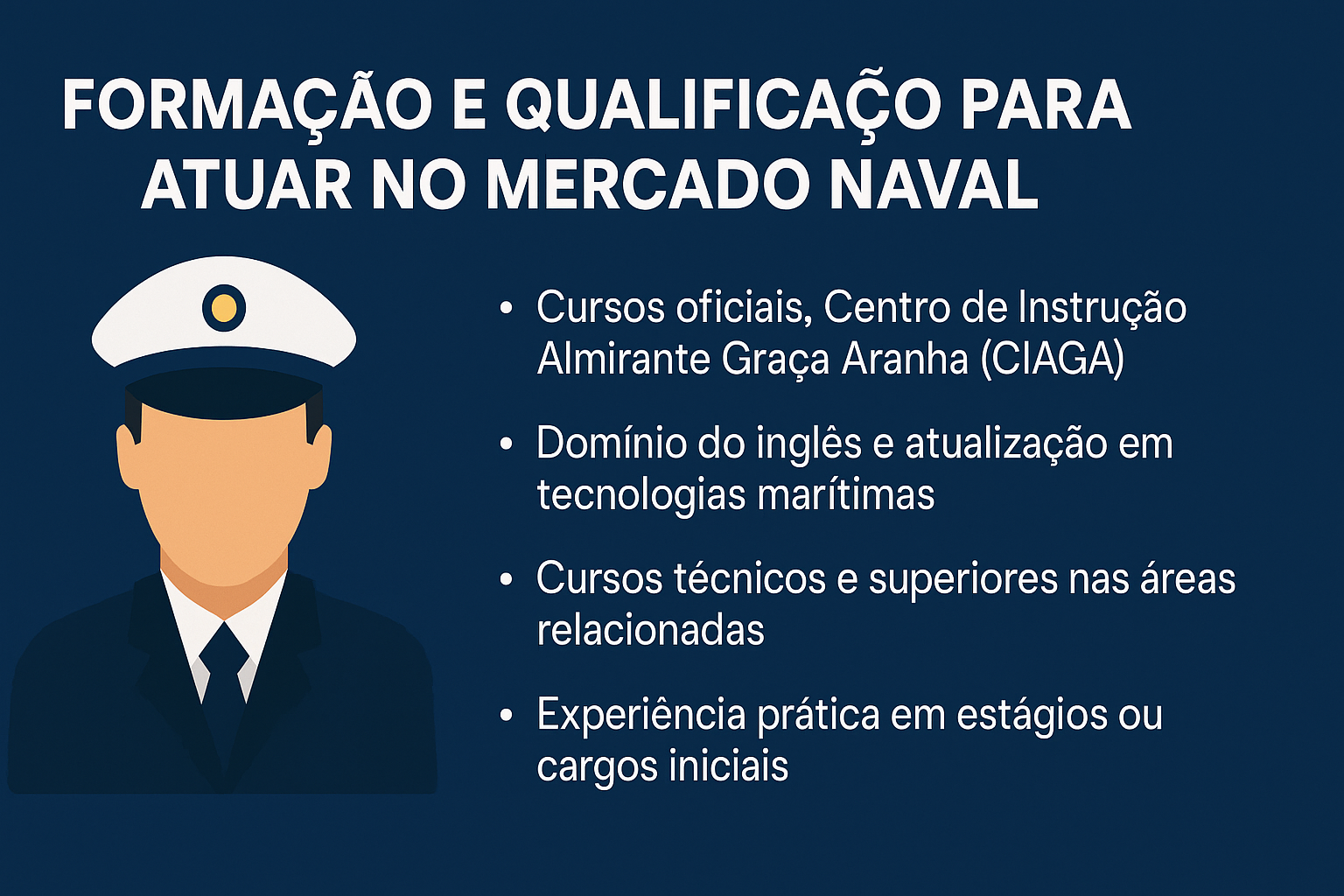
To enter the naval market, technical and academic qualification is essential.
The Admiral Graça Aranha Instruction Center (CIAGA), a Brazilian Navy institution, offers official courses for maritime training and certifications required by regulatory bodies.
Moreover, mastery of English and continuous updating on maritime technologies are essential to keep up with the sector’s evolution.
Technical and higher education institutions offer courses in naval engineering, port logistics, and related fields, preparing professionals to operate safely and efficiently.
Practical experience, obtained through internships or entry-level positions, is also valued. According to data from the Brazilian Navy, practical onboard training is a mandatory requirement for many maritime positions.
The Brazilian Naval Market: Potential and Challenges
With approximately 7,400 km of coastline, according to the Brazilian Institute of Geography and Statistics (IBGE), Brazil has tremendous potential in the naval market.
Maritime transport is fundamental for moving national production, especially in agribusiness and industry.
Additionally, the country invests in offshore exploration, particularly in the pre-salt region.
According to the National Agency of Petroleum (ANP), offshore production has been growing since the discovery of the pre-salt in 2007, increasing the demand for professionals specialized in shipbuilding and maintenance.
However, the sector faces challenges such as global competition, high costs, and the need for technological modernization.
The ABIN highlights that labor training and investment in innovation are essential to maintain the competitiveness of the Brazilian naval market.
Trends and Perspectives for the Future of the Naval Market
The naval market is heading towards transformation linked to the blue economy and environmental sustainability.
The International Maritime Organization (IMO) has reinforced standards to reduce carbon emissions and promote more eco-friendly vessels.
Additionally, the digitalization of the sector using artificial intelligence, the Internet of Things (IoT), and big data improves the efficiency of naval and port operations.
This scenario demands updated professionals, capable of working with emerging technologies and committed to sustainability, as highlighted in reports from ABIN and IMO.
In summary, the naval job market remains a strategic, dynamic, and opportunity-filled field.
Its historical and economic relevance reinforces that it will continue to be fundamental for global and national development.
Professionals who invest in qualification, technological updating, and adaptation to new environmental demands tend to stand out in their careers.
With a solid knowledge base and a keen eye on trends, the naval sector offers promising career paths that navigate through seas of innovation, sustainability, and growth.