






 Portuguese
  Spanish


Treasure with up to 15,000 Roman coins found in Wales could be the largest in the country and has already entered the rigorous process of the Treasure Act.
A metal detectorist in north Wales found what archaeologists consider one of the largest hoards of Roman coins ever discovered in the UK. The find is attributed to David Moss, 36, a resident of Cheshire, who unearthed up to 15,000 Roman coins stored in two clay pots in a field in north Wales. The discovery gained attention not only for the volume of material but also for the detectorist’s reaction. Fearing losing the treasure before handing it over to experts, Moss slept for three nights in his car with the coins, in an episode that turned an archaeological news story into one of international significance.
Metal detector, isolated field, and two clay pots changed the scale of the Roman find
According to ITV News, David Moss had been researching the same area in north Wales for years. He already suspected that the site still hid more archaeological material after having found, in 2018, a smaller Roman hoard with about 3,000 coins in the same region, using different equipment.
In the new search, conducted alongside his friend Ian Nicholson, Moss received a weak but constant signal, more than half a meter deep.
-
Top U.S. Bank Executive Fired After Dumping Trash on Street, Taking Bin Home, and Receiving Two Fines

-
Brazilian Man Arrested After FBI Alert on AI-Reported Plot to Harm Son and Attack Schools, Churches, and Officials
-
2,500-Year-Old Bronze Artifacts Unearthed by Detectorist in Eastern Poland

-
Over 5,000 Families Join Brazilian Network Providing 3D-Printed Prosthetics, Founded by Teacher Inspired by Daughter’s Limb Difference



Upon digging, he found the edge of a clay pot full of coins, and days later returned to the field, investigated another nearby flat spot, and located a second container buried next to the first.

The material is still under analysis, but ITV reports that the collection weighs more than 60 kilograms, was found in two clay vessels, and is considered a treasure of nearly 2,000 years. This helps explain why the case immediately caught the attention of archaeologists, conservators, and authorities responsible for historical finds.
Rainbow, rain, and six hours of excavation gave the treasure a movie scene atmosphere
The account of the discovery also drew attention due to the context. The Independent reported that Moss described the area as “virtually untouched” and mentioned that a rainbow appeared minutes before the signal that led to the treasure, a detail that reinforced the almost cinematic nature of the moment.
After the first signal, Moss and Nicholson spent about six and a half hours digging up the containers and removing the contents. ITV adds that the duo recorded the discovery in notes and on video, an important step to properly document the context of the find.
The shock of the discovery was immediate. Upon realizing he had found a pot full of Roman coins, Moss reported that his heart “stopped,” a kind of reaction understandable in the face of a collection that could redefine the scale of Roman treasures already located in Welsh territory.
Three nights in the car with the coins turned the detectorist into world news
The Independent reports that Moss took the coins home, in Cheshire, but preferred not to take them out of the vehicle and spent three days sleeping in the car because he did not want to leave the material out of his sight before handing it over to specialists.
This detail heightened the case’s repercussion because it highlighted the detectorist’s level of fear. It was not just a handful of ancient objects, but a collection that, if confirmed in preliminary numbers, could go down in history as the largest find of Roman coins ever made in Wales.
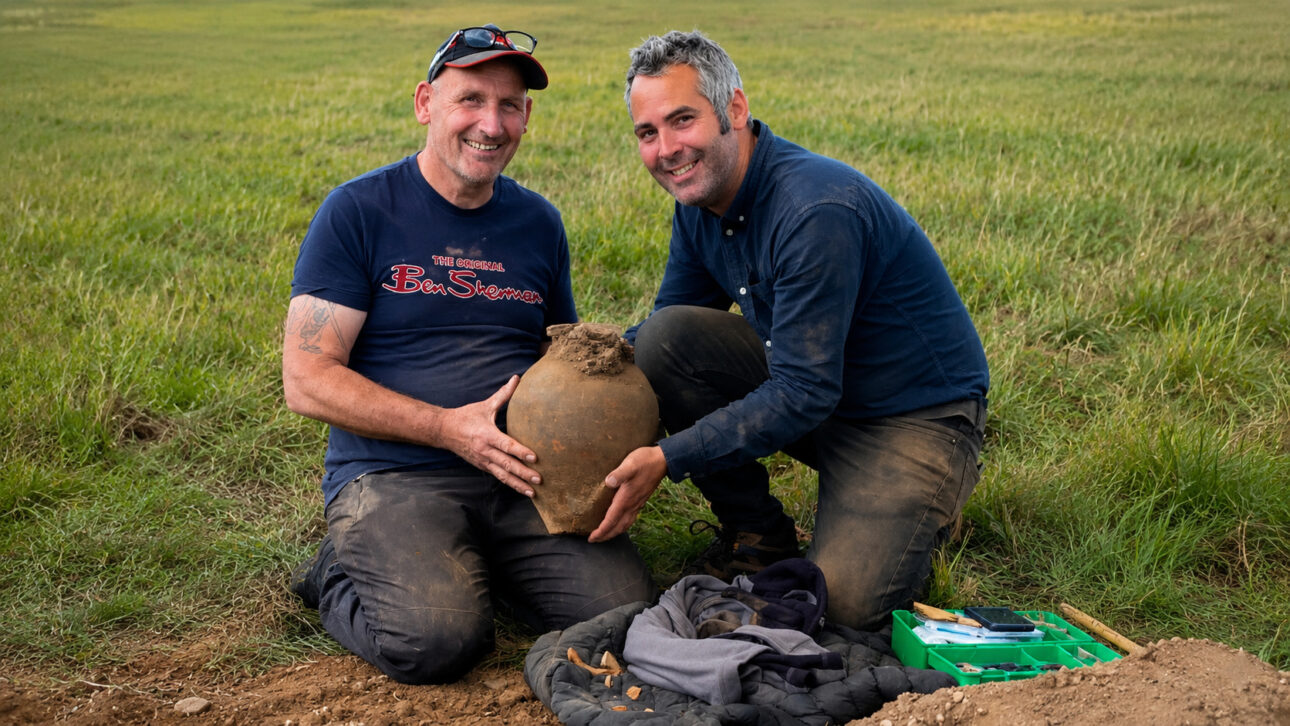
The decision to protect the material with such care also reveals the archaeological and financial weight of a discovery of this magnitude. The collection was then sent to the National Museum Cardiff, where it began to be analyzed by specialists.
Roman treasure in Wales could rewrite the monetary history of the region
ITV reports that the treasure contains a mix of Roman denarii and silver-plated radiates, coins associated with different phases of the Roman presence in Britain.
The combination broadens the historical interest of the find because it can help date the burial and reconstruct the economic context of the deposit.
The Independent highlighted that the find could be the largest ever recorded in Wales, and cited experts’ understanding that the collection surpasses, in potential scale, previous Welsh discoveries. As the definitive count and individual cleaning of the coins still depend on technical analysis, the final number remains subject to cataloging.
Treasure Act in the United Kingdom defines what happens after the discovery
After the find, the duo contacted the Finds Liaison Officer of the Wrexham area. ITV reports that, as the area was vulnerable and close to public trails, the detectorists were advised to carry out the excavation themselves with proper recording of the discovery.


From there, the legal procedure outlined in the United Kingdom comes into play. The British government mandates that a potential treasure must be reported to the Finds Liaison Officer within 14 days, and informs that, after communication, the case proceeds to analysis, technical report, and coroner’s inquest.
The same official procedure explains that museums can express interest in the material and that the reward can be divided between the finder and the landowner, provided everything was done in good faith and within legal rules. It is also the British government that informs that, in Wales, support in the process may involve the curators of the Amgueddfa Cymru, National Museum Wales.
Cardiff Museum will clean, study, and decide the future of the Roman coins
ITV reports that the treasure was taken to the National Museum Cardiff for specialized analysis. The outlet also notes that the museum does not comment on the case in detail before the conclusion of the coroner’s inquest, a mandatory step for the formal treasure recognition process.
This means that the path to a potential public exhibition will still be long. Before any definitive announcement, the coins need to be cleaned, cataloged, studied, and evaluated within the official process provided by British legislation on archaeological treasures.
In the end, David Moss’s discovery brings together all the elements that turn a find into a great story: persistence, chance, fear of theft, archaeological value, and a quantity of coins capable of putting a seemingly ordinary field in northern Wales at the center of the Roman archaeology map.


