Portuguese
  Spanish


The teacher from Paraná, Geane Poteriko, created Dar a Mão after her daughter was born with agenesis, missing part of her arm. Today, the association brings together over 5,000 families and produces low-cost 3D printed prosthetics for those with limb differences in Paraná and Brazil.
Faced with a diagnosis that would change her daughter’s life, Geane Poteriko did not wait for a ready-made solution: she set out to create her own. The teacher studied the subject, mobilized volunteers, and founded an association that now manufactures 3D printed prosthetics for the entire country. What began as a mother’s quest turned into a national network of low-cost assistive technology.
According to the Dar a Mão Association, the entity was born in 2015 in São João do Ivaí, in northern Paraná, and today connects more than 5,000 associated families throughout Brazil. All prosthetic production is done by volunteers, with no paid employees. The name is an affectionate pun: it combines the name of her daughter, Dara, with the gesture of “giving a hand” to those in need.
Who is Geane Poteriko and how Dar a Mão was born
The story begins with a birth and a scare common to many families.
-
Over 1,060 Wheelchairs Created from 102 Tons of Aluminum Tabs Collected Across Brazil, Turning Waste into Mobility Nationwide

-
Explore the History, Architecture, and Unique Features of Arena Fonte Nova, One of Brazil’s Most Iconic and Modern Football Stadiums

-
Indian School in Assam Expands Enrollment by Accepting Plastic Waste as Tuition Payment
-
Parintins Festival 2026 Celebrates Amazonian Tradition with Three Nights of Competition Between Caprichoso and Garantido, Highlighting Its Cultural Significance in Brazil


Geane’s daughter, Dara, was born with a difference in her upper limb, missing part of one arm.
Instead of treating the case as an isolated problem, the teacher decided to turn it into a cause.
She researched prosthetics, discovered the potential of 3D printing, and began gathering people willing to help.
Dar a Mão was officially founded in 2015, in northern Paraná, with Dara as inspiration and symbol.
Since then, the association has grown from a local project to a network with bases in various states.
Geane united two lives into one mission: that of a mother and the founder of an assistive technology organization.
What is agenesis and why 3D prosthetics help
Limb agenesis is the congenital absence of an arm, a leg, or parts of them, present from birth.
It is estimated that agenesis affects about one in every 1,500 children, according to data cited by sector entities.
Children with agenesis face an extra challenge: they grow, and the prosthetic needs to keep up with this growth.
A traditional imported prosthetic can cost tens of thousands of reais and become too small in a few months.
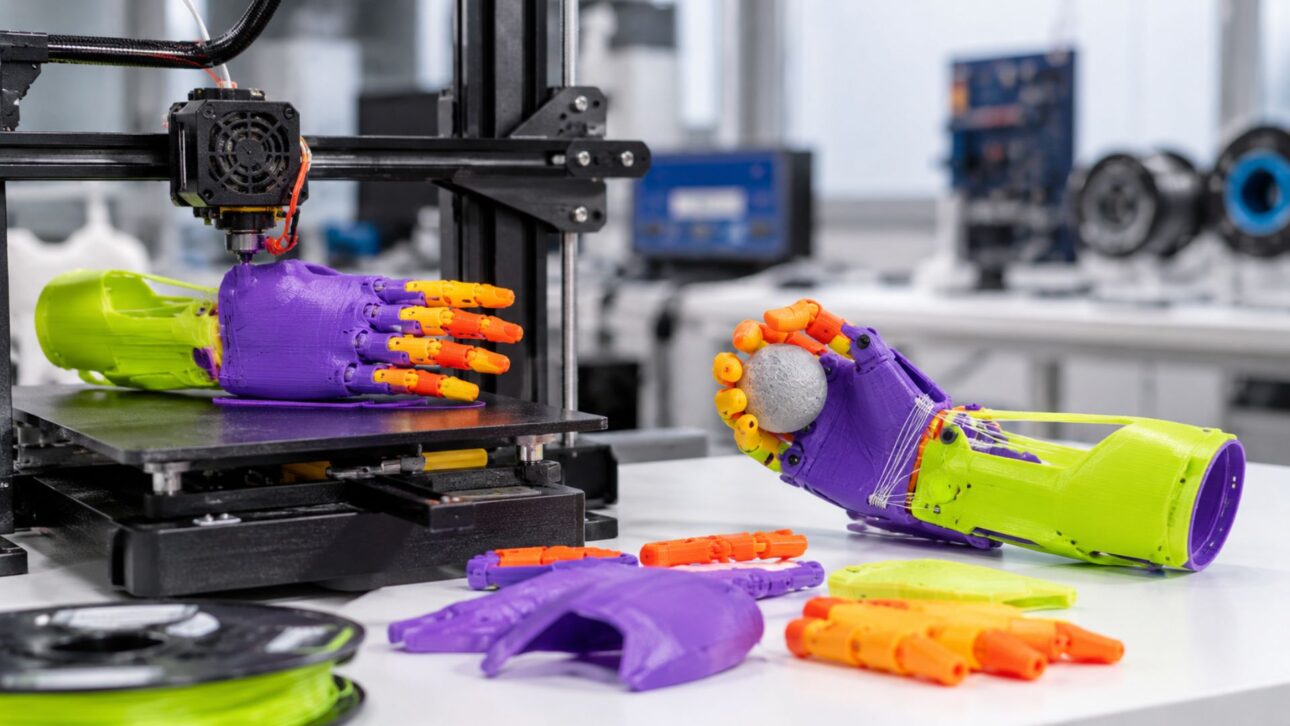
This is where 3D printing changes the game, allowing the piece to be cheaply remade whenever the child grows.
The prosthetic stops being a unique luxury and becomes a replaceable item, like clothing that changes size.
How the 3D printer reduces the cost of the prosthetic
The technology behind the project is what makes the cost feasible.
The 3D printer builds the prosthetic layer by layer, in strong and lightweight plastic, from a digital model.
Since the mold is a computer file, each prosthetic can be customized for the body of the user.
Many models work with wires that mimic tendons: by moving the wrist or elbow, the hand closes.
Without expensive motors or electronics, the mechanism is purely physical, which reduces cost and maintenance.
While commercial prosthetics exceed R$ 200,000 in advanced versions, a printed piece can cost just a few hundred reais.
This price difference allows the 3D printer to serve many people who would never buy the equipment.
The national network of volunteers behind Dar a Mão
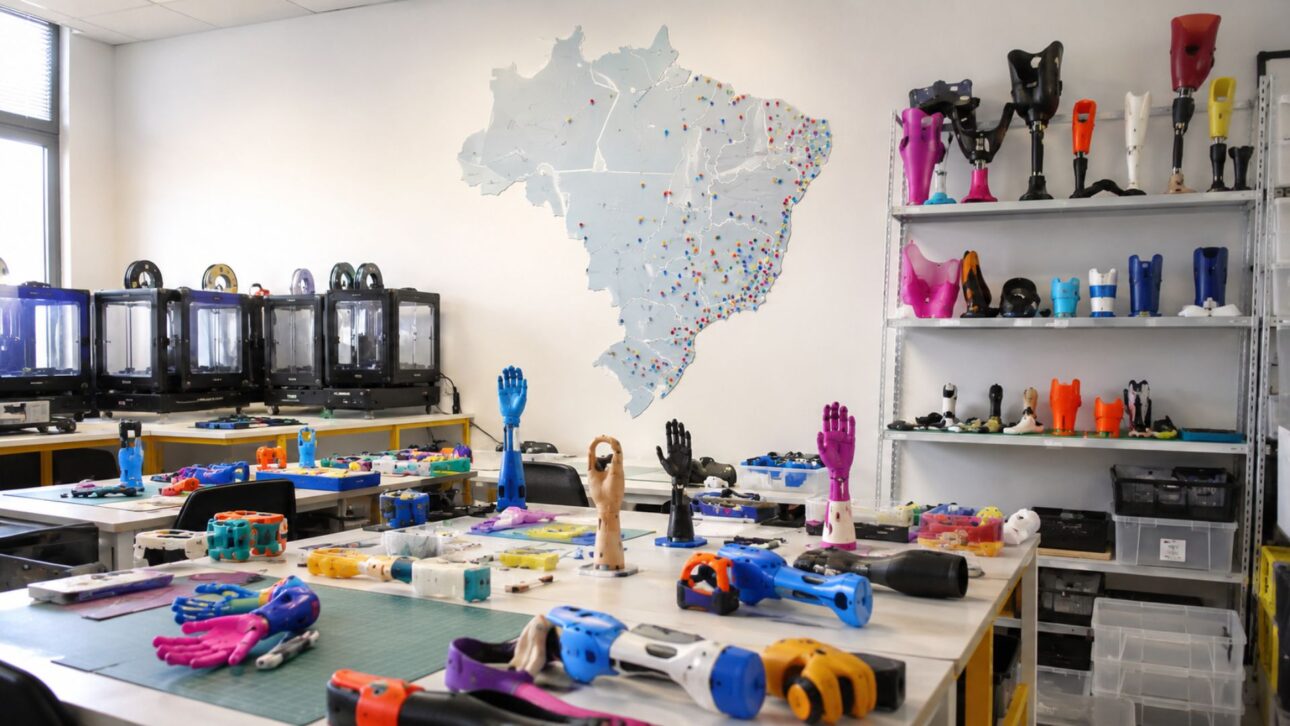
The association organizes Local Extension Bases, the BELs, in different states, to bring the service closer to families.
There are about a hundred volunteers, many linked to the health area, who carry out the production without receiving a salary.
Since 2015, Dar a Mão has also maintained a technical cooperation agreement with PUC-PR for research in assistive technology.
This arrangement unites academic knowledge, volunteer work, and 3D printer technology in the same project.
The network of more than 5,000 associated families is what gives national scale to an idea that started in the interior of Paraná.
Each new base means another region of Brazil with access to low-cost prosthetics.
Who receives the prosthetics from Dar a Mão
On the other side of the network are children and adults waiting for a simple movement.
The prosthetics go to people with agenesis or other limb differences, generally unable to afford the equipment.
For a child, receiving the prosthetic can mean holding a cup, riding a bike, or writing more firmly.
Families contact the association, which evaluates the case and forwards the production of the custom piece.
As the service is free and voluntary, the queue depends on the pace of donations and the number of active volunteers.
More than the mechanical function, the prosthetic usually restores autonomy and confidence to the recipient.
It is the point where technology and a charitable gesture meet in the real routine of people.
Why the model matters: low-cost inclusion
The case of Dar a Mão fits into a larger transformation of accessible healthcare.
3D printing has been democratizing assistive technology, previously tied to prohibitive prices.
By lowering the cost of a prosthetic to hundreds of reais, the model opens the door for those the traditional market ignored.
In Brazil, where access to expensive equipment is unequal, solutions like this gain enormous social weight.
The logic is replicable: prosthetic files can be shared and printed in any city with a machine.
It’s the difference between relying on an expensive import and producing the solution close to home, in Paraná or any state.
When technology becomes cheaper, inclusion stops being a promise and becomes a workshop routine.
What the case of Dar a Mão shows
The journey of Geane Poteriko is an example of how a personal problem can become a collective solution.
She proves that cheap technology, combined with volunteer work, can deliver health where money does not reach.
But it’s worth keeping your feet on the ground when reading the numbers.
The more than 5,000 are families associated with the network, not prostheses delivered, which total hundreds over the years.
3D printed prostheses are valuable functional aids, but they do not replace limbs nor do everything a biological hand does.
And, as it depends on volunteers and donations, the delivery pace varies and does not always meet the demand.
Even so, few projects summarize so well how the 3D printer can transform inclusion into something concrete and affordable.
From a diagnosis in São João do Ivaí to a national network, Dar a Mão showed that it is possible to restore movement at low cost.
And you, did you know that a hand prosthesis can cost hundreds, not thousands, with a 3D printer? Comment here if you would consider volunteering for a project like Dar a Mão in your city.