






 Portuguese
  Spanish
  5 min of reading
  0 comments


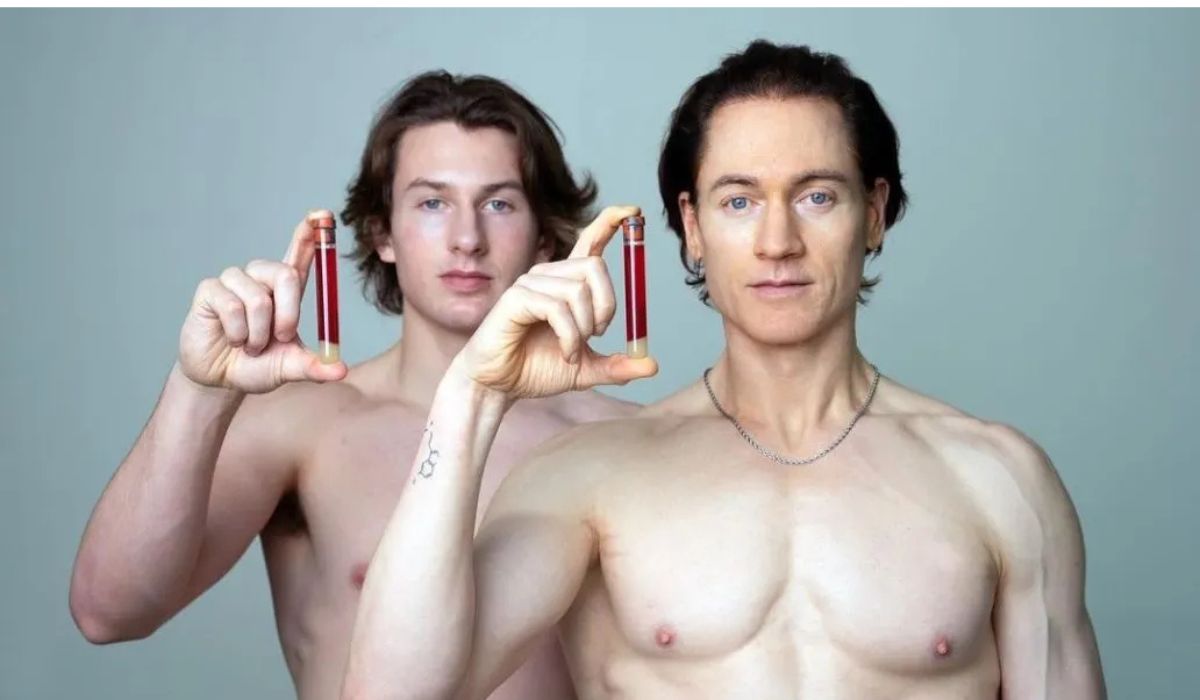
A Family Experience With Plasma Exchange Reignites Interest in “Young Blood” for Longevity and Highlights Warnings from Health Authorities, Extreme Monitoring Routines, and the Gap Between Personal Accounts and Scientific Evidence.
The American businessman Bryan Johnson drew attention again by reporting that he underwent a procedure involving his adolescent son’s plasma as part of an attempt to influence markers related to aging.
The initiative, which also included his father, was presented as a personal test within the health monitoring routine that Johnson claims to have followed for years.
-
Survivor of 1966 SS Daniel J. Morrell Shipwreck in Lake Huron Recounts 38-Hour Ordeal in Extreme Cold

-
The Greatest Hoax in World Cup History? The Film That Denied Brazil’s 1958 Victory and Exposed How Fake Evidence Can Seem Convincing on TV
-
Fake South Korean Online Stores Offer Shopping Thrill Without Spending Money or Receiving Products
-
The War of Jenkins’ Ear: How a Severed Ear Sparked One of the 18th Century’s Most Unusual Conflicts


According to what Johnson himself shared on social media and interviews, the experience consisted of a plasma exchange, not a total blood transfusion.
In the material published by him, the participation of the three generations was described as a “plasma exchange”: the businessman received from his son, and the father received from the businessman.
However, the practice is treated with caution by health authorities in the United States when associated with promises of “rejuvenation.”
The Food and Drug Administration (FDA) has already warned that there is no evidence of the efficacy of infusions of plasma from young donors for claims such as “treating normal aging” and pointed out potential risks, especially when the procedure is offered for commercial purposes and with unproven benefit promises.
Plasma Exchange Between Father, Son, and Grandfather
According to what Johnson reported, he and his son, then 17 years old, underwent collection to obtain plasma.

Subsequently, the businessman received plasma from the teenager.
According to the description shared by him, Johnson’s father also participated in the session and received plasma from his son.
The businessman had previously stated that he had been testing the use of plasma from selected donors with lifestyle-related criteria.
By including his son in the procedure, he presented the step as a way to observe if there would be measurable changes in the indicators he routinely monitors.
In July 2023, however, Johnson reported that he stopped doing “young plasma exchanges” after evaluating biomarkers and not identifying any benefits in his own case.
He stated that no gains were detected and said he would cease the practice.
Longevity and “Young Blood” in Scientific Debate
The association between blood components from young individuals and possible effects on older organisms gained visibility due to experiments in animals, especially studies assessing the effects of shared circulation or factors present in blood in rodents.
Some of these studies observed changes in specific parameters, such as performance on tests and metabolic markers, which fueled scientific interest and, in parallel, a longevity market.
However, experimental results in animals do not automatically translate into clinical benefits in humans.
For an intervention to be considered effective and safe for a purpose, a set of controlled studies reviewed by peers is necessary, as well as monitoring and reproduction of results by different teams.
FDA Warnings About Young Donor Plasma
In the United States, the FDA published a warning in 2019 advising consumers to be cautious with establishments offering infusions of plasma obtained from young donors with the promise of treating conditions ranging from normal aging to memory loss.
In the document, the agency stated that it was not aware of evidence demonstrating efficacy for this type of use and cited risks associated with plasma infusions.
In December 2024, the FDA updated the communication to reiterate that it had not approved “young plasma” for such claims and repeated that there was no evidence of effectiveness for promotional uses related to general health and well-being benefits.
This context helps to frame why reports like Johnson’s resonate: they lean on a hypothesis circulating in public debate but have not transformed into an established medical recommendation for “rejuvenation.”
Diet, Exercise, and Exams in Bryan Johnson’s Routine
In addition to the plasma procedure, Johnson became known for publicizing a routine based on strict control of habits and constant monitoring of health data.
In reports and publications associated with his project, descriptions of a diet with a fixed daily calorie goal, regular exercise, and use of supplements appear, along with recurring exams to observe variations over time.


In sleep, he also reports adopting measures to reduce stimuli at night, such as limiting exposure to screens and controlling the lighting in the environment.
The strategy is presented by him as part of a package of actions aimed at optimizing health parameters measured periodically.
When Johnson talks about “biological age” and changes of a few years, the term usually refers to estimates based on markers and models used to infer risk and physiological aging.
These results can vary depending on the method, the set of exams, and the laboratory, making the concept sensitive to the way of measurement and complicating direct comparisons between people and studies.
Braintree, eBay, and the Financing of the Project
Johnson is the founder of the payment company Braintree.
The company was acquired by eBay in 2013, becoming part of the PayPal ecosystem, which at the time belonged to the group.
eBay itself reported that the transaction was approximately US$ 800 million in cash.
After dedicating himself to the longevity project, he began to publicize routines and procedures, which broadened the reach of the topic on social media.
The inclusion of his son in a plasma procedure, in turn, led the case to be debated also from the perspective of the limits between personal experiments, public exposure of family members, and the pursuit of interventions that lack clinical validation for the stated purpose.





-

-

-

-

-

13 people reacted to this.