






 Portuguese
  Spanish
  5 min of reading
  0 comments


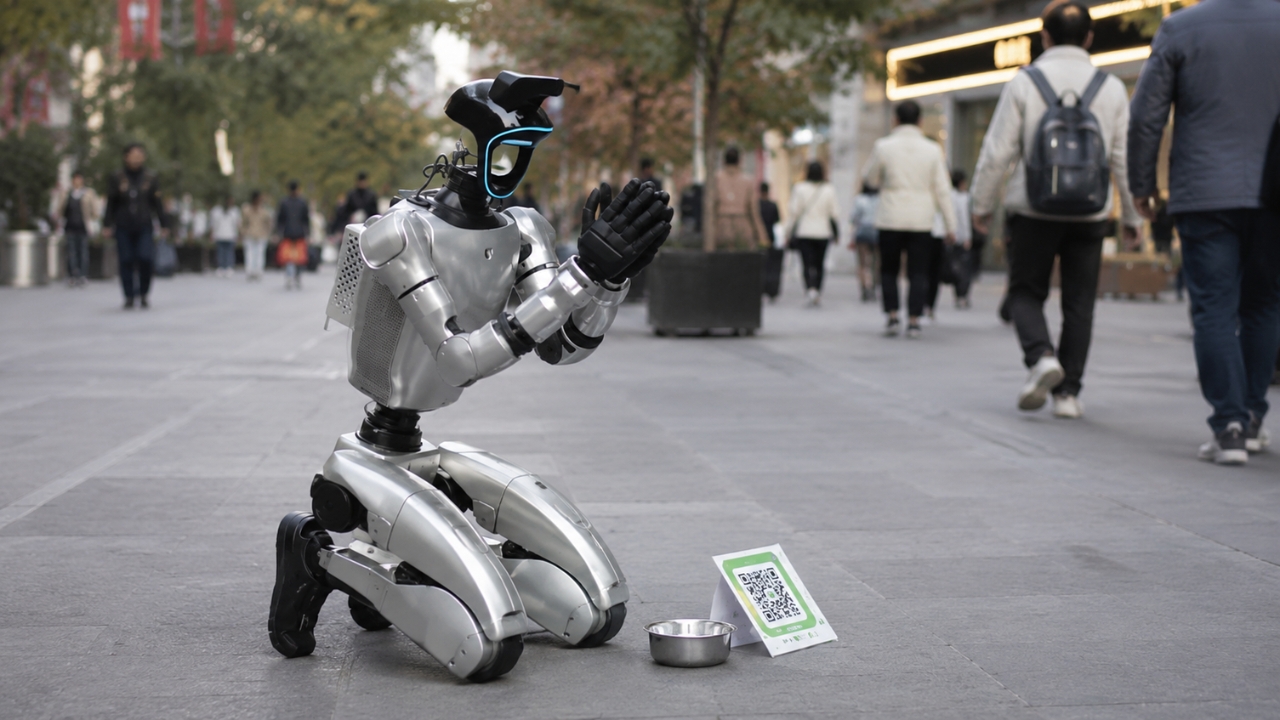
A scene recorded in Chinese cities drew attention by showing humanoid machines with bowls, posters, and digital payment codes, raising questions about marketing, social satire, and the symbolic limits of artificial intelligence.
On June 18, 2026, the site HK01 reported that recent images of humanoid robots kneeling in the streets of China were circulating on Weibo and provoking debate among internet users. The following day, June 19, 2026, Oddity Central brought the case to international attention by showing machines with posters, bowls, and QR Codes linked to requests to pay for energy.
The records were associated with cities such as Fuzhou, Beijing, and Chengdu. There is still no official confirmation about who placed the robots on the sidewalks, whether the payments were actually received, or if the scene was part of a marketing action, artistic performance, or social satire. Even so, the case went viral because it turns a curious image into an uncomfortable question: how far can artificial intelligence occupy spaces that always seemed human?
Records gained traction in June 2026 and circulated on Chinese networks
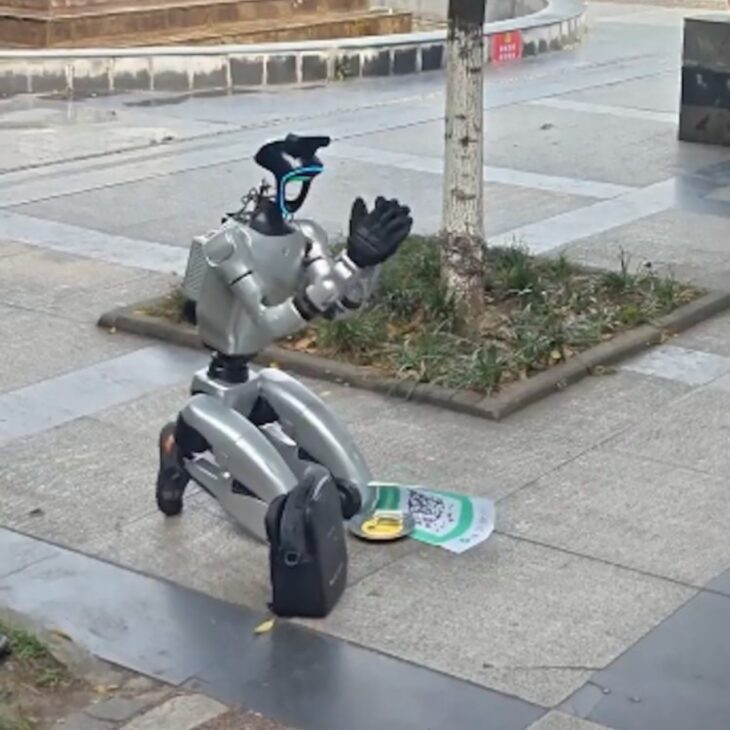
According to HK01, the repercussion began with recent images shared on Weibo, showing humanoid robots in a supplicating posture on Chinese streets. They appeared kneeling or crouching, with hands together, a bowl on the ground, and QR Codes aimed at digital payments.
-
After investing R$ 5,000 in fried chicken in his backyard, a Brazilian transformed two fryers and a freezer into a network with 115 sales points, presence in up to 17 states, and revenue exceeding R$ 115 million per year.

-
An 18-story human anthill was hidden 85 meters below Turkey: the underground city housed up to 20,000 people, had tunnels, rooms, passages, and ton-heavy stone doors, and was only rediscovered when a man broke a wall inside his own house.

-
Mother of 5 children started selling homemade pamonha door-to-door and today earns about R$ 250,000 per month with a factory that produces 1,500 units per day and sells to several Brazilian states.
-
The shortcut that Greece dreamed of for 2,000 years cuts through a strip of rock in the Mediterranean, connects two seas, and still impresses ships that pass squeezed between the stone walls.


The publication cited records attributed to Fuzhou, Beijing, and Chengdu. Oddity Central, on June 19, 2026, highlighted that the robots held messages related to paying the energy bill, which helped turn the scene into an international topic.
The reaction was immediate. Some internet users treated the scene as a joke, while others raised questions about the real purpose of the robots. Without official confirmation about the authorship of the action, the episode began to be discussed as possible marketing, artistic performance, or satire about artificial intelligence.
What is known and what has not yet been confirmed
Despite the repercussion, there is no official confirmation about who placed the robots on the streets, whether the QR Codes actually received donations, if there was a company behind the action, or if the equipment was controlled remotely.
Oddity Central treated the case as a viral phenomenon, while HK01 highlighted that some internet users raised doubts about the authenticity and purpose of the scene. Among the hypotheses discussed were artistic installation, marketing action, or social satire about artificial intelligence.
This caution is important. The image is strong, but it does not alone prove that robots have started to ask for money autonomously or permanently in Chinese cities. What exists so far is a viral scene with enormous symbolic power.
Why the QR Code Made the Scene Even More Credible
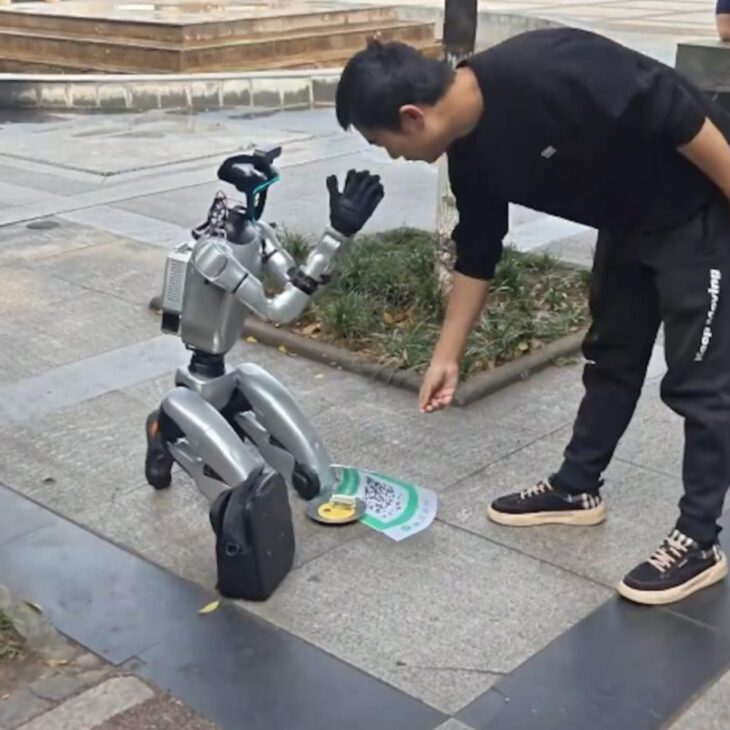
The detail of the QR Code helped make the case more plausible within Chinese daily life. In China, digital payments via codes are already part of urban life, especially through platforms like Alipay and WeChat Pay.
Brookings had already highlighted that digital payments transformed consumption habits in the country, reducing the use of physical money in various situations. CGAP also pointed out that Alipay and WeChat Pay popularized their own QR Codes since 2011 and that by 2016, this type of transaction was already moving more than US$ 1.65 trillion.
Therefore, a robot asking for money via QR Code seems absurd and, at the same time, recognizable. The technology used in the scene is not futuristic for the Chinese public. What causes shock is who is holding the code.
China is Experiencing an Accelerated Race for Humanoid Robots
The viral episode appears at a time when China is trying to transform humanoid robots into a strategic industry. According to China Daily, citing Xinhua, the country seeks to consolidate a preliminary innovation system for humanoids by 2025 and strengthen a more secure and reliable industrial chain by 2027.
Reuters also reported that China has been allocating strong subsidies to the sector, with more than US$ 20 billion allocated last year to humanoid and robotics companies. Cities like Shenzhen, Wuhan, and Beijing are part of this incentive movement.
Another data point shows the size of the bet. Reuters reported that more than 300 humanoid robots would participate in a half marathon in Beijing in 2026, with about 40% navigating autonomously. At the same time, experts warn that many demonstrations are still far from broad industrial applications.
The robot in the video may be too expensive to ask for coins
Some publications, such as Unwire, have linked the records to the Unitree G1. But this relationship has not been officially confirmed by the manufacturer, so it is more prudent to say only that the robots resemble Chinese commercial humanoid models.
Unitree itself states that the G1 starts at $13,500, measures about 132 cm, weighs approximately 35 kg with battery, and can have from 23 to 43 joint motors, depending on the version. Another model from the company, the H2, is listed at $29,900, with a height of 182 cm, about 70 kg, and 31 degrees of freedom.
These numbers reinforce the central doubt. Using a robot of this value just to collect small donations does not seem to make economic sense. Therefore, the hypothesis of marketing, artistic performance, or social critique gains strength.
A technological joke with a serious question behind it
The case of robots asking for money on the streets of China works because it seems like a visual joke ready to go viral. But it also exposes a real tension: artificial intelligence is no longer a subject restricted to offices, factories, and laboratories.
When a machine appears simulating a human need, the discussion shifts. It’s not just about efficiency, productivity, or job replacement. It’s about symbols, social spaces, and the discomfort of seeing technologies occupying roles previously considered unlikely.







Be the first to react!